On this page
How to identify it
- Infested cones are stuck together with frass mixed with webbing. Oregon's Department of Forestry says coarse, reddish brown piles of frass on the outside of a cone are the sign of an attack, and the USDA Forest Service describes cones covered in frass and web.[1][2][3]
- Chewed needles and mined terminal shoots are other signs. On young pines, a pitch mass near the entry point on the trunk gives the insect away.[1]
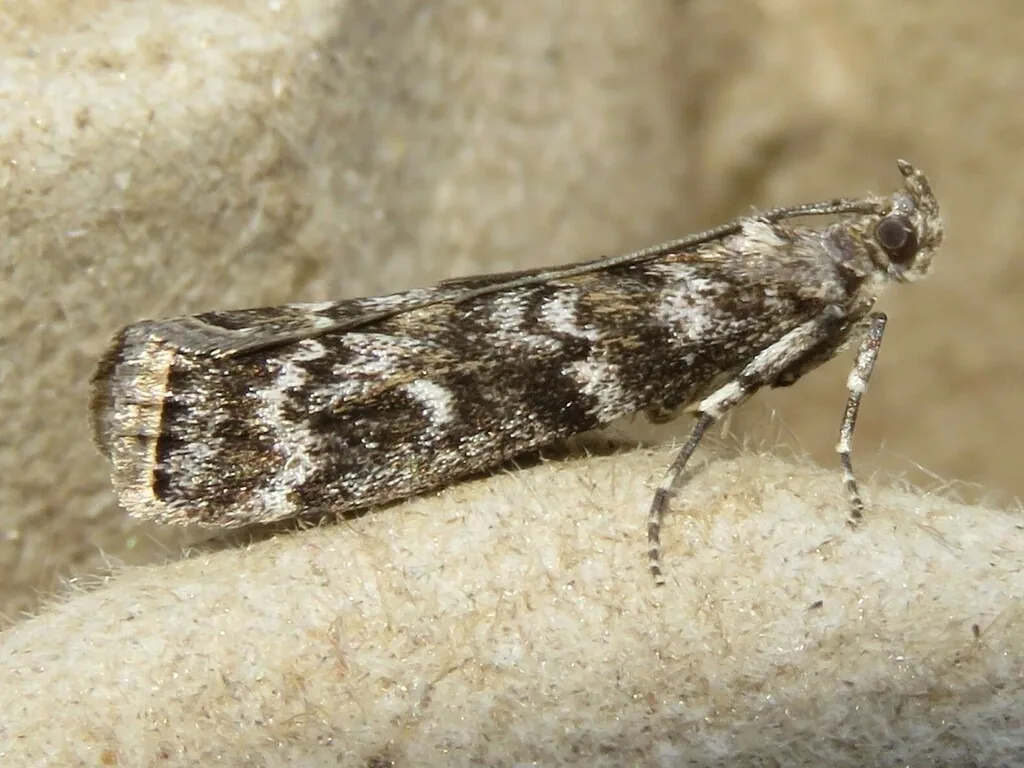
- The adult is a small moth; the pinned specimen Natural Resources Canada pictures has a wingspan of 25 mm (about 1 inch).[1]
- The USDA Forest Service says larvae grow to about 18 mm; the first stage is pale yellow and later stages are deep amber with a darker brown head. The brown pupa is about 10 mm long.[3]
- In a cone the caterpillar leaves a round, clear hole. The USDA Forest Service's Western Forest Insects says its webbed castings on the cone surface are free of pitch, unlike the work of the Douglas-fir cone moth (Barbara colfaxiana).[11]
- Western Forest Insects describes the adult's forewings as bluish gray with darker zigzag cross markings and the hindwings as dusky white with darker borders; its pictured adult has a 25 mm wingspread. Mature larvae are 17 to 20 mm long, naked, greenish red to amber brown above and flesh colored below.[11]
- Eastern Forest Insects describes the adult as dark gray with white zigzag lines bordered by black on the forewings and a wingspread of about 20 to 30 mm, and mature larvae as usually reddish-purple with a greenish tinge below and about 20 mm long.[10]
Look-alikes
| Look-alike | How to tell them apart |
|---|---|
| Spruce coneworm | Natural Resources Canada calls the fir coneworm similar in many respects to the spruce coneworm (Dioryctria reniculelloides), another cone-feeding Dioryctria of spruce and fir. Eastern Forest Insects describes the spruce coneworm adult as usually silvery-gray with zigzag white lines and a white spot on the forewings, 22 to 26 mm across, and its mature larva as reddish or amber brown with hairy warts on each body segment.[1][10] |
| Zimmerman pine moth | Zimmerman pine moth (Dioryctria zimmermani) is a related Dioryctria moth. Colorado State says its larvae tunnel in shoot tips and later feed at the base of branches, often under masses of pitch, rather than in cones. Eastern Forest Insects says that in the northern part of its range its caterpillars feed under the bark of pine limbs and trunks, while in the Southeastern States they feed almost only inside damaged loblolly pine cones; the adult is gray, about 25 to 37 mm across, with red and gray zigzag lines on the forewing.[4][10] |
| Pitch moths | Oregon's Department of Forestry says fir coneworm attacks on trunks can bring out sap and look like pitch moth (Synanthedon) attacks, which are mainly cosmetic.[2] |
| Douglas-fir cone moth | Another cone borer of Douglas-fir. Western Forest Insects tells the two apart on the cone surface: the fir coneworm's webbed castings are free of pitch, in contrast to the work of the Douglas-fir cone moth (Barbara colfaxiana).[11] |
Where it lives
The USDA Forest Service says its range runs from interior northern Alaska south to central Mexico and that in Canada it is found from coast to coast. Natural Resources Canada says it was first reported in Canada in 1939. It has been studied in white fir cones in California and in southwestern white pine cones in Mexico. Western Forest Insects calls it transcontinental, including British Columbia and the western states, and Eastern Forest Insects says it apparently occurs throughout the range of its pine hosts in the Northern Hemisphere.[3][1][5][6][11][10]
Biology and life cycle
It attacks various conifers, especially Douglas-fir and true firs, according to Oregon's Department of Forestry. Natural Resources Canada lists balsam fir, black, red, white and Norway spruce, and eastern white, jack, red and Scots pine as its main hosts in Canada. Western Forest Insects lists pines, Douglas-fir, true firs and spruces and calls it particularly destructive in fir and Douglas-fir cones; Eastern Forest Insects says it attacks many conifers, particularly pines.[2][1][11][10]
The caterpillars prefer cones but also feed on terminal shoots and the bark of the trunk and large limbs, and occasionally mine into branches or the trunk. Oregon notes that one larva can destroy an entire cone. In California it has damaged grafts of Douglas-fir and ponderosa pine, Western Forest Insects says, and Eastern Forest Insects says pine cones infected with the rust Cronartium strobilinum are especially attractive to it.[1][2][11][10]
In eastern Canada there is one generation a year, with caterpillars in the cones from mid-June until fall. Near the end of its growth the caterpillar drops to the ground and spins a silk cocoon, overwinters as a last-stage larva or prepupa, and pupates the next year.[1]
Farther south and west the cycle varies. Oregon's Department of Forestry says 1 to 1 1/2 overlapping generations a year are possible there, with larvae on trees from spring to fall. On southwestern white pine the Forest Service reports one generation a year, with larvae hatching in late spring or early summer and feeding until early fall. Western Forest Insects says it has one and a partial second generation a year in fir cones and only one in pine. Eastern Forest Insects says there may be five or six in Florida, where infestations in rust-infected cones show as early as April and attacks on second-year cones by mid-June.[2][3][11][10]
Females find mates by scent. A 2005 study found the sex pheromone is a blend of two compounds, and the Forest Service says traps baited with a synthetic version are used to catch adults.[7][3]
Damage and signs
- Cones are the main loss. Natural Resources Canada says a severe infestation can destroy an entire seed and cone crop, and the Forest Service says that in years with few cones, coneworms can destroy 10 to 50 percent of the southwestern white pine crop. In a Mexican study of that pine, caterpillars of a group of moths that includes the fir coneworm caused most of the cone damage. Eastern Forest Insects calls the larvae among the most destructive pests of slash and longleaf pine cones in the Southern States, and says red pine cones in the Lake States and southern Canada are occasionally seriously damaged.[1][3][6][10]
- The tree itself is not seriously harmed. In Canada, outbreaks have been limited to occasional local infestations in Ontario and Quebec, mostly in plantations and seed orchards.[1]
Health risk
It feeds inside conifer cones and shoots. Natural Resources Canada, the USDA Forest Service and Oregon's Department of Forestry treat it only as a forest and seed-orchard pest and don't mention any risk to people or pets.[1][3][2]
Control
Prevention
Because the tree is not seriously damaged, control matters mainly where the seed crop has value, such as seed orchards.[1]
Sanitation
On ornamental trees, Natural Resources Canada advises collecting and burning the cones while the caterpillars are still inside, before mid-August.[1]
In seed orchards and tree farms, Oregon lists bagging cones, site sanitation and sprays timed with pheromone-baited traps, and says removing the duff layer in fall can expose the overwintering larvae to predators and cold. The Forest Service calls synthetic pheromones, used to trap adults or disrupt mating, possibly the best option.[2][3]
Where the sources disagree
How it spends the winter: Natural Resources Canada says the full-grown caterpillar drops to the ground and overwinters in a silk cocoon; Oregon says late-stage larvae overwinter in the duff; on southwestern white pine the Forest Service says eggs laid near or on the cones overwinter and hatch in spring, with some insects passing the winter as prepupae.[1][2][3]
Generations: Natural Resources Canada says one a year in eastern Canada and the Forest Service one on southwestern white pine; Oregon says 1 to 1 1/2 overlapping generations are possible.[1][3][2]
When to pick infested cones: Natural Resources Canada says to collect and burn them before mid-August on ornamental trees; Oregon says destroying infested cones before September can reduce populations.[1][2]
Adult and larva: Eastern Forest Insects describes a dark gray moth about 20 to 30 mm across and a reddish-purple larva about 20 mm long; Western Forest Insects describes bluish gray forewings and a larva 17 to 20 mm long, greenish red to amber brown above.[10][11]
Generations in the South and West: Western Forest Insects gives one and a partial second in fir cones and one in pine; Eastern Forest Insects says there may be five or six in Florida.[11][10]
Common questions
- Why are the cones on my fir or spruce webbed together and full of sawdust-like frass?
- Webbing mixed with frass holding cones together, with coarse reddish brown frass on the outside of the cone, is the sign of a coneworm caterpillar such as the fir coneworm feeding inside. Western Forest Insects adds that the caterpillar leaves a round, clear hole in the cone and that its webbed castings are free of pitch.[1][2][11]
- Will the fir coneworm kill my tree?
- No. It does not cause serious damage to the tree. The loss is the cone and seed crop, and sometimes mined shoots or a pitch mass on the trunk of a young pine.[1]
- Do I need to spray?
- The forest sources suggest no spray for home trees. Removing and destroying infested cones before mid-August, while the caterpillars are still inside, is the recommended step on ornamentals.[1]
Sources
- Natural Resources Canada, Canadian Forest Service, “Fir coneworm, Trees, insects and diseases of Canada's forests.” tidcf.nrcan.gc.ca/en/insects/factsheet/11433 (accessed 2026-11-13)
- Oregon Department of Forestry, “Forest Health Fact Sheet: conifer cone and seed pests (September 2017).” www.oregon.gov/ODF/Documents/ForestBenefits/Conifer_cone_pests_2017.pdf (accessed 2026-11-13)
- USDA Forest Service, “Cone and Seed Insects of Southwestern White Pine (Forest Insect & Disease Leaflet 189, March 2020).” www.fs.usda.gov/foresthealth/docs/fidls/FIDL-189-ConeAndSeedInsectsWhitePine.pdf (accessed 2026-11-13)
- Colorado State University, Department of Agricultural Biology, “Shade Tree Borers.” agsci.colostate.edu/agbio/ipm-pests/shade-tree-borers/ (accessed 2026-11-13)
- Oecologia, via PubMed, “Interactions among phytophagous insect species colonizing cones of white fir (Abies concolor) (Shea 1989).” pubmed.ncbi.nlm.nih.gov/28312165/ (accessed 2026-11-13)
- Frontiers in Plant Science, via PubMed, “Assessment and Models of Insect Damage to Cones and Seeds of Pinus strobiformis in the Sierra Madre Occidental, Mexico (Leal-Sáenz et al. 2021).” pubmed.ncbi.nlm.nih.gov/33995433/ (accessed 2026-11-13)
- Journal of Chemical Ecology, via PubMed, “(3Z,6Z,9Z,12Z,15Z)-Pentacosapentaene, a key pheromone component of the fir coneworm moth, Dioryctria abietivorella (Millar et al. 2005).” pubmed.ncbi.nlm.nih.gov/16124244/ (accessed 2026-11-13)
- Global Biodiversity Information Facility (GBIF), “Dioryctria abietivorella (Grote, 1878) (GBIF Backbone Taxonomy).” api.gbif.org/v1/species/1877319 (accessed 2026-11-13)
- iNaturalist, “Dioryctria abietivorella taxon page (order and family).” www.inaturalist.org/taxa/218479 (accessed 2026-11-10)
- USDA Forest Service (scan at Internet Archive), “Eastern Forest Insects, Miscellaneous Publication 1175 (W. L. Baker, 1972).” archive.org/details/easternforestins1175bake (accessed 2026-11-14)
- USDA Forest Service (scan at Internet Archive), “Western Forest Insects, Miscellaneous Publication 1339 (R. L. Furniss and V. M. Carolin, 1977).” archive.org/details/CAT78702369 (accessed 2026-11-14)