On this page
How to identify it
- Pitch masses start small, soft, glistening and reddish brown to pink, then grow, harden and turn darker gray as the larva beneath them grows. Older masses can reach about 3 to 5 inches.[1]
- After the moth leaves, a thin brown pupal case often sticks out of the mass. Abandoned masses can stay on the bark for years and are often reinfested.[1][2]
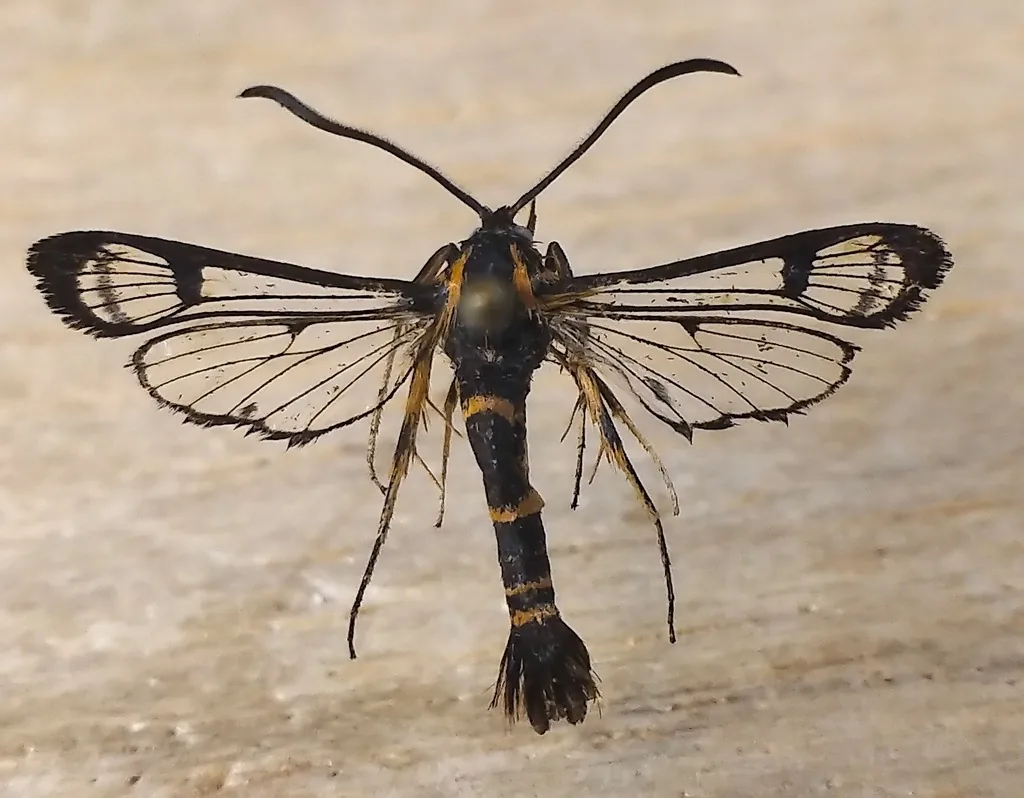
- Adults are day-flying clearwing moths about 3/4 inch long that look like a paper wasp or yellowjacket. The sequoia pitch moth is black and yellow; the Douglas-fir pitch moth has orange rather than yellow bands. UC IPM gives a wingspan of 3/4 to 1 1/4 inches, while the Forest Service and Oregon Department of Forestry give 3/4 to 1 3/4 inches.[1][2][3]
- Larvae are dirty white, grayish or pink with a red-brown or brownish head and reach about an inch when grown.[1][2]
Look-alikes
| Look-alike | How to tell them apart |
|---|---|
| Bark beetle pitch tubes | Bark beetle pitch tubes are usually under 1/2 inch across, often with a round hole near the center, like the end of a gummy drinking straw. Pitch moth masses get much larger, are roundish to oval and often lack a clear exit hole.[1][2] |
| Dioryctria pitch moth larvae | Infestations of Dioryctria moths (family Pyralidae) are sometimes confused with pitch moths, but they usually show plenty of granular frass and relatively little pitch.[2] |
| Pitch canker and other resin flow | When injuries or fungi such as pitch canker cause the ooze, bark is usually coated with a thin layer of resin like thick syrup rather than distinct blobs, and pitch canker discolors the bark.[1] |
| Pitch mass borer | A related eastern clearwing (Synanthedon pini) that looks like the Douglas-fir pitch moth. The Forest Service says it is not known to occur in the West.[2] |
Where it lives
UC IPM describes the sequoia pitch moth from California north through British Columbia, especially on Monterey pine in urban coastal Northern California, and the Douglas-fir pitch moth from Northern California to Alaska. The Forest Service maps the sequoia pitch moth from central British Columbia to California and east to Idaho and Montana, Oregon's forestry agency finds it through most of Oregon except the southeast, and Arizona Extension calls it one of the common pine pests in north central Arizona.[1][2][3][4]
Biology and life cycle
Egg-laying females prefer bark near pruning wounds and other injuries, laying eggs one at a time in bark crevices, and they often return to old pitch masses. Eggs are about 1/16 inch, reddish brown and hatch in about two weeks.[1][2]
Most individuals take two years from egg to adult. The larva feeds on the inner bark for months, then pupates in the mass for about a month and moves to the surface just before the adult emerges.[1][2][5]
Adults live only a few days and don't feed. UC IPM says adults can be present anytime from May through early September, and the Forest Service says they emerge from late May to early September; both put the peak in June and July. Arizona Extension says the moths emerge in mid- to late April there and can continue through August.[1][2][4]
The Forest Service names lodgepole and ponderosa pine as principal hosts, with Douglas-fir and spruce attacked occasionally. Despite the name, it is not known to feed on sequoias.[2][3]
Damage and signs
- Larvae do little harm to cambium or wood and rarely girdle or kill trees, though limbs on young trees may die or break.[1]
- Small trees are more at risk: the Forest Service says stems under about four inches across can be girdled. Years of repeated attacks leave overlapping pitch masses and heavy pitch flow, which can make trees more flammable.[2][3]
Health risk
UC IPM says clearwing moths, including pitch moths, are not wasps: they do not sting. UC IPM, the Forest Service, Oregon's forestry agency, Arizona Extension and Utah State describe damage to trees and don't mention any risk to people or pets.[1][2][3][4][5]
Control
Prevention
Protect trees from injury and avoid unnecessary pruning, since fresh wounds attract egg-laying moths. Keep mowers and string trimmers away from trunks and don't tie trunks tightly to stakes.[1][2]
UC IPM rates Monterey, Aleppo and related Afghan pines, Bishop, Japanese black, Mexican, ponderosa and shore pines as most susceptible, and Canary Island and Italian stone pines as least. Off-site or non-native pines are at higher risk.[1][2][3]
If pines must be pruned, UC IPM and the Forest Service advise October through January, so wounds start to close before moths fly. Oregon's forestry agency and Arizona Extension give October through February.[1][2][3][4]
UC IPM says to provide proper care to maintain vigorous growth: for established trees, apply water beneath the outer canopy, not near trunks, and irrigate infrequently so the water penetrates 1 to 2 feet into the soil.[1]
Traps and physical control
The only direct control is to pry or scrape off each pitch mass with a screwdriver or stiff putty knife and crush or bag the larva or pupa. Scraping without finding the insect lets it survive and form a new mass. Hard, dry masses older than about two years are usually empty unless reinfested.[1][3]
Pesticides
Sources disagree. UC IPM says insecticides have been found not to work, Arizona Extension does not recommend them, and the Forest Service's 2017 leaflet says no pesticides were registered for sequoia pitch moth. Utah State's page lists summer or fall sprays of a residual insecticide, oil or soap as Utah's current recommendation.[1][4][2][5]
Monitoring
Pheromone-baited sticky traps catch males and show when moths are flying, which helps time pruning. Trapping out males has limited value for control and may draw more males to the site.[2][3]
Where the sources disagree
Wingspan: UC IPM gives 3/4 to 1 1/4 inches; the Forest Service and Oregon's forestry agency give 3/4 to 1 3/4 inches.[1][2][3]
When moths fly: UC IPM says May through early September; the Forest Service says late May to early September; Arizona Extension says emergence starts in mid- to late April.[1][2][4]
Pruning window: UC IPM and the Forest Service say October through January; Oregon's forestry agency and Arizona Extension say October through February.[1][2][3][4]
Sprays: UC IPM says insecticide applications have been found not to be effective, Arizona Extension says pesticides are not recommended, and the Forest Service says none are currently registered for sequoia pitch moth; Utah State says the current Utah recommendation is to target crawlers with a residual insecticide, horticultural oil or soap in summer and/or fall.[1][4][2][5]
Susceptible pines: UC IPM rates Monterey, Aleppo, Afghan, Bishop, Japanese black, Mexican, ponderosa and shore pines most susceptible; Arizona Extension names Mondell, Aleppo, Japanese black, pinyon and ponderosa pines.[1][4]
Small trees: the Forest Service says stems under about four inches across can be girdled; Oregon's forestry agency says trees less than six feet in height are usually not infested.[2][3]
Common questions
- What are the pink, gummy blobs on my pine trunk?
- Probably pitch moth masses, formed as larvae feed beneath them. Fresh masses are soft and pink to reddish brown; old ones are hard and gray.[1]
- Will pitch moths kill my pine?
- Rarely. Mature trees withstand attacks, though young trees may lose limbs and small stems can be girdled.[1][2]
- Is the wasp-like insect on my pine dangerous?
- UC IPM says clearwing moths, including pitch moths, are not wasps and do not sting. UC IPM, the Forest Service, Oregon's forestry agency, Arizona Extension and Utah State don't mention any risk to people or pets.[1][2][3][4][5]
Sources
- University of California Statewide IPM Program, “Pest Notes: Pitch Moths (Publication 7479).” ipm.ucanr.edu/PMG/PESTNOTES/pn7479.html (accessed 2026-11-13)
- USDA Forest Service, “Sequoia Pitch Moth (Forest Insect & Disease Leaflet 185, Mehmel and Buhl, 2017).” www.fs.usda.gov/foresthealth/docs/fidls/FIDL-185-SequoiaPitchMoth.pdf (accessed 2026-11-13)
- Oregon Department of Forestry, “Sequoia Pitch Moth (Forest Health Fact Sheet, March 2017).” www.oregon.gov/odf/Documents/forestbenefits/SPM_2017.pdf (accessed 2026-11-13)
- University of Arizona Cooperative Extension, “Sequoia Pitch Moth (Backyard Gardener #19, 2022).” extension.arizona.edu/sites/extension.arizona.edu/files/attachment/SequoiaPitchMoth.pdf (accessed 2026-11-13)
- Utah State University Extension, “Sequoia Pitch Moth.” extension.usu.edu/planthealth/ipm/notes_orn/list-treeshrubs/sequoia-pitch-moth.php (accessed 2026-11-13)
- Global Biodiversity Information Facility (GBIF), “Synanthedon sequoiae (Edwards, 1881) (GBIF Backbone Taxonomy).” api.gbif.org/v1/species/10077965 (accessed 2026-11-13)
- Global Biodiversity Information Facility (GBIF), “Synanthedon novaroensis (Edwards, 1881) (GBIF Backbone Taxonomy).” api.gbif.org/v1/species/9930604 (accessed 2026-11-13)