On this page
How to identify it
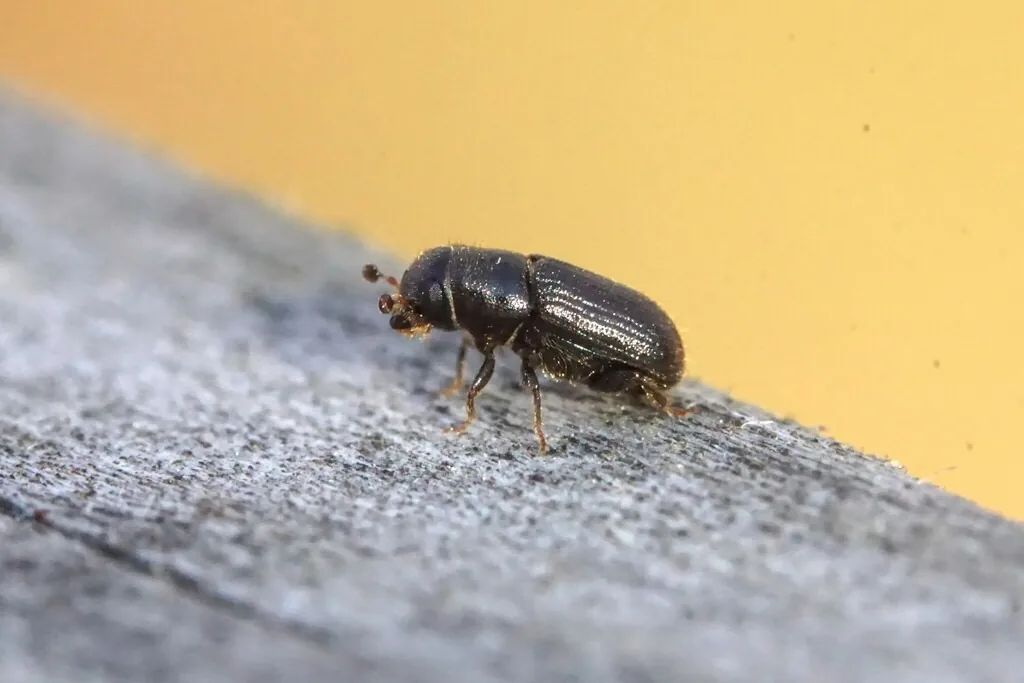
- Southern pine beetle adults are 2 to 4 mm long (about the size of a grain of rice), cylindrical and dark red-brown to black, with a rounded rear end and a head visible from above. UF/IFAS adds that males have a notch on the front of the head, females have a raised crosswise ridge at the front of the pronotum, and new adults darken from yellow to dark brown. Ips engravers, by contrast, have a hollowed rear end ringed with teeth.[4][1][3][5]
- Ips engravers are dark reddish brown to almost black, and the rear of the wing covers looks cut off at an angle and hollowed, with four to six small spines on each edge.[2]
- Eastern six-spined engravers are about 3/16 inch long; the five-spined and southern pine engravers are about 1/8 inch.[2]
- Southern pine beetle pitch tubes are popcorn-sized clumps of resin, white, yellow or reddish depending on the pine, sitting in the crevices between bark plates and found along the whole trunk. Fresh attacks also leave reddish-white boring dust. UF/IFAS says pitch tubes are almost always in bark crevices, spread along the main stem and less common at the base or in the crown, and may form from near ground level up to 20 m (60 ft); trees badly weakened before the attack may form none. The earliest sign is often reddish-brown dust with white pitch specks.[4][1][3][5]
- Under the bark, southern pine beetle galleries wind in S shapes and crisscross, while Ips engravers make Y- or H-shaped egg galleries. UF/IFAS adds that the S-shaped galleries are packed with boring dust and frass, and the larval tunnels are very short and end in feeding chambers.[4][1][2][3][5]
- After the new generation leaves, the bark shows many small round exit holes about 1 mm across, in a shotgun pattern.[4][1]
- Southern pine beetle eggs are 1.5 x 1.0 mm, oval and pearly white. Larvae are 2 to 7 mm long, wrinkled, legless and yellowish white with reddish heads.[5]
Look-alikes
| Look-alike | How to tell them apart |
|---|---|
| Black turpentine beetle | Its pitch tubes are usually low on the trunk, under 12 feet, about twice the size of a southern pine beetle's (about 1 inch across) and often runny, and its galleries are short and D- or fan-shaped. UF/IFAS notes it is the only other Dendroctonus in the Southeast and is more than twice as large as the southern pine beetle.[3][5] |
| Ips engraver pitch tubes | Ips pitch tubes form on the bark plates rather than in the crevices and are very small and orange to pink. Ips are mostly secondary pests of dead, dying and stressed trees.[3] |
| Ambrosia beetles | White sawdust from wood-boring ambrosia beetles often piles up at the base of pines the southern pine beetles have already left.[4] |
| Hylastes and Hylurgops beetles | UF/IFAS says several species in these genera look superficially like the southern pine beetle but never attack healthy pines.[5] |
Where it lives
The USDA Forest Service maps the southern pine beetle across the southeastern United States from Pennsylvania and New Jersey to Texas, and from Arizona and New Mexico through Mexico to Nicaragua. New York DEC says it has been expanding up the East Coast, likely helped by milder winter extremes, and was first found infesting trees on Long Island in October 2014. In Florida it has never been recorded south of a line from about Pasco to Volusia County. In North Carolina all native pines are susceptible to Ips engravers. UF/IFAS says it is common in north Florida, with no known outbreak south of Osceola County, and is unlikely south of about 28° 15' north. Since 2014 it has moved into Connecticut, New York, Rhode Island, New Jersey and even Maine, which UF/IFAS attributes to warmer winters and mature, overstocked pine stands.[4][3][1][2][5]
Biology and life cycle
A southern pine beetle female picks the host tree and releases a pheromone, mainly frontalin, that draws males and more females. This mass attack overwhelms the tree's resin defenses; once a tree is full, other signals divert incoming beetles to neighboring pines. UF/IFAS adds that males release endo-brevicomin, which strengthens the attraction of frontalin, and that resin can 'pitch out' a few attackers on a healthy tree but mass attacks drain it.[4][1][5]
Pairs cut S-shaped egg galleries in the inner bark. Larvae tunnel away from the gallery feeding on inner bark tissue and fungi, then move into the outer bark to pupate. In ideal conditions egg to adult can take as little as 26 days. UF/IFAS says eggs hatch 3 to 34 days after laying depending on temperature, pupae take 15 to 40 days, new adults stay under the bark six to 14 days, and egg to adult ranges from 26 to 54 days; Florida can have as many as seven generations a year.[4][1][5]
Most multiple-tree southern pine beetle spots start in spring, often in lightning-struck or badly stressed pines, and spread most rapidly in summer; large spots can spread more than 120 feet a day. A second dispersal flight comes in fall. There is no winter diapause, and spots can keep spreading when temperatures top 60°F.[4][1]
Ips males bore into the bark and make a small chamber, where one to four females join them; each female then cuts egg galleries in the inner bark.[2]
Ips engravers prefer fallen trees and logging slash but attack apparently healthy pines after drought or injury; in hot weather a generation can take as little as 3 weeks.[2]
UF/IFAS says the larvae feed mostly on a symbiotic fungus (Entomocorticium) that the female carries in special pouches called mycangia, so their tunnels are very short, usually under two centimeters.[5]
Adults can fly up to 2 miles (3 km) when no suitable tree is near, and during dispersal about half travel more than 0.43 mile (0.69 km). Spring emergence is the main dispersal phase, infestations grow fastest in summer, and fall brings scattered small spots.[5]
Natural enemies, from fungi to predators such as the checkered beetle Thanasimus dubius, often kill so many beetles inside an attacked tree that few emerge. UF/IFAS cites evidence that persistent insecticide use suppresses these enemies more than the pest.[5]
Outside outbreaks, UF/IFAS calls the southern pine beetle a rare insect; outbreaks occur almost only in and around overstocked pine stands. A 1998 to 2002 outbreak in the southern Appalachians affected more than 1 million acres.[5]
Damage and signs
- Gallery tunnels girdle the tree, and blue stain fungi carried by the beetles block its water-conducting wood; together they kill pines quickly, often in spots or groups of trees.[4][2]
- New York DEC says a tree attacked by southern pine beetles typically dies in 2 to 4 months.[3]
- Needles fade from green to yellow to reddish brown. By the time the crown has turned red or brown, the beetles have usually finished and left.[1][2]
- Any pine in its range can be attacked. Loblolly, shortleaf and pond pines are preferred in the South, with pitch and Virginia pines also favored hosts; in New York, pitch pine has been hit hardest. UF/IFAS adds spruce pine and sand pine in Florida, and in the Northeast lists pitch, shortleaf and Virginia pines, with Norway spruce, red pine, Scots pine and white pine also seen infested.[4][1][3][5]
Health risk
These beetles attack pines; none of these sources reports a risk to people. The harm is dying trees and the loss of nearby pines as an infestation spreads.[4][2]
Control
Prevention
Thin crowded pines. Forest guidance is to thin stands to a basal area of 80 square feet per acre or less, because dense stands let beetles mass-attack neighboring trees. UF/IFAS gives the same 80 sq. ft. per acre (18 sq. m per ha) target, suggests prescribed fire to keep stands open, and recommends promoting tree diversity and shortening rotation ages to less than 30 years.[4][1][5]
Thin in the coolest months without damaging the trees that remain, remove weakened or damaged trees, and when planting choose pines suited to the site; longleaf and slash pines are less susceptible than loblolly. UF/IFAS adds: avoid construction and logging damage and soil compaction around pines, minimize changes in soil and water levels, and quickly remove pines badly damaged by lightning or landscaping work.[1][5]
Sanitation
For engravers, cut down infested trees, remove their bark, and burn or bury the slash.[2]
Traps and physical control
To stop an active southern pine beetle spot, cut actively infested pines plus a buffer strip of green trees ahead of the direction it is spreading. In yards, cut and remove infested trees as quickly as possible. UF/IFAS recommends a buffer strip 50 to 100 feet (15 to 30 m) wide, and says trees the beetles have already left should stay, since they no longer pose a danger and produce many natural enemies; such trees show distinctly red or gray needles, many exit holes and no larvae under the bark.[4][1][5]
If infested trees can't be hauled away, UF/IFAS says at least fell them, ideally toward the center of the spot, which lowers larval survival; peeling the bark or chipping the whole tree kills more beetles.[5]
Pesticides
No insecticide will reliably save an infested pine or kill beetles already inside. Permethrin and bifenthrin are labeled for bark beetles and can be used only to protect nearby uninfested, high-value pines, following the label; keep pyrethroids away from pools, ponds and streams. UF/IFAS says preventive emamectin benzoate injection is effective and approved for forests, bifenthrin and permethrin sprays are approved only for ornamental settings, and carbaryl, though approved for forests, is not effective against the southern pine beetle.[1][2][5]
When to call a professional
Engravers often attack the leader and upper crown, which is hard to spray with homeowner equipment, so a tree professional is usually needed.[2]
Where sources disagree
Spacing yard pines: the USDA Forest Service recommends more than 20 feet between pines in urban settings, while the Florida Forest Service says at least 8 meters when planting. UF/IFAS says at least 25 ft (8 m) between mature pines in urban settings.[4][1][5]
Pitch tube color: the USDA Forest Service and Florida Forest Service say southern pine beetle pitch tubes can be white, yellow or reddish, and New York DEC calls them brownish to white; only the S-shaped galleries under the bark confirm the beetle.[4][1][3]
Spread rate: the USDA Forest Service says large spots can spread more than 120 feet a day; UF/IFAS gives up to 15 m (50 ft) a day.[4][5]
Blue stain fungi: the USDA Forest Service and NC State say blue stain fungi carried by the beetles help kill the tree; UF/IFAS says current evidence shows these fungi harm the beetle larvae and have very little effect on tree death compared with the mass attack itself.[4][2][5]
Larval food: the Florida Forest Service describes larvae feeding on inner bark tissue and fungi; UF/IFAS says they feed almost exclusively on a symbiotic fungus.[1][5]
Which pines are at risk: the Florida Forest Service calls longleaf and slash pines less susceptible than loblolly; UF/IFAS agrees they are considered more resistant but cites research showing longleaf pines are just as likely to be attacked and killed when they grow with loblolly in an active infestation.[1][5]
Stressed trees: the USDA Forest Service and Florida Forest Service say spots often start in lightning-struck or badly stressed pines; UF/IFAS says natural attacks are mostly on trees injured by fire or lightning, while chronically stressed pines, such as drought-stressed or shaded-out ones, are rarely colonized.[4][1][5]
Southern limit in Florida: the Florida Forest Service says it has never been recorded south of a line from about Pasco to Volusia County; UF/IFAS says there is no known outbreak south of Osceola County.[1][5]
How southern pine beetle is monitored
In Florida, the Florida Forest Service flies an aerial survey each summer to spot groups of dead pines, which local staff check on the ground, and notifies nearby landowners of confirmed infestations.[5]
Each spring, state forestry agencies in Florida and other southeastern states set funnel traps baited with frontalin and alpha-pinene, with endo-brevicomin a few meters away, and use counts of the beetle and its predator, the checkered beetle, to predict where outbreaks are likely the next year.[5]
The Florida Forest Service's Southern Pine Beetle Assistance and Prevention Program, limited to 44 northern Florida counties, offers incentives for thinning, prescribed burning, underbrush control and planting longleaf or slash pine.[5]
Common questions
- Can I save a pine that already has bark beetles?
- Usually not. No insecticide reliably saves a colonized pine, and by the time engravers are found the tree is very likely doomed. Remove it quickly and protect nearby healthy pines.[1][2]
- Does every dead pine with beetles mean my other pines are at risk?
- Not always. Ips engravers mostly breed in dead, dying and stressed trees, and ambrosia beetles move into pines southern pine beetles have already left. Peel some bark and look at the gallery pattern before deciding. UF/IFAS stresses that every dead pine in the Southeast gets colonized by bark and wood-boring beetles, mostly secondary species that don't attack healthy trees, so unless there is a major outbreak nearby, southern pine beetle attacks are rare.[3][4][1][5]
- Are white pitch tubes different from red ones?
- Color isn't diagnostic. Southern pine beetle pitch tubes can be whitish, yellow or reddish; the most reliable check is peeling bark to see the S-shaped galleries. UF/IFAS calls the idea that white tubes mean southern pine beetle and red ones mean secondary beetles a myth.[4][1][5]
- Should I cut down pines the beetles have already left?
- Not on account of the beetles. UF/IFAS says trees the southern pine beetle has already left no longer pose a danger and produce natural enemies of the beetle, so they can be left in place. They show red or gray needles, many exit holes and no larvae under the bark.[5]
Sources
- Florida Forest Service, Florida Department of Agriculture and Consumer Services, “Southern Pine Beetle, Leaflet Number 1 (Eickwort, June 2023).” ccmedia.fdacs.gov/content/download/114244/file/Leaflet-1-Southern-Pine-Beetle.pdf (accessed 2026-11-14)
- NC State Extension, “Pine Engraver Beetles (PDIC Factsheets, reviewed May 2024).” content.ces.ncsu.edu/pine-engraver-beetles (accessed 2026-11-14)
- New York State Department of Environmental Conservation, “Southern Pine Beetle.” dec.ny.gov/nature/animals-fish-plants/southern-pine-beetle (accessed 2026-11-14)
- USDA Forest Service, “Southern Pine Beetle, Forest Insect & Disease Leaflet 49 (Clarke and Nowak, rev. 2009).” www.fs.usda.gov/foresthealth/docs/fidls/FIDL-49-SouthernPineBeetle.pdf (accessed 2026-11-14)
- University of Florida/IFAS Extension (Featured Creatures), “The Southern Pine Beetle, Dendroctonus frontalis Zimmermann, EENY-176/IN333.” ask.ifas.ufl.edu/publication/IN333 (accessed 2026-11-14). Used for identification, range, biology, hosts, monitoring and management; its dollar-loss figures are not used.
- iNaturalist, “Dendroctonus frontalis taxon page (order and family).” www.inaturalist.org/taxa/218219 (accessed 2026-11-14)