The short answer
- Signs of an attack are reddish boring dust in bark crevices, pitch streamers on the trunk and needles fading to yellow or red within weeks to months.[3][7][14]
- The pattern of tunnels under the bark tells the beetles apart, and keeping trees vigorous is the best protection.[1][5][7]
- Preventive bark sprays only help healthy trees that haven't been attacked yet and must be on before the beetles fly; they are generally kept for high-value trees near homes and other valued sites.[10][8][13]
- A colonized tree can't be saved with insecticide. Remove it and destroy the beetles in the wood before they emerge, so they don't move into nearby trees.[10][1][6]
Bark beetle profiles
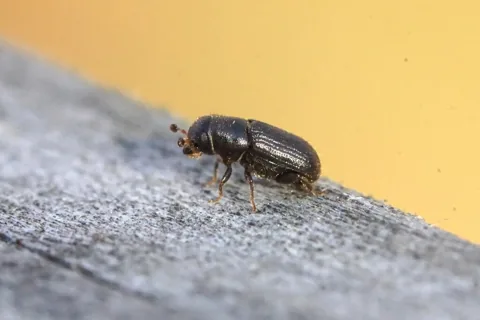 Pine Bark Beetles
Dendroctonus frontalis and Ips species (I. calligraphus, I. grandicollis, I. avulsus)
Pine bark beetles are tiny beetles that breed in the inner bark of pines. The southern pine beetle is the most destructive pine bark beetle in the southern United States, and three Ips engraver beetles also kill pines in the Southeast. Once beetles mass-attack and colonize a pine, the tree almost always dies.
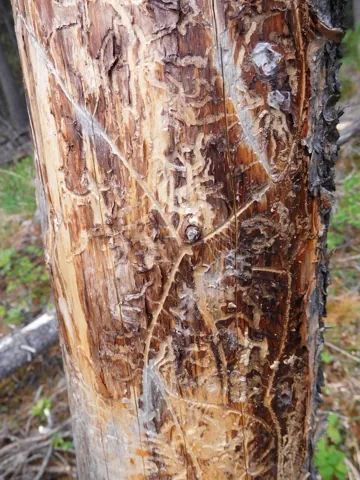 Pine Engraver
Ips pini
The pine engraver is a small bark beetle that breeds in freshly cut pine material and attacks stressed or newly transplanted pines, killing tops or whole trees; it almost never attacks healthy pines in periods of near-normal rainfall.
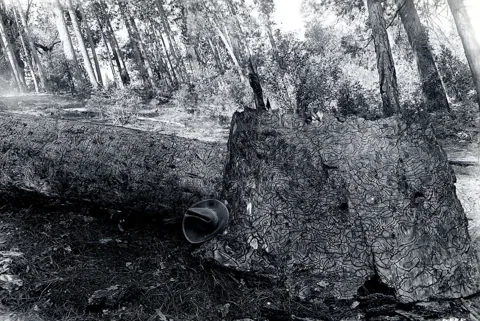 Western Pine Beetle
Dendroctonus brevicomis
The western pine beetle is a native bark beetle that attacks the trunks of ponderosa pines, killing trees weakened by drought, fire, disease or crowding, often in groups.
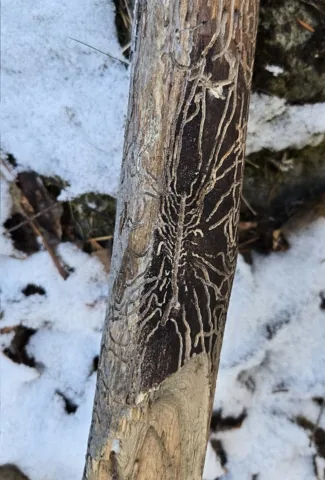 Douglas-fir Beetle
Dendroctonus pseudotsugae
The Douglas-fir beetle is a native bark beetle that breeds in windthrown, fire-scorched or weakened Douglas-firs; when downed or damaged trees are plentiful, populations build and spill over into healthy trees, killing them in groups.
 Mountain Pine Beetle
Dendroctonus ponderosae
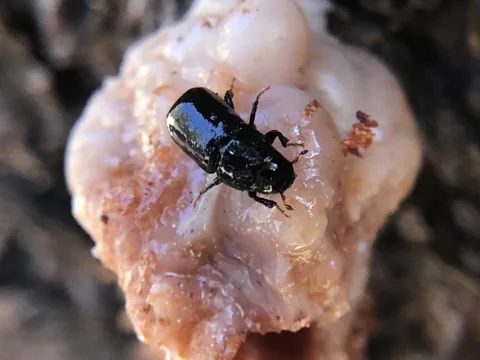
Mountain pine beetle is a native bark beetle of western North America whose outbreaks can kill millions of pines; the Colorado State Forest Service notes it also plays a natural role by killing diseased and dying pines.
 Red Turpentine Beetle
Dendroctonus valens
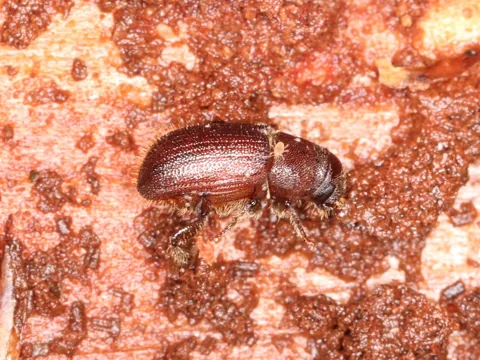
The red turpentine beetle is a native bark beetle that bores into the lower trunk, root collar and large roots of pines, leaving big pitch tubes. It rarely kills trees by itself, but its attacks often mark a stressed tree.
 Black Turpentine Beetle
Dendroctonus terebrans
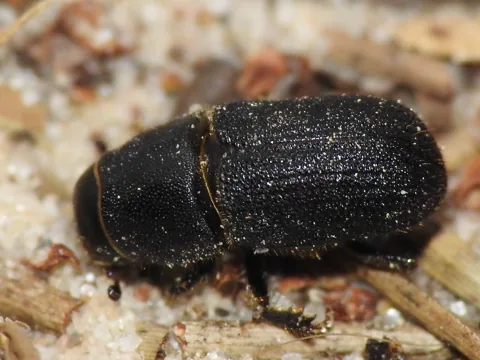
Large reddish pitch tubes on the lowest few feet of a pine trunk are the classic sign of the black turpentine beetle, the largest native pine bark beetle in the southern and eastern United States. A few attacks may only weaken a tree; many can kill it.
 Spruce Beetle
Dendroctonus rufipennis
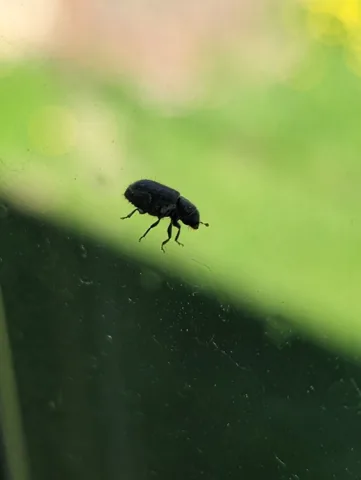
The spruce beetle is a native bark beetle and a major cause of spruce death in North America, especially in Alaska, western Canada and the Rocky Mountains.
 Cypress and cedar bark beetles
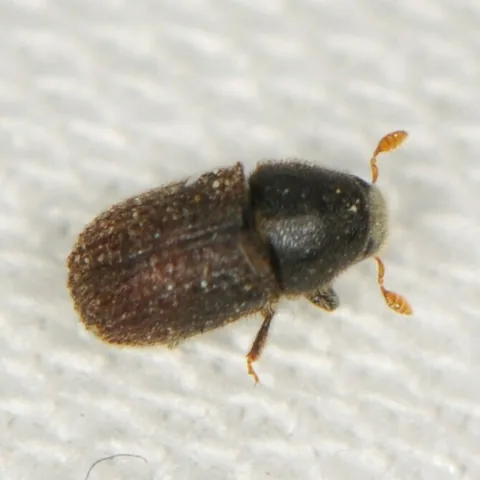
Phloeosinus species (e.g., P. cristatus)
Cypress and cedar bark beetles are tiny native beetles in the genus Phloeosinus that attack cypress, junipers and eastern red cedar. They seldom kill healthy trees, but in drought they can girdle and kill stressed ones, and planted Arizona and Leyland cypress that go without water are common victims.
 Pine shoot beetle
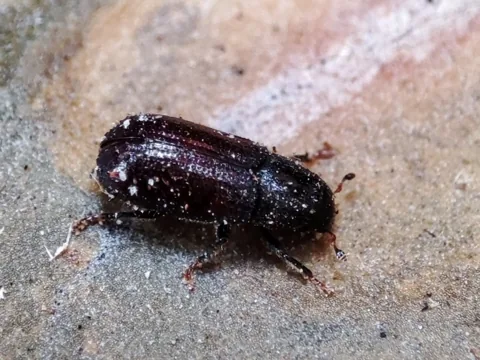
Tomicus piniperda
The pine shoot beetle is a small bark beetle native to Europe and Asia, first found in the United States in 1992 at a Christmas tree plantation in Ohio. It breeds under the bark of freshly cut pine stumps and logs, and the new adults fly to healthy pines and hollow out the shoots, which droop, turn yellow and eventually fall off.
No photo yet
California fivespined ips
Ips paraconfusus
The California fivespined ips is a small bark beetle of pines west of the Sierra Nevada and Cascades. It breeds in fresh pine slash and usually kills only scattered weakened trees, but during droughts it kills and top-kills many pines, including ponderosa and Monterey pines planted as shade trees. To prevent losses, the Forest Service and UC IPM advise watering pines during drought, keeping fresh pine firewood and slash away from living trees, avoiding pruning while the beetles fly, and removing infested trees before the new brood emerges.
 Fir engraver
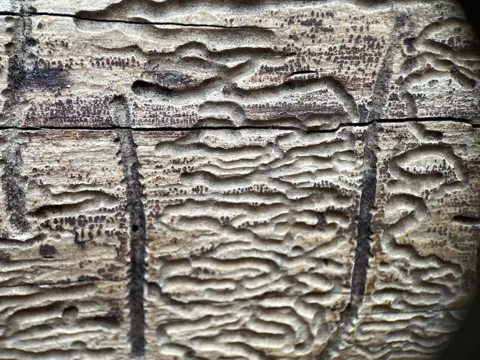
Scolytus ventralis
The fir engraver is a native bark beetle of western firs, mainly white, grand and red fir. Its galleries girdle branches and stems, so the first sign is often scattered red or yellow branches in an otherwise green crown. Trees stressed by drought, defoliation, crowding, dwarf mistletoe or root disease are the ones most likely to be killed.
No photo yet
Jeffrey pine beetle
Dendroctonus jeffreyi
The Jeffrey pine beetle is a native bark beetle that attacks only Jeffrey pine. Numbers usually stay low, but after severe or prolonged drought it kills Jeffrey pines, from single large trees to groups of several hundred, including in high-elevation landscapes such as the Lake Tahoe Basin.
 Mediterranean pine engraver
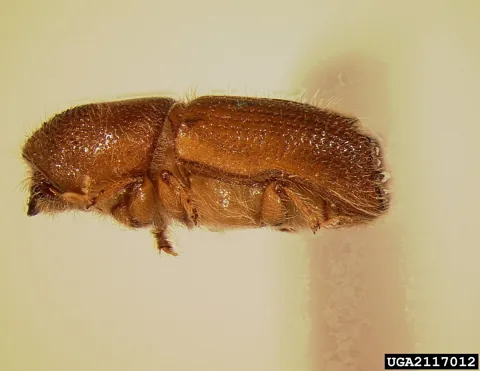
Orthotomicus erosus (formerly Ips erosus)
The Mediterranean pine engraver is a tiny bark beetle from the Mediterranean region, the Middle East and Asia, first found in the United States in Fresno, California, in 2004. It breeds under the bark of pine trunks and large limbs, especially Aleppo and Italian stone pines planted in the Central Valley and around Los Angeles. Keep pines well watered, don't prune them while beetles fly, remove and chip infested wood, don't move firewood, and leave preventive bark sprays on valuable trees to a licensed applicator.
No photo yet
Western balsam bark beetle
Dryocoetes confusus
Most of the subalpine fir that dies in the high country dies from this beetle, but slowly. Less than five percent of a stand is usually attacked in a year, and the attacks are high on the trunk where nobody looks, so the first sign is a tree whose needles go brick red. Dryocoetes confusus also carries a canker fungus on its thorax, and Canadian work credits that fungus with roughly two-thirds of the mortality: trees that successfully pitch out the beetles can still be girdled by coalescing fungal lesions.
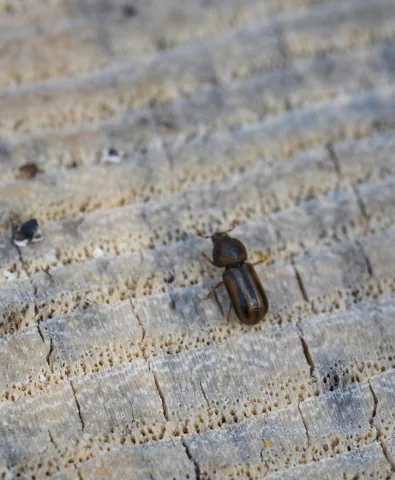 Striped ambrosia beetle
Trypodendron lineatum
This beetle does not kill trees; it ruins logs. Females bore straight into the sapwood of conifers that are already down or dying, carry in a fungus that they and their larvae eat, and leave behind perfectly round pinholes ringed with black stain. On a Douglas-fir log that can mean degrade on a quarter of the volume, on western hemlock far more, which is why mills and sort yards in the Northwest watch the spring flight closely. Logs cut between August and January and left in the woods through spring are the ones it finds.
No photo yet
Western ambrosia beetles
Gnathotrichus sulcatus and Gnathotrichus retusus
Two native ambrosia beetles in the genus Gnathotrichus share the western log-degrade problem with the striped ambrosia beetle, and in some ways they are the harder pair to manage: they will attack timber felled at any time of year, come back to the same log for a second and third season, bore deeper, and have even been found in freshly sawn green hemlock lumber. Their holes are about 1.3 mm across, and the dark stain around them comes from the fungus they carry in and eat.
No photo yet
Silver fir beetle and fir root bark beetle
Pseudohylesinus sericeus and Pseudohylesinus granulatus
These two beetles are a steady background presence in true fir stands rather than an outbreak insect: every year they kill scattered trees and small groups, usually ones already windthrown, felled or injured. They divide the tree between them. The smaller silver fir beetle works the upper bole and branches, down to limbs an inch thick, while the larger fir root bark beetle works the base of the trunk and the roots. Their attacks are hard to spot because the entrance holes hide in bark crevices and under moss, so the first sign is usually a crown turning yellow, then red-orange.
No photo yet
Monterey pine ips
Pseudips mexicanus
This engraver beetle is a slash problem before it is a tree problem. Fresh Monterey pine slash from logging, wind breakage or land clearing produces enormous broods, and when those broods sit next to trees weakened by crowding, drought, mistletoe or other beetles, the beetles move into limbs, tops and sometimes whole trees. In native Monterey pine forests from the Bay Area south to Cambria it has periodically damaged scattered trees over many square miles, and in park and estate plantings it ruins prized specimens.
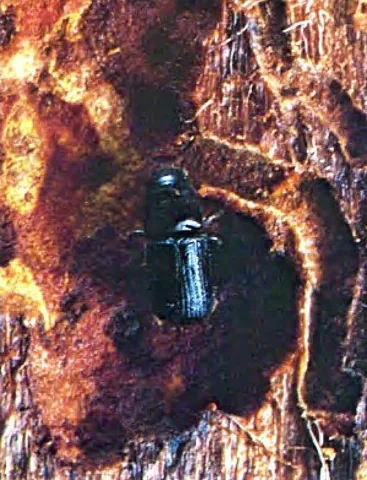 Roundheaded pine beetle
Dendroctonus adjunctus
Every other tree-killing Dendroctonus in the United States flies in summer. This one waits: adults emerge and attack ponderosa pines from late September into November, spend the winter mostly as eggs under the bark, and hatch in March. The Forest Service calls that life history unique for the genus in this country, and probably a consequence of living at the northern edge of a range that runs down through Mexico. Outbreaks in southern New Mexico have killed hundreds of thousands of pole-sized pines.
No photo yet
Northern spruce engraver
Ips perturbatus
In most years this beetle is a minor presence, breeding in logging slash, broken tops and a few scattered spruce. After a disturbance it is a different insect: an outbreak north of Fort Yukon in the 1950s covered more than 1,500 square miles, and a 1986 outbreak near Fairbanks killed thousands of mature white spruce on over 16,000 acres after a wildfire and heavy ice and snow breakage. The tell is the gallery: frass-free and shaped like a tuning fork, often etched into the wood beneath the bark.
No photo yet
Arizona fivespined ips
Ips lecontei
This small bark beetle prefers freshly cut pine slash. In drought it turns on standing ponderosa pines: during 2002 and 2003 it killed tens of thousands of trees on more than 90,000 acres of the Prescott National Forest, and inside an infestation center more than 90 percent of pines 3 inches or more in diameter can die. Outbreaks are usually local and last only a year or two.
No photo yet
Southwestern pine beetle
Dendroctonus barberi
For more than 50 years this beetle was lumped in with the western pine beetle, so anything written about western pine beetle east of the Great Basin between 1963 and 2019 is really about this one. It is a lower-trunk attacker of ponderosa pine, and in the Davis Mountains of west Texas it helped drive a die-off between 2011 and 2016 that has now taken more than half of the ponderosa pines there.
Signs of a bark beetle attack
Look for yellow, orange or reddish-brown boring dust in the bark crevices and at the base of the tree, small shot-hole exit holes in the bark, and needles turning yellow to red.[3][1][4]
Pitch tubes, popcorn-shaped masses of resin where a beetle started to bore in, can be brown, pink or white. Not every pitch tube means the tree lost: a vigorous tree may drown the beetles in resin or push them back out. If most tubes hold trapped beetles, the tree may have survived that year's attack.[8][14]
Drought-stressed trees may make no pitch tubes at all, because they lack the moisture to push out resin. Look for boring dust instead. Texas A&M Forest Service found only small, dried-out pitch tubes, or none, on pines killed by Ips beetles after the February 2021 freeze and drought.[5][4][15]
How fast the crown changes color depends on the beetle and the season. After an Ips attack, needles can go from dull green to red brown in 2 to 4 weeks in summer but take several months in winter. Mountain pine beetle trees usually fade eight to 10 months after the attack, spruce beetle trees show little or no fade the year they are attacked, and some Douglas-fir beetle trees don't fade until a year later.[14][8][13][7]
A red crown usually means the new generation has already left. UC IPM says reddish brown foliage marks a dead tree from which the beetles have already emerged, and Idaho Department of Lands says Douglas-fir beetles are usually gone by the time the tree turns red.[10][6]
- Woodpeckers flaking off the outer bark to reach the larvae is a common sign on ponderosa pines attacked by western pine beetle.[5]
- Streams of clear resin running down the trunk from the uppermost entrance holes can also mark a Douglas-fir beetle attack; in standing trees its galleries are densest above the lowest part of the trunk.[7]
- Peeling away a small piece of bark with a hatchet to look for beetles, tunnels or blue-stained wood is the surest check; check at more than one point around the trunk.[8][10]
Telling the beetles apart by their tunnels
Peeling back a piece of bark from a dying tree shows the gallery pattern, which differs by species.[5][7]
Western pine beetle and red turpentine beetle adults pack much of their egg galleries with sawdust-like frass, while engraver beetles keep their adult galleries clean and open. The tunnels made by larvae of all of them are packed with frass.[10][1]
- Pine engravers (Ips beetles) leave branching tunnels shaped like a Y, X or H that etch the surface of the wood under the bark, and often attack the tops of trees or small material.[3][1][4]
- Western pine beetles cut winding, criss-crossing galleries in ponderosa pine.[5]
- Douglas-fir beetles lay eggs in niches alternating on opposite sides of a gallery that runs along the trunk.[7]
- Mountain pine beetles cut a vertical egg gallery under the bark, and the fungi they carry stain the sapwood blue-gray.[8]
- Southern pine beetles make winding, S-shaped egg galleries.[12]
- Spruce beetle egg galleries run along the trunk with a slight crook at the lower end and are packed with frass; larval mines radiate outward from them.[13]
- Red turpentine beetles mine wide, cave-like galleries that run down the lower trunk, where prominent pitch tubes on standing trees or fresh stumps almost always mean this beetle is present.[10]
Ips engravers or Dendroctonus beetles?
Most conifer-killing bark beetles belong to two groups. Ips (engraver) beetles have a hollow at the rear end lined with three to six pairs of tooth-like spines; Dendroctonus beetles, such as the mountain pine, spruce and Douglas-fir beetles, have a gently curved rear end. Colorado State University gives 1/8 to 3/8 inch for Ips and 1/8 to 1/3 inch for Dendroctonus.[1][8]
Ips beetles are usually less aggressive. They normally attack trees already in decline and breed in fresh slash, then move into standing trees, often the tops or small trees. They have several generations a year: two to four in Colorado, two to three in Oregon, and one generation can take 21 to 40 days in a southern summer.[1][4][14]
Dendroctonus beetles mostly attack the main trunk of larger trees. Oregon's fact sheets note that Ips attack the top of the tree, western and mountain pine beetles the main trunk, and red turpentine beetles the lower trunk and root collar. Once their numbers build, mountain pine and southern pine beetles can kill healthy trees.[4][5][8][12]
- Mountain pine beetle (West): ponderosa, lodgepole, Scotch and limber pines in Colorado, and lodgepole and sugar pines in California. Colorado State Forest Service reports it affected 3.4 million acres of Colorado forest from the late 1990s through 2013.[8][10][9]
- Western pine beetle (West): ponderosa pine and, in California, Coulter pine. It attacks trees over 6 inches in trunk diameter and has two generations a year in most of Oregon.[5][10]
- Douglas-fir beetle (West): Douglas-fir, with one generation a year in Idaho; outbreaks usually follow wind, fire or defoliation.[6][7]
- Spruce beetle: Engelmann spruce in the Rocky Mountains, white spruce in Alaska and red spruce in the East; in Colorado it also attacks Colorado blue spruce. It usually takes 2 years to complete its life cycle, but only 1 in warmer climates.[13][8]
- Southern pine beetle (southeastern U.S. into Mexico and Central America): favors loblolly, shortleaf, pitch, pond and Virginia pines and is in outbreak somewhere in its range every year. Infestations grow as "spots" of attacked trees.[12]
- Southern Ips: the eastern six-spined, eastern five-spined and small southern pine engravers. Texas A&M Forest Service says they may attack healthy and stressed trees alike but usually succeed only in severely stressed pines.[14][15]
Which trees are at risk
Newly planted trees and trees stressed by drought, root injury, soil compaction or disease are attacked first; during outbreaks the beetles can kill healthier trees too.[1][2][5]
Drought is the trigger in many outbreaks. Western pine beetle infestations increase sharply after dry periods, Ips outbreaks in Oregon usually come when April-to-July precipitation is 25% below normal, and prolonged drought fed recent Ips problems in Colorado. Warm temperatures and droughts have set off spruce beetle outbreaks in Alaska, western Canada and the Rockies.[5][4][1][13]
Other stresses work the same way. Construction that compacts soil or injures roots, storms, lightning, ice and wildfire all leave trees or downed wood that bark beetles exploit; Texas A&M Forest Service tied a wave of Ips-killed pines to the 2021 freeze followed by dry weather.[10][14][15]
- Pine engraver populations build in fresh pine slash and cut material and then move into nearby standing pines.[2][4]
- Douglas-fir beetles breed in windthrown, broken or fire-scorched Douglas-firs, and the new beetles that emerge the following spring attack standing trees nearby.[6][7]
- Old, dense stands are most at risk. Most mature Colorado forests carry about twice as many trees per acre as forests that resist mountain pine beetle, and in the South it is recommended that pines in urban settings be spaced more than 20 feet apart.[8][12]
Watering pines and spruces through drought
Colorado State, UC IPM, Wisconsin DNR and the USDA Forest Service all recommend watering stressed landscape trees during drought. They agree on slow, deep watering but give different amounts.[1][10][2][14]
- UC IPM: water infrequently, such as twice a month during drought, but enough to soak the soil about 1 foot deep, around the outer canopy rather than near the trunk. Avoid frequent, shallow lawn-style watering.[10]
- Wisconsin DNR: when monthly precipitation runs 1 inch or more below average, slowly water select ornamental pines once every two weeks for several hours at or just beyond the dripline, for example with a soaker hose.[2]
- For amounts, Wisconsin DNR quotes two rules of thumb: about 10 gallons of water per inch of trunk diameter (Colorado State) or one hour of watering per inch of diameter (Minnesota).[2]
- Colorado State calls for adequate but not excessive water. UC IPM adds that the right amount varies with the site, the size of the tree and whether the species is adapted to summer drought.[1][10]
Protecting landscape trees
Prevention works far better than treatment, because a tree that bark beetles have colonized usually can't be saved.[1][3]
- Water trees during drought and avoid root injury and soil compaction.[1]
- Don't leave fresh pine slash or firewood near live pines through spring and summer, and remove infested trees before new beetles emerge.[2][5][4]
- Thin crowded stands of pine and Douglas-fir to keep the remaining trees vigorous.[5][6]
- Preventive trunk sprays on valuable trees, or MCH repellent pouches for Douglas-fir, must go on before the beetles fly in spring.[5][3][6][1]
- Don't prune pines during the beetles' flight season; UC IPM says to avoid pruning pines from February to mid-October, and not to pile freshly cut, unseasoned wood near landscape trees.[10]
Is a tree worth spraying?
Colorado State's rule of thumb is to look for groups of beetle-killed trees within sight of the live trees in question. Recently transplanted or disturbed trees near known beetle sources may also warrant protection. Tree value always counts; interest is highest in trees around homes, golf courses and other highly visible settings.[1]
The Colorado State Forest Service recommends spraying only high-value trees near homes, businesses or recreation areas. UC IPM says spraying valuable, uninfested host trees near infested ones may be warranted, but sprays are no substitute for proper care. Oregon Department of Forestry notes these treatments are expensive and difficult to apply.[8][10][5]
Insecticides are often not needed at all. Ips problems in Colorado tend to last a few years and then fade on their own, and USDA Forest Service says chemical control of Ips in forests is seldom warranted, though high-value trees in residential or recreational areas may justify it.[1][14]
- Spray only trees that are still healthy and of a species the local beetle attacks; pine bark beetles don't attack oaks, for example.[10]
- Don't spray trees that are fading throughout the crown, already heavily attacked, or riddled with exit holes; nothing will save them, and treating trees the beetles have left does no good.[10][8]
When to apply preventive sprays
Preventive sprays coat the bark so beetles die when they land and try to bore in. They have to be in place before the attack; once beetles are under the bark, spraying does nothing.[10][1][13]
Who should spray is where sources differ. UC IPM says insecticides sold to home users are not effective against bark beetles and that protective spraying must be done by a licensed applicator. Colorado State lists permethrin, bifenthrin and carbaryl as the active ingredients used and says many products contain them, while noting that homeowners may benefit from working with a licensed applicator. The rates used on bark are often considerably higher than those for foliage insects.[10][1][8]
Trunk injections are another split. UC IPM says injected or soil-applied systemics have not been shown to prevent bark beetle attack and are not recommended. USDA Forest Service leaflets report that bole injections are highly effective at protecting high-value trees from western pine beetle, and that emamectin benzoate injections protected Engelmann spruce for two seasons when given a full year ahead, but failed in white and Lutz spruce in south-central Alaska.[10][11][13]
- Mountain pine beetle, Colorado: spray high-value trees each year between April 1 and July 1. Trees sprayed after June may already have been attacked.[8]
- Ips, Colorado: overwintering beetles start emerging in spring once daytime temperatures consistently reach 50 F to 60 F, and adults have been seen entering trees from late February into November, so two treatments (early spring and summer) may be needed. Labeled rates should give at least three months of control.[1]
- California: late winter to early spring in warm areas and late spring in cooler, higher areas. A single spray around mid-February should cover red turpentine and engraver beetles, with a second if heavy rain or sprinklers wash the trunk.[10]
- Oregon, western pine beetle: before flights begin in March or April. Ips flights in Oregon start in April and may continue into October.[5][4]
- Spruce beetle: bole sprays go on in fall or spring, covering the bark from the root collar to mid-crown.[13]
- How long it lasts varies by product and source: UC IPM says one application a year usually gives season-long control, Colorado State says the mountain pine beetle spray lasts through one flight (one year), the western pine beetle leaflet says most products give two field seasons, and the spruce beetle leaflet gives carbaryl two field seasons and permethrin or bifenthrin one.[10][8][11][13]
Pheromone repellents
Some bark beetles release a repellent (anti-aggregation) pheromone that signals a tree is full. For Douglas-fir beetle it is MCH, sold in pouches stapled to trees in spring before beetle flight; Idaho says two pouches protect an individual tree and the pouches last one season.[6][7]
MCH is also registered to protect spruce from spruce beetle, though it works less well when beetle numbers are high. Verbenone may have some effect on western pine beetle but does not work for Ips.[13][5][4]
Why a sprayed tree still dies
Colorado State lists the usual reasons a preventively sprayed tree later dies of beetle attack:[1][8]
- It was sprayed after it was already attacked, or the spray wore off before the beetles arrived.[1][8]
- The mix was too dilute or not fully mixed.[1][8]
- Coverage missed bark: Colorado State says to spray from ground level all the way around the trunk up to where it tapers below six inches; sprayers may not reach the upper trunk of very tall spruces.[8][13]
- Significant rain within two hours of application may wash the insecticide off.[8]
Dealing with infested trees, slash and firewood
Get infested wood out of the cycle before the next generation emerges. Douglas-fir beetle trees should be removed before adults emerge the following spring, Idaho says before snowfall, and Wisconsin says pines dying in summer should be cut and their wood destroyed within 3 weeks.[7][6][2]
- Destroy the inner bark: debark, chip, burn or bury the wood. Ips larvae will not survive standard chipping or debarking.[1][2][14]
- Solarizing: UC IPM seals small piles under thick (10 mil) clear plastic in the sun for several months; Colorado State's Ips sheet uses a double layer of 6-mil clear plastic sealed with soil, and its mountain pine beetle sheet says the temperature under the bark must reach 110 degrees Fahrenheit or more.[10][1][8]
- Don't move firewood. Beetles travel in infested wood, and landscape pines many miles from the mountains have been killed by beetles brought in with firewood.[10][8]
- Time slash: Oregon says Ips will not attack slash over a year old, and that 3-8 inch slash lopped and scattered in the sun from October through December has time to break down before beetles attack in April. Wisconsin suggests cutting pine from October to the end of February.[4][2]
- No insecticide treats wood that is already infested: insecticides are not labeled for slash, and Colorado State says no labeled pesticides exist for mountain pine beetle larvae.[4][8][1]
Common questions
- Can a tree with bark beetles be saved?
- Usually not once the beetles are established; removing it promptly protects nearby trees.[3][5]
- Why do bark beetles attack my pines after a drought?
- Outbreaks usually build in trees weakened by drought, fire, root disease, soil compaction or crowding.[5]
- When should I spray my pines for bark beetles?
- Before the local beetles fly: April 1 to July 1 for mountain pine beetle in Colorado, late winter to early spring in warm parts of California, and before the March-April flights for western pine beetle in Oregon. Ips may need a second spray in summer.[8][10][5][1]
- Will a cold winter kill bark beetles?
- Only extreme cold. Colorado State says mountain pine beetle larvae need at least 30 degrees below zero Fahrenheit for five days in midwinter, Oregon gives -20F for heavy western pine beetle mortality, and the spruce beetle leaflet says temperatures below -30 °F can kill many.[8][5][13]
- Does a pitch tube mean my tree will die?
- Not always. Healthy trees often push attacking beetles out with resin. Peel back a little bark: live beetles, larvae, tunnels or blue stain mean the attack succeeded.[14][8]
Photo credits
- Pine Bark Beetles: (c) Matt Pelikan, some rights reserved (CC BY) — via iNaturalist, CC BY 4.0
- Pine Engraver: Dezene Huber, public domain (CC0), via iNaturalist
- Western Pine Beetle: USDA Forest Service photo, 1920 (public domain), via Flickr
- Douglas-fir Beetle: Megan Blackmore, public domain (CC0), via iNaturalist
- Mountain Pine Beetle: (c) Justin Paulin, some rights reserved (CC BY) — via iNaturalist, CC BY 4.0
- Red Turpentine Beetle: (c) Jake McCumber, some rights reserved (CC BY) — via iNaturalist, CC BY 4.0
- Black Turpentine Beetle: (c) Sam Kieschnick, some rights reserved (CC BY) — via iNaturalist, CC BY 4.0
- Spruce Beetle: (c) Alexandria 'Alex' Wenninger, some rights reserved (CC BY) — via iNaturalist, CC BY 4.0
- Cypress and cedar bark beetles: (c) Elliott Gordon, some rights reserved (CC BY) — via iNaturalist, CC BY 4.0
- Pine shoot beetle: (c) K.P., some rights reserved (CC BY) — via iNaturalist, CC BY 4.0
- Fir engraver: Emily Langdon-Lassagne, public domain (CC0), via iNaturalist
- Mediterranean pine engraver: Orthotomicus erosus by Jim Stimmel, Pennsylvania Department of Agriculture, Bugwood.org — via Wikimedia Commons, CC BY 3.0
- Striped ambrosia beetle: (c) Chris walker, some rights reserved (CC BY) — via iNaturalist, CC BY 4.0
- Roundheaded pine beetle: C. L. Massey, D. D. Lucht and J. M. Schmid, USDA Forest Service (public domain), via Wikimedia Commons
Sources
- Colorado State University Extension, “Ips Beetles (Fact Sheet 5.558, W. Cranshaw; copy hosted by Utah State University).” extension.usu.edu/pests/uppdl/files/factsheet/05558.pdf (accessed 2026-11-10)
- Wisconsin DNR Forest Health Protection (hosted by UW Forestry Extension), “The Pine Engraver Bark Beetle (Ips pini) in Northern Wisconsin (FHP-2).” forestry.extension.wisc.edu/files/2017/09/FHP-2.pdf (accessed 2026-11-10)
- Montana State University Extension (Urban IPM), “Engraver Beetles (Ips spp.).” urbanipm.montana.edu/entomology/resources/fact-sheets/engraver-beetles.html (accessed 2026-11-10)
- Oregon Department of Forestry, “Ips beetles (Forest Health Fact Sheet).” oregon.gov/odf/documents/forestbenefits/ips.pdf (accessed 2026-11-10)
- Oregon Department of Forestry, “Western Pine Beetle (Forest Health Fact Sheet, March 2017).” egov.oregon.gov/odf/Documents/forestbenefits/Western%20Pine%20Beetle.pdf (accessed 2026-11-10)
- Idaho Department of Lands, “Douglas-fir Beetle (Forest Pest Fact Sheet, 2020).” www.idl.idaho.gov/wp-content/uploads/sites/2/2020/03/2016-single-pest-fact-sheet-Douglas-fir-Beetle_3_19_2020.pdf (accessed 2026-11-10)
- USDA Forest Service, “Douglas-fir Beetle (Forest Insect & Disease Leaflet 5, rev. February 2014; M. M. Furniss and S. J. Kegley; copy hosted by Montana DNRC).” dnrc.mt.gov/_docs/forestry/Forestry_Assistance/Forest_Pests/Douglas-firBeetle-FIDL.pdf (accessed 2026-11-10)
- Colorado State University Extension, “Mountain Pine Beetle (Fact Sheet 5.528).” extension.colostate.edu/topic-areas/insects/mountain-pine-beetle-5-528/ (accessed 2026-11-10)
- Colorado State Forest Service, “Mountain Pine Beetle.” csfs.colostate.edu/forest-management/common-forest-insects-diseases/mountain-pine-beetle/ (accessed 2026-11-10)
- University of California Statewide IPM Program, “Pest Notes: Bark Beetles (Publication 7421).” ipm.ucanr.edu/PMG/PESTNOTES/pn7421.html (accessed 2026-11-10)
- USDA Forest Service, “Western Pine Beetle (Forest Insect and Disease Leaflet 1, FS-1192, 2022).” www.fs.usda.gov/foresthealth/docs/fidls/FIDL-01-WesternPineBeetle.pdf (accessed 2026-11-10)
- USDA Forest Service, “Southern Pine Beetle (Forest Insect and Disease Leaflet 49, revised 2009).” www.fs.usda.gov/foresthealth/docs/fidls/FIDL-49-SouthernPineBeetle.pdf (accessed 2026-11-10)
- USDA Forest Service, “Spruce Beetle (Forest Insect and Disease Leaflet 127, April 2026).” www.fs.usda.gov/foresthealth/docs/fidls/FIDL-127-SpruceBeetle.pdf (accessed 2026-11-10)
- USDA Forest Service, “Ips Bark Beetles in the South (Forest Insect and Disease Leaflet 129; scanned, read by OCR).” www.fs.usda.gov/foresthealth/docs/fidls/FIDL-129-IpsBarkBeetlesSouth.pdf (accessed 2026-11-10)
- Texas A&M Forest Service, “Winter Storm Uri continued tree impacts: pine tree mortality.” tfsweb.tamu.edu/?p=15732 (accessed 2026-11-10)