On this page
How to identify it
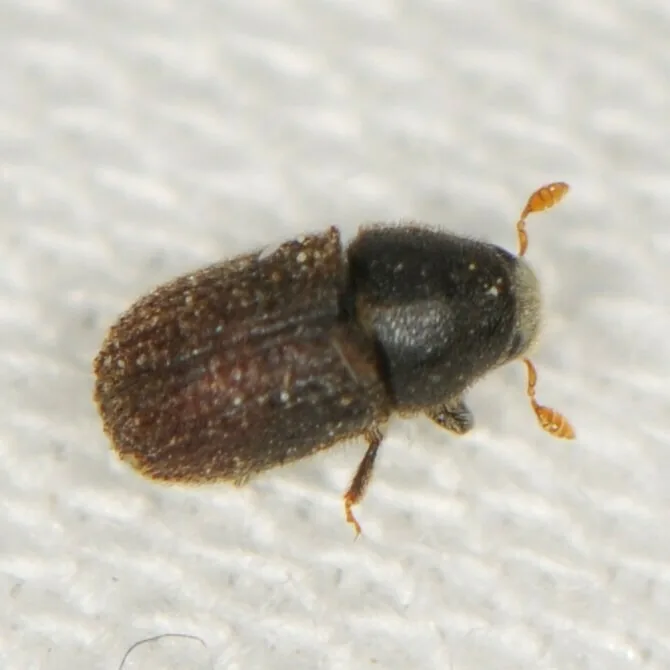
- Adults are about 1/8 inch (2 to 3 mm) long, reddish brown to black and often shiny.[1][2][3]
- A common sign is dead, faded branch tips, called flags, where new adults have hollowed out the twig a few inches from the end; the dead tips hang on for a while, then break off, and hundreds can pile up under a heavily attacked tree.[1][3]
- On the trunk and larger limbs look for very fine sawdust in bark crevices or at the base, and tiny entry and exit holes about 1/32 inch across. Under the bark is a straight gallery 1 to 3 inches long with egg niches along both sides and larval tunnels fanning out from it.[3][1]
- The larvae are white, legless grubs with brown heads that look like very small grains of cooked rice.[2][3]
Look-alikes
| Look-alike | How to tell them apart |
|---|---|
| Drought injury | A tree killed by the beetles looks much like one killed by lack of water. Check for fine sawdust, tiny holes and galleries under the bark before blaming the weather alone.[3] |
| Pine engraver beetles | Ips engraver beetles are relatives that attack pines and spruce rather than junipers and cypress.[3] |
Where it lives
They are native insects. Arizona Extension reports Phloeosinus cristatus throughout Arizona, Utah State covers them on junipers and cypress in Utah, and the Colorado State Forest Service lists at least three species in Colorado.[1][2][3]
Biology and life cycle
Hosts include Arizona cypress, Leyland cypress and other cypress, eastern red cedar, and Utah, Rocky Mountain and other junipers.[1][2][3]
They need trees weakened by drought, bad weather, chemical injury, poor planting or care, soil compaction or animal damage. In the wild they breed in broken, dying or felled trees and are common in juniper firewood, and they rarely kill native junipers.[3][1]
In a stressed tree, adults bore into the trunk and limbs at least 3/4 inch thick to mate and lay eggs, and the larvae eat the inner bark and outer sapwood, girdling the stem.[1][3]
They spend the winter as larvae under the bark. Colorado's sheet says one generation a year; Utah State says two may occur in some locations, and Arizona says more than one is possible during extended drought.[3][2][1]
Trees are attacked in spring and summer; adults fly from July into September in Colorado and in mid to late summer in most of Utah.[1][3][2]
Damage and signs
- Twig flagging by new adults matters little to the tree's health, but it shows the beetles are nearby.[3][1]
- Brood galleries in the trunk and limbs girdle the tree. The crown turns yellow-green and then red-brown, and the result is top-kill, dead branches and sometimes a dead tree.[1][3][2]
- Planted Arizona and Leyland cypress often die because owners assume these native trees can live without extra water.[1]
Health risk
They are bark beetles of trees, and no cited source describes any risk to people or pets.[1][2][3]
Control
Prevention
Water is the main defense. During extended drought, often April through June, water susceptible trees slowly, deeply and infrequently with drip irrigation or a soaker hose placed at the drip line, but don't overwater. Extra fertilizer isn't generally recommended.[1][2]
Plant trees properly, avoid wounding them or compacting the soil around them, and if the beetles have been active nearby, plant new trees in the fall.[3][1]
Sanitation
Prune out dead and dying wood in winter, and promptly remove cut, dead or fallen material from the area.[1][2]
Traps and physical control
Destroy infested trees before the new beetles fly: burn or chip them, bury them under at least 8 inches of soil, or haul them at least a mile from large junipers or cedars.[3]
Pesticides
The sources differ on spraying. Arizona Extension does not recommend insecticides against cypress bark beetles and notes that once the trunk is colonized control isn't practical. Utah State lists carbamate or pyrethroid bark sprays to protect susceptible trees where the beetles are active.[1][2]
Where the sources disagree
Spraying: Arizona Extension says insecticides are not recommended against cypress bark beetles and control is not practical once the trunk is colonized, while Utah State lists carbamate or pyrethroid bark sprays to protect susceptible trees where the beetles are active.[1][2]
Generations: Colorado's 1997 sheet says one a year, Utah State says two may occur in some locations, and Arizona says more are possible during extended drought.[3][2][1]
When to water: Arizona Extension advises slow, deep, infrequent watering during extended drought, often April through June; Colorado's sheet says to water during hot summer weather and dry, warm winters.[1][3]
Flight timing: Colorado's sheet says adults usually fly from July through September, and Utah State says adults can attack from spring to fall depending on location, mid to late summer in most of Utah.[3][2]
Species name: Arizona Extension names Phloeosinus cristatus (LeConte), while the GBIF Backbone Taxonomy gives the authority as Wood & Bright, 1992.[1][5]
Common questions
- Why are the branch tips on my Arizona cypress turning brown and dropping?
- It may be new cypress bark beetles feeding in the twigs, which kills the tips. That feeding does little harm by itself, but check the trunk for fine sawdust and tiny holes, and give the tree deep water during drought.[1][3]
- Should I spray my cypress or junipers for bark beetles?
- Arizona Extension says no and puts the emphasis on deep watering; Utah State lists preventive bark sprays only for susceptible trees where the beetles are active. Arizona notes that control isn't practical once the trunk is colonized.[1][2]
- Do these beetles live in juniper firewood?
- Yes. Arizona Extension says they are common in juniper firewood and breed in broken, dying or felled wood, so remove cut, dead or fallen material promptly.[1]
Sources
- University of Arizona Cooperative Extension, “Cypress Bark Beetles, AZ1316 (J. Schalau, revised December 2011).” extension.arizona.edu/sites/extension.arizona.edu/files/pubs/az1316.pdf (accessed 2026-11-13)
- Utah State University Extension, Integrated Pest Management, “Cedar/Cypress Bark Beetles (Ornamental Pest Guide).” extension.usu.edu/planthealth/ipm/ornamental-pest-guide/arthopods/bark-beetles/cedar-cypress-bark-beetles (accessed 2026-11-13)
- Colorado State Forest Service, “Western Cedar Bark Beetles (D. Leatherman and D. Lange, September 1997).” csfs.colostate.edu/wp-content/uploads/2014/12/western_cedar_bark_beetles.pdf (accessed 2026-11-13)
- Global Biodiversity Information Facility (GBIF), “Phloeosinus F.Chapuis, 1869 (genus) (GBIF Backbone Taxonomy).” api.gbif.org/v1/species/1241514 (accessed 2026-11-13)
- Global Biodiversity Information Facility (GBIF), “Phloeosinus cristatus Wood & Bright, 1992 (GBIF Backbone Taxonomy).” api.gbif.org/v1/species/1241602 (accessed 2026-11-13)