On this page
How to identify it
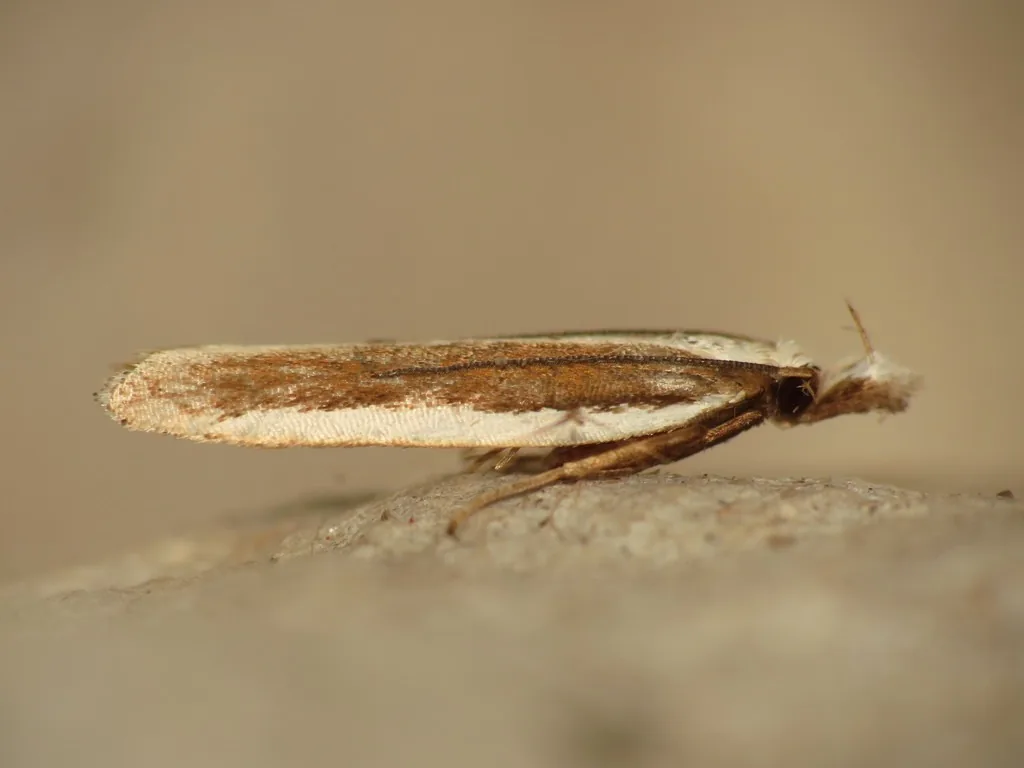
- Adults are small, slender copper-brown moths with white bands along the edges of the front wings. The PNW handbook says about 1/2 inch across; NC State says 5/8 inch long. They rarely fly unless disturbed.[1][2]
- Larvae have a dark head and dark lines down the back. NC State describes the caterpillar as about 3/4 inch long, whitish or light brown with reddish-brown stripes, with larger ones grayish brown with two dark stripes and a fainter one between; the PNW handbook calls the mature larva yellowish to brownish (see where the sources disagree).[1][2]
- Damaged foliage turns brown and is covered with dirty webbing; small trees may be completely webbed.[1]
- Pupae are light to dark reddish brown, about 1/4 inch long, inside whitish silk cases.[2]
Where it lives
First reported on juniper in Europe in 1775, it also occurs in northern Asia and the United States. It infests only junipers.[2][1]
Biology and life cycle
Partly grown caterpillars overwinter in nests of webbed twigs and silk tubes, feed together in a shared web in spring and pupate. NC State says adults emerge about two weeks later, from May to July with a peak in June; males live about 12 days and females about 14.[1][2]
Females lay 50 to 200 eggs singly where new needles join the twig. About 10 days later the larvae hatch and mine the leaves, then feed on the surface from silk tubes.[2][1]
Irish juniper is the preferred host; Chinese juniper, red cedar and several common juniper varieties are also infested.[1]
There's one generation a year.[1]
Damage and signs
Health risk
It feeds on junipers; the PNW handbook and NC State Extension mention no risk to people or pets.[1][2]
Control
Prevention
Watch for the first signs of webbing; Juniperus procumbens and J. squamata are infested only occasionally.[1]
Traps and physical control
Hand-pick caterpillars and prune out infested growth.[1]
Biological control
Braconid and ichneumonid wasps parasitize the larvae and pupae, but NC State says they usually act too late to prevent significant damage.[2]
Pesticides
NC State says juniper webworms are not especially resistant to insecticides, and a product labeled for landscape use should control them if applied while the caterpillars are actively feeding.[2]
Adults and timing
Adults are small, slender brown moths with white wing margins that rarely fly unless disturbed; NC State says they emerge from May to July, peaking in June, while the PNW handbook says late spring.[2][1]
Where the sources disagree
Moth size: the PNW handbook gives about 0.5 inch across; NC State says 5/8 inch long.[1][2]
Caterpillar size: the PNW handbook gives the mature larva as 0.05 to 0.06 inch long; NC State gives 3/4 inch.[1][2]
Flight: the PNW handbook says moths fly in late spring; NC State says adults emerge from May to July, peaking in June.[1][2]
Common questions
Sources
- Pacific Northwest Pest Management Handbooks (OSU, WSU, University of Idaho), “Juniper (Juniperus): Juniper webworm (Insect Management Handbook).” pnwhandbooks.org/insect/hort/landscape/hosts-pests-landscape-plants/juniper-juniperus-juniper-webworm (accessed 2026-11-13)
- NC State Extension, “Juniper Webworm.” content.ces.ncsu.edu/juniper-webworm-1 (accessed 2026-11-13)
- Global Biodiversity Information Facility (GBIF), “Dichomeris marginella (Fabricius, 1781) (GBIF Backbone Taxonomy).” api.gbif.org/v1/species/1847407 (accessed 2026-11-13)
- iNaturalist, “Dichomeris marginella taxon page (order and family).” www.inaturalist.org/taxa/951186 (accessed 2026-10-06)