On this page
How to identify it
- Look near the shoot tips for cocoon-like feeding shelters that incorporate frass, gnawed twigs and foliage, with browned or dying tips around them; the caterpillar ties two or more leaves together with silk into a tube where it hides and feeds.[1]
- The full-grown caterpillar is up to 10 mm long, reddish brown, with an unmarked brown head and two pairs of dark spots on the top of each abdominal segment. The USDA Forest Service's 1977 Western Forest Insects describes the mature larva as blackish pink and about 10 mm long.[1][2]
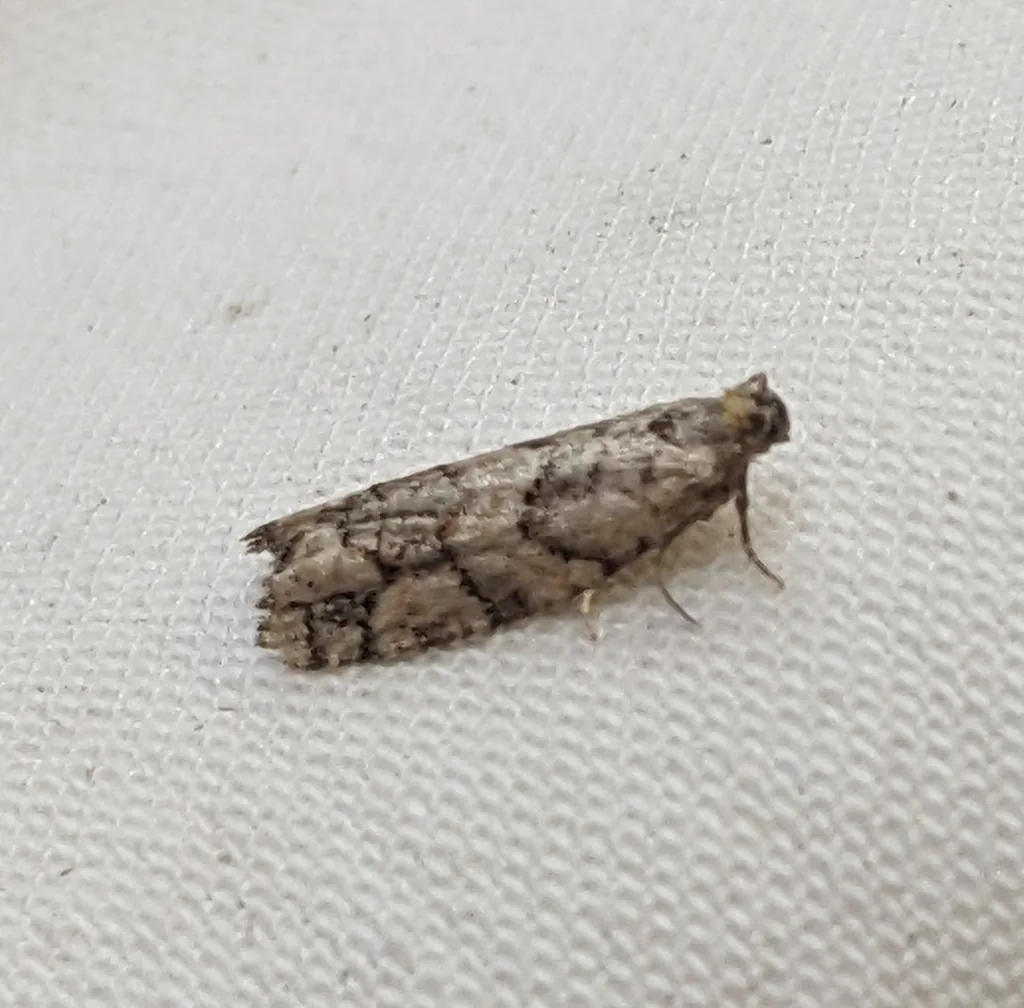
- The moth has a wingspread of about 20 mm and checkerboarded forewings, according to the Forest Service manual.[2]
Look-alikes
| Look-alike | How to tell them apart |
|---|---|
| Cypress tip moth | The cypress tip moth (Argyresthia cupressella) has small green caterpillars, about 1/8 inch long, that tunnel inside 1- and 2-year-old shoot tips; tips turn brown in late winter, and white papery cocoons sit in the leaf axils. The cypress leaftier instead builds an outside shelter of frass, gnawed twigs and foliage. The Forest Service manual says the leaftier often occurs together with Argyresthia cupressella.[3][4][1][2] |
| Juniper webworm | Juniper webworm caterpillars are yellowish to brown with dark brown lines on the back and feed in colonies inside nests of webbed foliage deep in the plant; the cypress leaftier caterpillar is reddish brown with two pairs of dark spots per segment.[5][1] |
| Cypress webber (Herculia phoezalis) | The Forest Service manual says its damage on ornamental cypress, false cypress and arborvitae in southern California somewhat resembles the leaftier's, but its larvae live in groups in loosely webbed tunnels rather than singly in cocoon-like shelters. The mature larva is about 18 mm long and shiny black; the adult is dark brown with two narrow, wavy cross bands and a wingspread of 17 to 25 mm.[2] |
Where it lives
Found throughout south coastal British Columbia and south along the Pacific coast to California. The Forest Service manual likewise gives southern California north through Oregon and Washington into British Columbia.[1][2]
Biology and life cycle
The principal hosts are western redcedar and various ornamental cedar, cypress and juniper species. Natural Resources Canada's host list names cedars and arborvitae, Chinese, common and Rocky Mountain junipers, cypress, eastern redcedar, western redcedar, yellow-cedar and grand fir. The Forest Service manual calls it a significant pest of ornamental cypress (Cupressus) and, to a lesser degree, arborvitae (Thuja) and juniper.[1][2]
The moth overwinters as a small caterpillar. Feeding resumes in March, when the caterpillar builds its shelter near a shoot tip from frass, gnawed twigs and foliage and feeds inside it.[1]
Pupation takes place in early June and the moths emerge in July.[1]
Damage and signs
- The caterpillars tie and chew the foliage at the shoot tips. Natural Resources Canada says the insect occasionally causes visible shoot dieback on ornamental cypress-family trees. The Forest Service manual says heavy infestations turn attacked trees brown early in the spring.[1][2]
- Other tip-browning insects on the same trees are more often the cause: WSU and the PNW handbook describe the cypress tip moth, whose mined tips brown in late winter and whose repeated heavy attacks can cause severe dieback on arborvitae and junipers.[3][4]
Health risk
The sources treat it only as a feeder on ornamental conifers and mention no bites, stings or other effect on people or pets.[1]
Control
Prevention
Step 2, confirm the culprit: if the tips are mined from the inside and white papery cocoons sit in the leaf axils, the cypress tip moth is the cause, not the leaftier. WSU notes western redcedar is highly resistant to the tip moth and American arborvitae very susceptible.[3][4][1]
Traps and physical control
Step 1, clip: from March on, look for the frass-bound shelters near the shoot tips of cypress, cedar and juniper and clip them off with the caterpillar inside; feeding continues until pupation in early June.[1]
Biological control
Avoid broad-spectrum insecticides on these shrubs: WSU notes that natural enemies help hold down related webbing caterpillars such as the juniper webworm. Carbaryl (Sevin) is toxic to bees, and WSU says homeowners should not spray trees over 10 feet tall.[5][3]
Where the sources disagree
How serious it is: Natural Resources Canada says it only occasionally causes visible shoot dieback on ornamental cypress-family trees, while the Forest Service's 1977 manual calls it a significant pest of ornamental cypress whose heavy infestations turn trees brown early in spring.[1][2]
Common questions
- What is making little clumps of frass and dead twigs on my cypress?
- Those are the feeding shelters of the cypress leaftier caterpillar, built near the shoot tips from frass, gnawed twigs and foliage from March until early June.[1]
- Why are the tips of my cypress turning brown?
- If you find shelters of frass and chewed twigs, it is the cypress leaftier, which occasionally causes shoot dieback. If the tips are hollowed out from inside and turn brown in late winter, it is more likely the cypress tip moth. The Forest Service manual adds that heavy leaftier infestations turn trees brown early in the spring.[1][3][4][2]
- Which trees does it attack?
- Western redcedar and ornamental cedars, cypresses and junipers. Natural Resources Canada also lists arborvitae, yellow-cedar and grand fir, and the Forest Service calls ornamental cypress the main host, with arborvitae and juniper attacked less.[1][2]
Sources
- Natural Resources Canada, Canadian Forest Service, “Cypress leaftier, Epinotia subviridis (Trees, insects, mites and diseases of Canada's forests).” tidcf.nrcan.gc.ca/en/insects/factsheet/11025 (accessed 2026-11-14)
- USDA Forest Service, “Western Forest Insects, Miscellaneous Publication 1339 (R. L. Furniss and V. M. Carolin, November 1977; scanned copy).” archive.org/details/CAT78702369 (accessed 2026-11-14). Scanned copy of the USDA Forest Service publication on the Internet Archive; text read from the archive.org full-text (djvu.txt) file.
- Washington State University Extension, “Arborvitae: Cypress tip moth (Hortsense).” hortsense.cahnrs.wsu.edu/fact-sheet/arborvitae-cypress-tip-moth/ (accessed 2026-11-12)
- Pacific Northwest Pest Management Handbooks (Oregon State University), “Arborvitae (Thuja)-Cypress tip moth.” pnwhandbooks.org/insect/hort/landscape/hosts-pests-landscape-plants/arborvitae-thuja-cypress-tip-moth (accessed 2026-11-12)
- Washington State University Extension, “Arborvitae: Juniper webworm (Hortsense).” hortsense.cahnrs.wsu.edu/fact-sheet/arborvitae-juniper-webworm/ (accessed 2026-11-12)
- iNaturalist, “Epinotia subviridis taxon page (order and family).” www.inaturalist.org/taxa/345436 (accessed 2026-11-10)