On this page
How to identify it
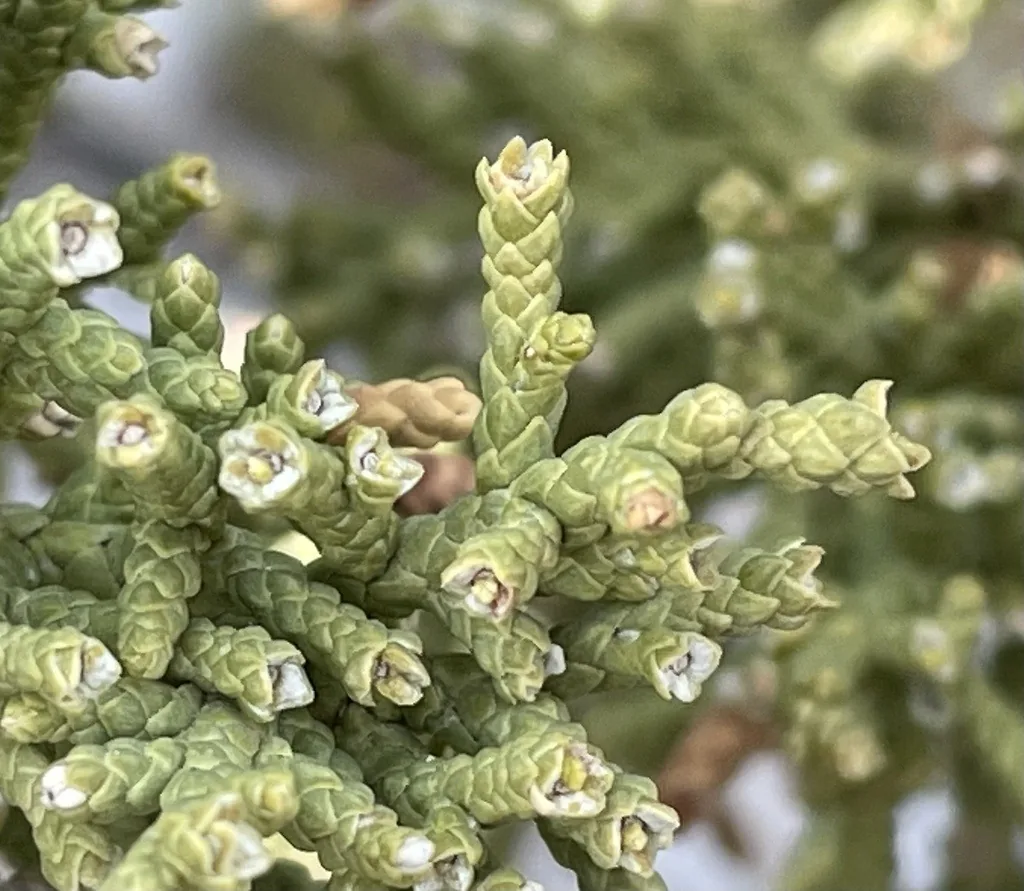
- The galls are the field mark: swollen juniper shoot tips, green while the larvae are inside and brown to reddish afterward; Colorado State describes a reddish or yellow gall that looks like a rosette of leaves at the tip.[1][2]
- Mining and exit holes can be found at the junction between living and dead tissue or at the base of the swollen portion of the tip.[1]
- The adult is a tiny yellow fly that looks like a miniature mosquito: about 0.06 inch long according to the Pacific Northwest handbook, 1/30 inch according to Colorado State. The larva is a pale, legless maggot with no distinct head.[1][2]
Look-alikes
| Look-alike | How to tell them apart |
|---|---|
| Phomopsis tip blight | Fungal tip blight also browns and kills juniper shoot tips; the midge's tips are swollen into small galls and show exit holes where live and dead tissue meet.[1] |
| Juniper webworm | A yellowish to brownish caterpillar that first mines inside the leaves and then feeds in small colonies in nests of webbed foliage; the tip midge leaves no webbing, only swollen, browning tips.[3][1] |
| Cypress tip moth | A silver-tan moth about 0.3 inch long whose green larvae tunnel in the growing points of one- and two-year-old shoot tips without forming a swollen gall.[4][1] |
Where it lives
Colorado State covers it among the insects that feed on Colorado trees and shrubs, and the Pacific Northwest handbook treats it as a landscape and nursery pest of juniper. GBIF holds 23 U.S. records since 1990, 16 of them from California and the rest from New Mexico, Nevada, Oregon and Utah.[2][1][5]
Biology and life cycle
The larvae feed within the shoot tips, which respond by swelling into tiny green galls; the galls turn brown, sometimes reddish, and the tips die back after the larvae have left.[1]
Colorado State says winter is spent as a larva in the gall; the midges pupate in spring, and females lay eggs on the new foliage. The young larvae move to the branchlet tips and feed on the developing growth, which forms the gall.[2]
Damage and signs
- Infested tips swell, then brown and die back, producing scattered dead tips over the plant that can be mistaken for fungal tip blight.[1]
Health risk
The Pacific Northwest handbook and Colorado State treat it only as a juniper pest; neither mentions any effect on people or pets.[1][2]
Control
Traps and physical control
Remove the green galls and damaged tips while the larvae are still inside them, before the galls brown and the midges emerge.[1]
Pesticides
The Pacific Northwest handbook refers readers to its landscape chemical-control table and its general gallmaker section rather than naming a specific product for this midge.[1]
Where the sources disagree
Adult size: the Pacific Northwest handbook gives about 0.06 inch; Colorado State gives 1/30 inch.[1][2]
Control: the Pacific Northwest handbook advises removing green galls while the larvae are inside; Colorado State says no controls have been developed and none appear needed.[1][2]
Name: the Pacific Northwest handbook lists it as Walshomyia (Oligotrophus) betheli; Colorado State and GBIF use Oligotrophus betheli.[1][2][6]
Common questions
- Why are the tips of my juniper swelling and turning brown?
- Swollen tips that are green at first and then brown or reddish, with tiny exit holes at the base of the swelling, are galls of the juniper tip midge; plain browning without swelling is more likely Phomopsis tip blight.[1]
- How do I get rid of juniper tip midge?
- Prune off the green galls and damaged tips while the maggots are still inside, which removes the next generation with them.[1]
- Where does the juniper tip midge occur?
- Colorado State covers it in Colorado and the Pacific Northwest handbook treats it as a juniper pest in the Northwest; GBIF's U.S. records since 1990 come mostly from California.[2][1][5]
Sources
- Pacific Northwest Pest Management Handbooks (Oregon State University, Washington State University and University of Idaho), “Juniper (Juniperus)-Juniper tip midge, Hosts and Pests of Landscape Plants, Pacific Northwest Insect Management Handbook.” pnwhandbooks.org/insect/hort/landscape/hosts-pests-landscape-plants/juniper-juniperus-juniper-tip-midge (accessed 2026-11-13)
- Colorado State University Cooperative Extension, “Insects That Feed on Colorado Trees and Shrubs, Bulletin 506A (W. S. Cranshaw, D. A. Leatherman and B. C. Kondratieff).” static.colostate.edu/client-files/csfs/pdfs/steamboat-district/Insects_Feed_Trees.pdf (accessed 2026-11-13)
- Pacific Northwest Pest Management Handbooks (Oregon State University, Washington State University and University of Idaho), “Juniper (Juniperus)-Juniper webworm, Hosts and Pests of Landscape Plants, Pacific Northwest Insect Management Handbook.” pnwhandbooks.org/insect/hort/landscape/hosts-pests-landscape-plants/juniper-juniperus-juniper-webworm (accessed 2026-11-13)
- Pacific Northwest Pest Management Handbooks (Oregon State University, Washington State University and University of Idaho), “Juniper (Juniperus)-Cypress tip moth, Hosts and Pests of Landscape Plants, Pacific Northwest Insect Management Handbook.” pnwhandbooks.org/insect/hort/landscape/hosts-pests-landscape-plants/juniper-juniperus-cypress-tip-moth (accessed 2026-11-13)
- Global Biodiversity Information Facility (GBIF), “Oligotrophus betheli: U.S. occurrence records since 1990 by state (GBIF occurrence search).” api.gbif.org/v1/occurrence/search?taxonKey=1594330&country=US&hasGeospatialIssue=false&occurrenceStatus=PRESENT&year=1990%2C2026&facet=stateProvince&facetLimit=400&limit=0 (accessed 2026-11-13)
- Global Biodiversity Information Facility (GBIF), “Oligotrophus betheli Felt, 1912 (GBIF Backbone Taxonomy).” api.gbif.org/v1/species/1594330 (accessed 2026-11-13)
- iNaturalist, “Oligotrophus betheli taxon page (order and family).” www.inaturalist.org/taxa/702435 (accessed 2026-11-10)