On this page
How to identify it
- Adults are tiny, delicate-looking flies. The PNW handbook puts them around 0.05 inch long; the Oregon Department of Forestry says 2 mm (about 0.08 inch).[1][2]
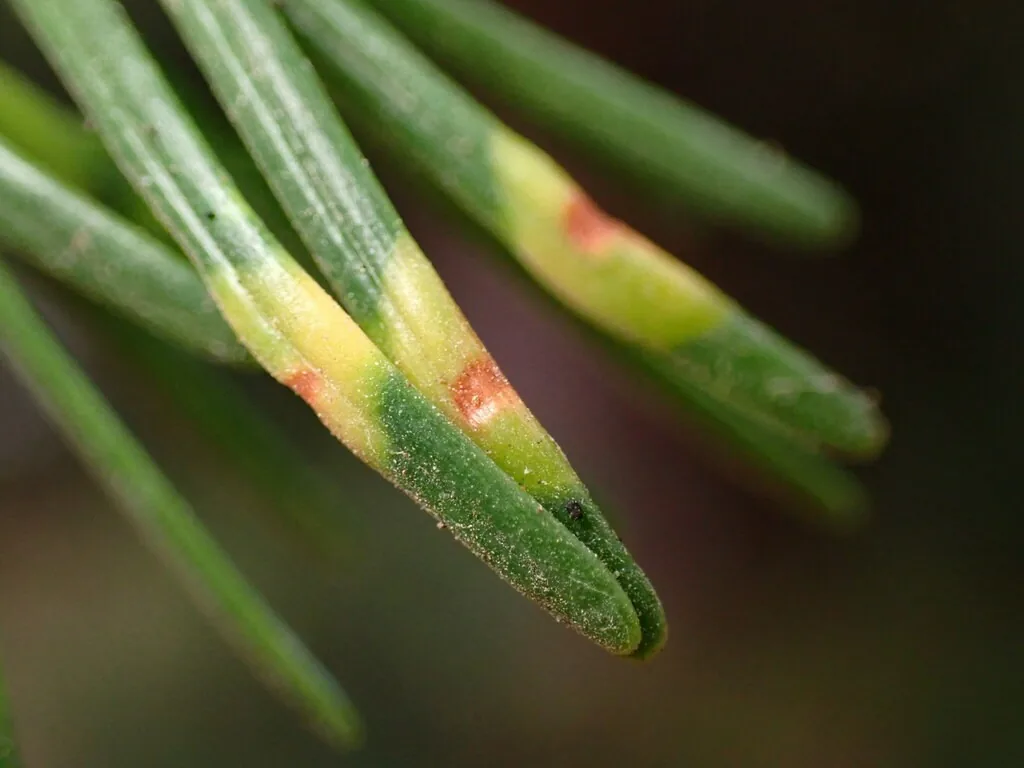
- The tiny white larvae mine inside needles, forming slight swellings; the area around them turns yellow with brown or purple patches, and needles often bend sharply at the injury. Several larvae may feed in one needle.[1][2]
- Three midges infest Douglas-fir: one feeds near the needle base, one near the tip and one near the middle. ODF names Contarinia pseudotsugae as the most abundant, with C. constricta and C. cuniculator, and more than one can attack a tree at once.[1][2]
- Eggs are yellow-brown or orange and can be seen on new needles with a hand lens.[2]
Where it lives
ODF says these midges occur from Canada down to California and east to Montana. Both ODF and the PNW handbook call them mainly pests of Christmas tree farms and other plantations.[2][1]
Biology and life cycle
Adults emerge from the ground around budbreak, about May, and lay eggs on new needles.[1][2]
Larvae mine the needles through summer; ODF says they stay first instars until early August and molt twice more by late September. Sources differ on when they leave: the PNW handbook says at the end of summer, ODF from mid-October to December, when they drop to the ground and spin cocoons for the winter. There is one generation a year.[1][2]
Damage and signs
Health risk
It feeds on Douglas-fir needles; neither the PNW handbook nor ODF mentions a risk to people.[1][2]
Control
Prevention
Planting stock that breaks bud later might throw off the timing between midge emergence and budbreak that sets up attacks.[2]
Traps and physical control
Prune out heavily infested twigs and branches. On plantations, ODF advises destroying heavily infested trees in early fall, before the larvae drop to the ground.[1][2]
Pesticides
ODF says sprays aimed at the adults must go on before they fly, around May, and suggests timing with degree-day models or traps, but notes traps also catch many similar, harmless flies.[2]
Related midges
Other Contarinia midges, such as the Douglas-fir cone gall midge, may attack needles and sometimes cones of other conifers.[2]
Common questions
Sources
- Pacific Northwest Pest Management Handbooks (OSU, WSU, University of Idaho), “Douglas-fir (Pseudotsuga): Douglas-fir needle midge (Insect Management Handbook).” pnwhandbooks.org/insect/hort/landscape/hosts-pests-landscape-plants/douglas-fir-pseudotsuga-douglas-fir-needle-midge (accessed 2026-11-13)
- Oregon Department of Forestry (Forest Health Fact Sheets), “Douglas-fir Needle Midge (Forest Health Fact Sheet, September 2017).” egov.oregon.gov/odf/Documents/forestbenefits/DF_needle_midge_2017.pdf (accessed 2026-11-13)
- Global Biodiversity Information Facility (GBIF), “Contarinia pseudotsugae Condrashoff, 1961 (GBIF Backbone Taxonomy).” api.gbif.org/v1/species/5082110 (accessed 2026-11-13)
- iNaturalist, “Contarinia pseudotsugae taxon page (order and family).” www.inaturalist.org/taxa/208526 (accessed 2026-10-06)