On this page
How to identify it
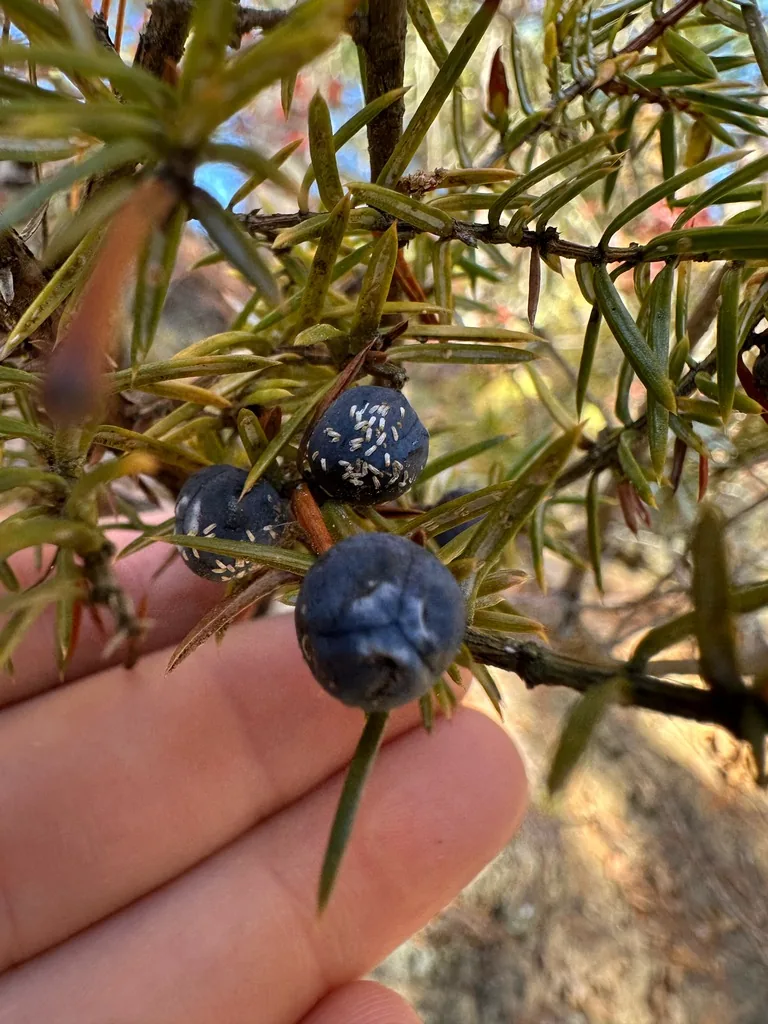
- Female scales are round and white with a yellow center, like tiny fried eggs; Penn State gives about 1/16 inch across, Kentucky about 1/10 inch wide (see where the sources disagree).[1][2]
- Immature males are smaller, elongate and ridged, white with yellow at one end; crawlers are tiny and yellow.[1]
- The two species look alike and need a microscope to tell apart.[1]
Where it lives
Both occur throughout the eastern United States and parts of adjacent Canada, and on the West Coast from California to British Columbia; juniper scale is more common in northern areas such as Pennsylvania and minute cypress scale in the Southeast. Extension guides cover it in Pennsylvania and Kentucky.[1][2]
Biology and life cycle
They overwinter as mated females; in Pennsylvania, eggs are laid from late April to mid-May and crawlers peak in late May.[1]
Hosts include junipers, cypresses, arborvitae, false cypress and incense cedar, and sometimes cedars, spruces, pines and yews.[1]
Damage and signs
- Foliage first loses its shine, then turns yellow on individual branches and may die; severe infestations kill plants.[1]
Health risk
It feeds on conifers; Penn State Extension and the University of Kentucky mention no risk to people or pets.[1][2]
Control
Biological control
Dustywings, lady beetles and at least four parasitic wasps attack these scales; keeping plants unstressed lets them do the work.[1]
Pesticides
For heavier infestations, target crawlers from late May through June with horticultural oil first, or apply dormant oil in early April above 40°F.[1]
Time crawler sprays by watching for crawlers: Kentucky says they are active in May, so inspect for them or put black electrical tape (sticky side out) or double-sided tape near the scales and treat once the first crawlers show up on the tape.[2]
Kentucky names dinotefuran as a systemic option for armored scales such as juniper scale, applied in spring or fall; read and follow the label. Either approach may take repeated treatments over a couple of growing seasons.[2]
More from UK Entomology
Females are circular with 'fried egg' coloring, while males are more elongated.[2]
Where the sources disagree
Female size: Penn State gives about 1/16 inch (1.5 mm) across; Kentucky about 1/10 inch wide.[1][2]
Generations: Kentucky reports one generation a year; Penn State says there is one in cooler areas and may be two in warmer ones, though the southern life cycle hasn't been studied.[2][1]
Crawler timing: Penn State puts peak crawler emergence in late May in Pennsylvania; Kentucky says eggs hatch over 10 to 14 days in about mid-May in central Kentucky.[1][2]
Treatment order: Penn State says to try horticultural oil first and broader-spectrum insecticides only in later years; Kentucky presents a systemic dinotefuran treatment and crawler sprays as two options.[1][2]
Common questions
Sources
- Penn State Extension, “Juniper and Minute Cypress Scales.” extension.psu.edu/juniper-and-minute-cypress-scales (accessed 2026-11-13)
- University of Kentucky Entomology, “ENTFACT-429: Juniper Scale.” entomology.mgcafe.uky.edu/ef429 (accessed 2026-11-13)
- Global Biodiversity Information Facility (GBIF), “Carulaspis juniperi (Bouché, 1851) (GBIF Backbone Taxonomy).” api.gbif.org/v1/species/8218672 (accessed 2026-11-13)
- Global Biodiversity Information Facility (GBIF), “Carulaspis minima (Signoret, 1869) (GBIF Backbone Taxonomy).” api.gbif.org/v1/species/7631015 (accessed 2026-11-13)
- iNaturalist, “Carulaspis juniperi taxon page (order and family).” www.inaturalist.org/taxa/387181 (accessed 2026-10-06)