On this page
How to identify it
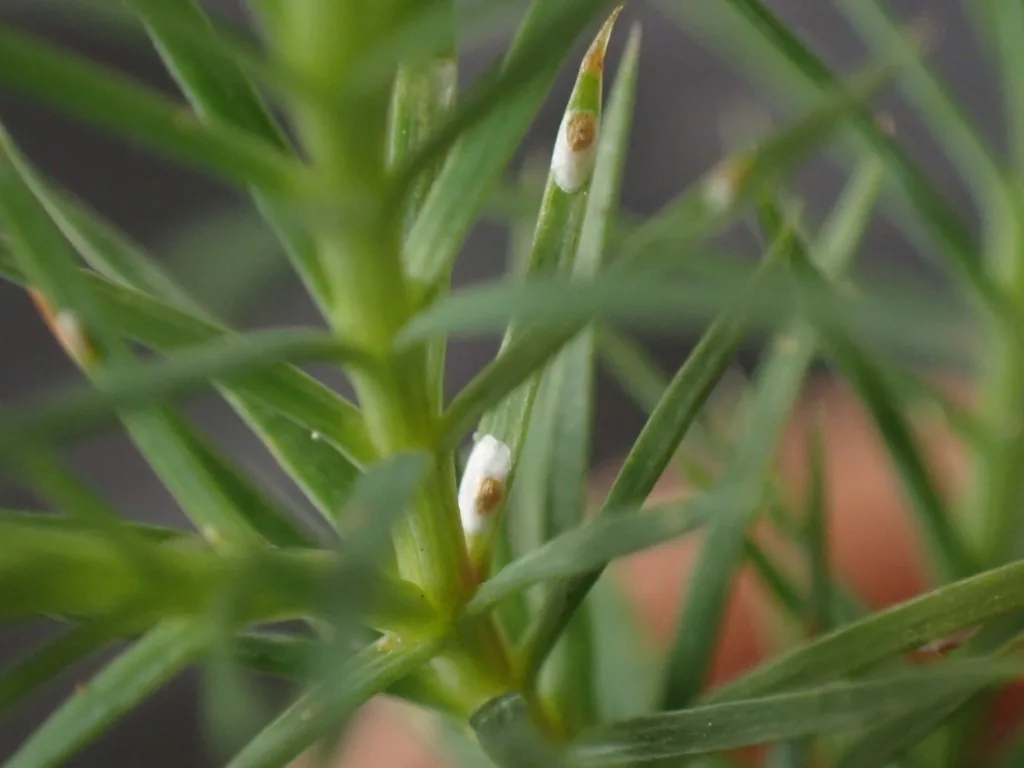
- The female's cover is round, whitish and parchment-like with a yellow to brown center; Penn State likens it to a tiny fried egg. Size estimates vary: up to 1 mm wide (NC State), about 1.5 mm (UMass and Penn State) or 1/16 inch or less (UC IPM). Immature males are smaller, elongate and ridged.[4][1][2][3]
- Scales this small are easy to miss. A plant that loses its luster and turns dull or yellowish is often the first clue, so check discolored foliage with a hand lens.[4][1][2][3]
- Unlike many soft scales, it does not produce honeydew.[1]
Look-alikes
| Look-alike | How to tell them apart |
|---|---|
| Juniper scale | Juniper scale (Carulaspis juniperi) can't be told apart in the field. Penn State says separating them takes slide-mounted specimens under a compound microscope; UMass notes minute cypress scale may run slightly smaller. Both can be on the same plant.[2][3][1] |
| Cypress tip moth and webworms | Caterpillars of cypress tipminer, juniper twig girdler and webworms cause similar browning and twig dieback. UC IPM suggests shaking the foliage: tiny moths flying out, or caterpillars and silk, point to these moths. The scales make no silk.[3] |
Where it lives
It has spread around the world in the nursery trade. Penn State places it across the eastern United States and nearby Canada and along the West Coast from California to British Columbia, and says it favors warmer climates, so it is more common in the Southeast than juniper scale. UC IPM calls it widespread in California, and UMass has confirmed specimens from Massachusetts.[2][3][1]
Biology and life cycle
Mated females spend the winter on the foliage. In Pennsylvania, eggs are laid from late April through mid-May and crawlers peak in late May; UMass gives up to 40 reddish-yellow eggs per female in the Northeast. In California, UC IPM says crawlers appear in late winter and spring.[2][1][3]
Crawlers drift on the wind to new plants. Males mature and mate in summer or early fall and die before winter.[1][2][3]
Cooler areas get one generation a year and warmer areas may get two; UC IPM reports one to two in California. NC State notes that little is known about its biology, and Penn State says no studies have been done in the southern United States.[2][3][4]
Besides cypress-family plants, it has been recorded on Atlas and Lebanese cedar, spruce, pine and yew.[2][1]
Damage and signs
- Sources differ on how much it matters. UMass calls it a serious pest of juniper and NC State a debilitating pest of juniper and Leyland cypress. Penn State says infestations are generally light and don't affect healthy plants, and UC IPM says it is usually not a serious landscape pest in California except on Italian cypress. All agree heavy infestations can cause dieback and needle drop.[1][4][2][3]
- It can be a serious problem in nurseries, and badly infested plants may become more open to other pests.[3][1][4]
Health risk
It feeds on conifer sap. UMass, NC State, Penn State and UC IPM describe plant damage only and don't mention any risk to people or pets.[1][4][2][3]
Control
Traps and physical control
Cut out and destroy heavily infested branches where that won't spoil the plant's shape, and water during dry spells to keep plants from getting stressed.[1][2]
Biological control
Natural enemies often hold the scale in check. UMass counts at least 22 genera in 11 families, including parasitic wasps such as Aphytis and Encarsia and Chilocorus lady beetles; Penn State adds dustywings.[1][2][3]
Pesticides
Spray only if damage is intolerable. Crawlers, which lack the waxy cover, are the easiest stage to kill, so time horticultural oil to when monitoring shows crawlers are active; Penn State says to try oil before broader insecticides. If the label says the plant is sensitive to oil, UC IPM says to pick a different product.[3][2][4]
Massachusetts made neonicotinoids state restricted-use on trees and shrubs from July 1, 2022. UMass also advises waiting until after bloom to protect pollinators.[1]
Common questions
- Why does my Leyland cypress look dull and off-color?
- Minute cypress scale is one possible cause. Look for tiny round white scales with yellow centers on the needles, and shake a branch to rule out tipminers and webworms.[4][1][3]
- Do I need to treat minute cypress scale?
- Often not. UC IPM says no control is usually needed in landscapes, and Penn State says light infestations don't hurt healthy plants. Act if plants start to decline.[3][2]
Sources
- UMass Extension Landscape, Nursery and Urban Forestry Program (Landscape Insect & Mite Guide), “Carulaspis minima (Minute Cypress Scale).” www.umass.edu/agriculture-food-environment/landscape/publications-resources/insect-mite-guide/carulaspis-minima (accessed 2026-11-13)
- Penn State Extension, “Juniper and Minute Cypress Scales (updated January 19, 2026).” extension.psu.edu/juniper-and-minute-cypress-scales (accessed 2026-11-13)
- University of California Statewide IPM Program, “Minute Cypress Scale (Home and Landscape).” ipm.ucanr.edu/home-and-landscape/minute-cypress-scale/ (accessed 2026-11-13)
- NC State Extension, “Minute Cypress Scale Insect (PDIC Factsheet).” content.ces.ncsu.edu/minute-cypress-scale-insect (accessed 2026-11-13)
- Global Biodiversity Information Facility (GBIF), “Carulaspis minima (Signoret, 1869) (GBIF Backbone Taxonomy).” api.gbif.org/v1/species/7631015 (accessed 2026-11-13)
- iNaturalist, “Carulaspis minima taxon page (order and family).” www.inaturalist.org/taxa/387187 (accessed 2026-10-06)