On this page
How to identify it
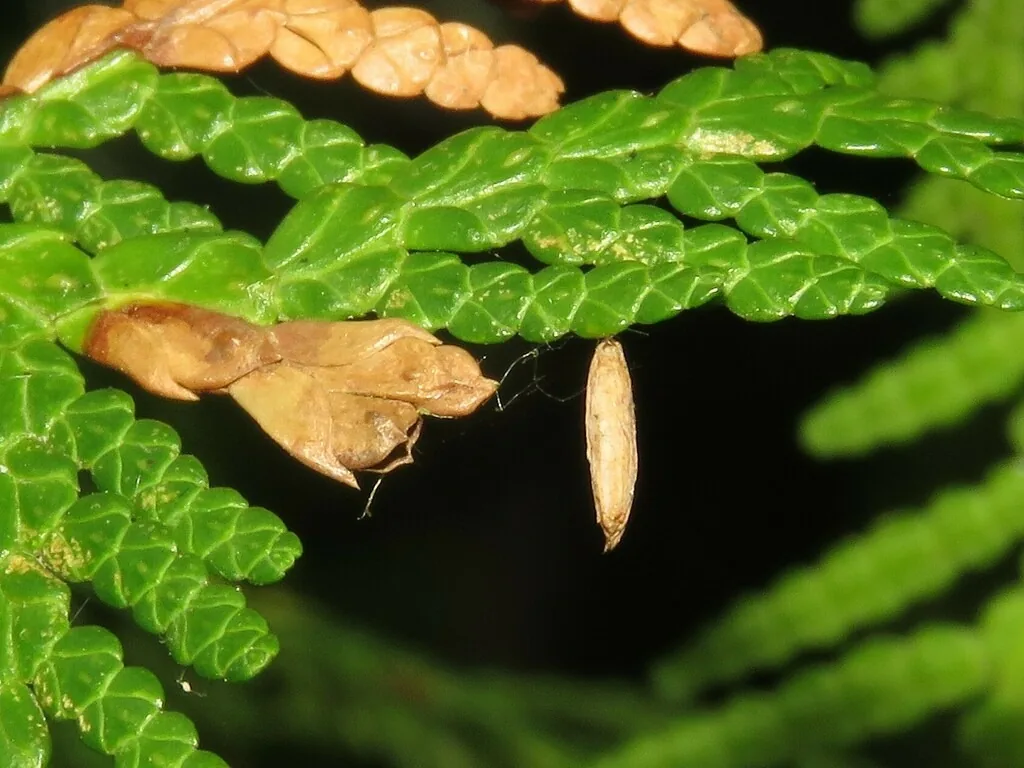
- The giveaway is brown tips that are hollow inside and hold frass and sometimes a living larva; brown tips that aren't hollow point to winter injury, disease or another cause.[1]
- Larvae are green, sometimes reddish-tinged, or brownish caterpillars up to about 1/4 inch long with a dark head.[2]
- Adults are tiny moths about 1/8 inch long, silvery tan (UMass) or light gray with brown and black spots (NC State).[1][2]
Look-alikes
| Look-alike | How to tell them apart |
|---|---|
| Winter injury | Leafminer browning often doesn't show until late January or February, so it is easily mistaken for winter burn; check whether the brown tips are hollow.[1] |
Where it lives
UMass and NC State cover it as a pest of arborvitae in Massachusetts and North Carolina. UMass notes a western species, Argyresthia cupressella, sometimes found in the East, and A. freyella, which attacks eastern redcedar as well as arborvitae.[1][2]
Biology and life cycle
Adults lay eggs on the foliage, and newly hatched larvae bore into the scale leaves and mine from the tips toward the base; NC State says eggs go in the branchlet axils or along leaf margins.[1][2]
Larvae feed until fall, overwinter in their mines, resume feeding in spring and pupate inside the mine.[1][2]
Damage and signs
- All arborvitae varieties are attacked, with American pyramidal, globe and golden arborvitae preferred; NC State notes it may also attack juniper.[2]
- Mined tips turn yellowish or whitish, then brown, and whole shrubs can brown; heavy attacks can make leaves drop or, rarely, kill a plant, though arborvitae usually survives with reduced looks.[1][2]
Health risk
It feeds inside arborvitae foliage. UMass and NC State describe plant damage only and don't mention any risk to people or pets.[1][2]
Control
Prevention
To check for adults, gently shake the foliage in June and July and watch for moths; yellow sticky cards don't work for this pest.[1][2]
Traps and physical control
NC State suggests pruning out dead tips later in the season and destroying the clippings.[2]
Biological control
Parasitic wasps attack it: NC State says at least 26 species have been reared from it, and UMass says that after two or three years of rising leafminer numbers they can severely reduce the population.[1][2]
Pesticides
If control is wanted, UMass and NC State describe sprays aimed at the moths during their flight period; UMass says that once larvae are inside the leaves, systemic products applied to the soil or by trunk injection may be needed. Follow the label.[1][2]
Where the sources disagree
Moth flight: UMass says adults are active from about mid-June into early July; NC State says moths emerge to lay eggs in May and June, with most eggs laid around the first of June.[1][2]
Wingspan: UMass gives 5 to 6 mm; an NC State photo caption gives 5/16 inch.[1][2]
Pupation: UMass says pupation begins by late May; NC State says March to May.[1][2]
Whether to spray: NC State says doing nothing should let parasites bring the population down; UMass notes arborvitae survives heavy feeding but its looks may suffer unacceptably.[2][1]
Common questions
- Why are the tips of my arborvitae brown in late winter?
- Break a tip open: if it is hollow with frass inside, arborvitae leafminer is the likely cause; if not, suspect winter injury or disease.[1]
- Will arborvitae leafminer kill my hedge?
- Rarely; plants usually survive even heavy damage, though they can look bad and parasites often bring numbers down within a few years.[1][2]
Sources
- UMass Extension Landscape, Nursery and Urban Forestry Program, “Arborvitae Leafminer (fact sheet, R. Childs, rev. 10/2011).” www.umass.edu/agriculture-food-environment/landscape/fact-sheets/arborvitae-leafminer (accessed 2026-11-13)
- NC State Extension, “Arborvitae Leafminer (PDIC Factsheet).” content.ces.ncsu.edu/arborvitae-leafminer (accessed 2026-11-13)
- Global Biodiversity Information Facility (GBIF), “Argyresthia thuiella Packard, 1871 (GBIF Backbone Taxonomy).” api.gbif.org/v1/species/1830284 (accessed 2026-11-13)
- iNaturalist, “Argyresthia thuiella taxon page (order and family).” www.inaturalist.org/taxa/128555 (accessed 2026-10-06)