On this page
How to identify it
- Leafminer damage shows as off-color patches, blisters or winding trails in leaves; the host plant and the shape of the mine help identify which insect made it.[1]
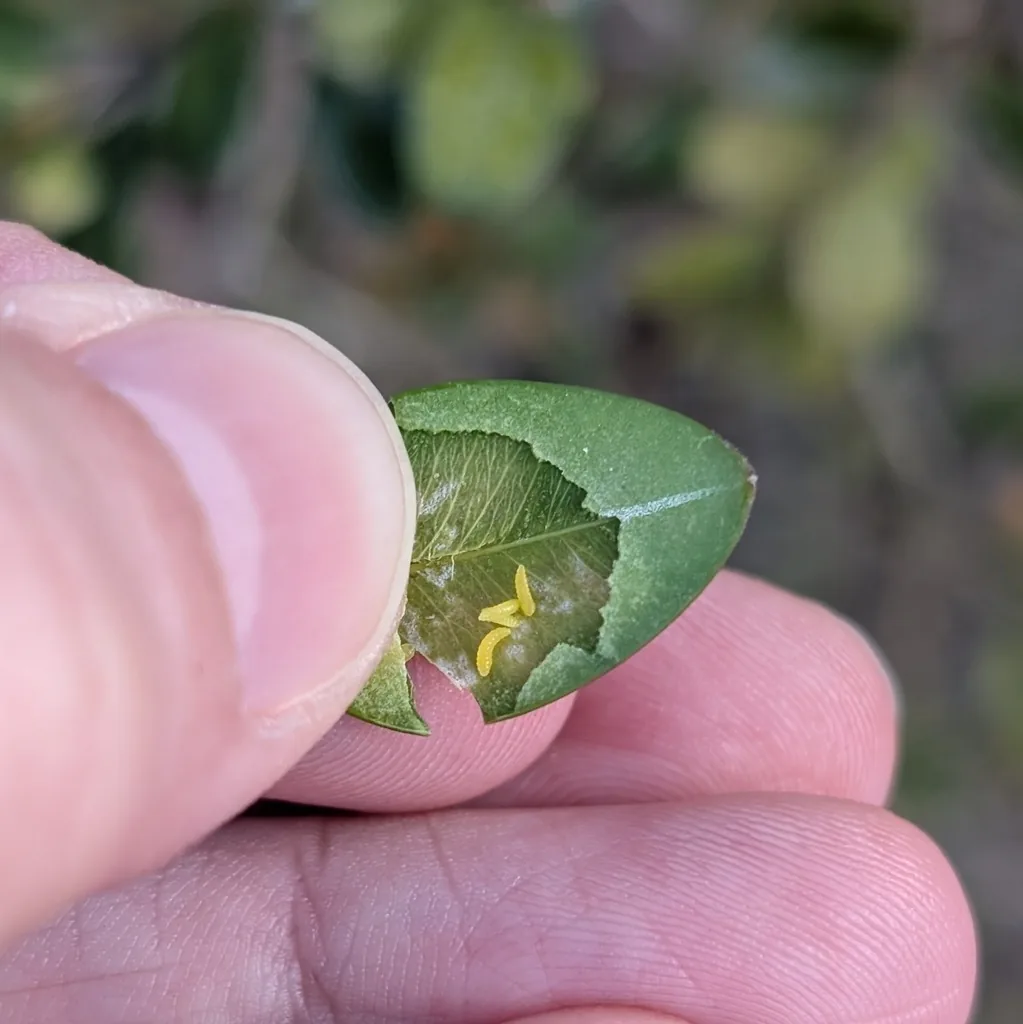
- Boxwood leafminer makes a blotch-shaped blister on the underside of boxwood leaves that turns yellow or brown and gives the leaf a puffy look.[3][2]
- Opening a blister reveals two to six small maggots about 3 mm long; Penn State calls them whitish to lemon-yellow and UMass bright yellow to orange.[3][2]
- Adults are tiny yellow to orange-red, gnat-like flies about 2 to 3 mm long; UMass suggests looking for swarms early in the morning or shaking the bushes from late April to spot them.[2][3]
Look-alikes
| Look-alike | How to tell them apart |
|---|---|
| Citrus leafminer | A tiny moth whose larvae make shallow, winding mines with a thin dark trail of droppings in young citrus leaves, then curl the leaf edge to pupate.[4] |
| Box tree moth | Its lime-green, black-striped caterpillars eat leaves down to the midrib and leave webbing and green-black frass, instead of hiding inside blistered leaves. APHIS says it was first detected in New York in 2021 and has since been confirmed in nine more states, and that federal and state officials restrict boxwood movement; report suspected finds.[5][6] |
Where it lives
UMass says it came from Europe, likely on potted boxwood in the mid-1600s, but wasn't reported at pest levels until the early 1900s in Rhode Island; Penn State says it was first reported as a U.S. pest in 1910. Both say it is now found across the United States wherever boxwood grows.[3][2]
Biology and life cycle
Boxwood leafminer has one generation a year and spends the winter as a partly grown larva inside the leaf.[2][3]
Larvae finish feeding in spring and pupate; the blisters develop a clear window as they mature.[2][3]
Adults emerge in spring, often while weigela is blooming (see where the sources disagree on timing); UMass says the adult stage lasts only two to three weeks.[2][3][7]
Each female lays about 29 eggs into the new season's leaves and dies soon after; the eggs hatch in about two to three weeks, and the larvae feed slowly through summer.[2][3][7]
Damage and signs
- Heavily mined boxwood leaves may swell, yellow and drop early, leaving sparse, ragged plants with some dead twigs.[2][3]
- Repeated attack can cause branch dieback, weaken plants and may make boxwood in cold climates more prone to winter kill.[3]
- UMass says all boxwoods can be attacked, with common boxwood and most of its cultivars, round leaf boxwood and Balearic boxwood especially attractive; some common boxwood cultivars, including English boxwood ('Suffruticosa'), and Japanese boxwood are more resistant. Penn State says most boxwood varieties are attacked.[3][2]
- In general, established woody plants tolerate a lot of leaf mining and are rarely if ever killed.[1]
Health risk
UC IPM, Penn State and UMass Extension describe leaf and plant damage only and don't mention any risk to people or pets.[1][2][3]
Control
Prevention
Keep plants vigorous with proper watering and site conditions, and choose resistant species or cultivars when planting.[1][3]
Traps and physical control
Pruning out and disposing of infested foliage improves appearance and gives some control; for boxwood, cut back first-year growth after egg-laying in June and destroy the clippings.[1][3]
Biological control
Natural enemies control some leafminers, so avoid broad-spectrum, persistent insecticides that kill them; for boxwood leafminer, UMass knows of no effective natural enemies.[1][3]
Pesticides
Boxwood leafminer larvae are protected inside the leaves, so Penn State and UMass time sprays of registered contact insecticides to the brief adult flight, around May when weigela blooms; UMass advises confirming the flies are present first.[2][3]
UMass lists systemic soil drenches, including clothianidin and imidacloprid, but advises choosing alternatives where possible and applying any insecticide after bloom to protect pollinators.[3]
Citrus leafminer on backyard citrus
Citrus leafminer (Phyllocnistis citrella) is a tiny moth native to Asia that arrived in Florida in 1993 and was first found in California, in Imperial County, in 2000. UC IPM says it now infests most of southern California, the coast north to San Luis Obispo County, and the San Joaquin Valley.[4]
Larvae can survive only in tender new citrus leaves, which become curled and distorted; older, hardened leaves are not attacked unless numbers are very high.[4]
Mature backyard trees tolerate the damage, and even young trees with heavy infestations are unlikely to die.[4]
UC IPM recommends leaving it alone so natural enemies can build up, and not pruning live branches more than once a year, since the moths are drawn to new flush.[4]
UC IPM says insecticides available for backyard trees aren't very effective against larvae inside the mines and many leave residues that kill natural enemies; mature trees rarely if ever need treatment.[4]
Where the sources disagree
Which leaf surface gets the eggs: Penn State says females push their eggs through the lower surface and Oregon State says the underside; UMass says the eggs go deep into the upper surface of the current season's leaves.[2][7][3]
Adult emergence: Penn State says May; UMass says by mid-May or early June; Oregon State says late April through May in the Pacific Northwest.[2][3][7]
Arrival: UMass says it was likely introduced in the mid-1600s; Penn State dates the first U.S. pest report to 1910.[3][2]
Common questions
- Why do my boxwood leaves look puffy and yellow underneath?
- That is the classic sign of boxwood leafminer: larvae feed between the leaf surfaces and create swollen blisters that turn yellow or brown.[3][2]
- When should I treat boxwood leafminer?
- Target the adult flies when they emerge, typically around May while weigela is blooming (Oregon State says late April through May in the Pacific Northwest); at other times the larvae are sealed inside the leaves.[2][3][7]
- Will leafminers kill my plants?
- Rarely. Established woody plants tolerate extensive mining, though years of heavy attack can thin boxwood and cause dieback.[1][3]
Sources
- University of California Statewide IPM Program, “Foliage Miners (Home and Landscape).” ipm.ucanr.edu/home-and-landscape/foliage-miners/ (accessed 2026-11-13)
- Penn State Extension, “Boxwood Leafminer (updated June 24, 2026).” extension.psu.edu/boxwood-leafminer (accessed 2026-11-13)
- UMass Extension Landscape, Nursery and Urban Forestry Program, “Boxwood Leafminer (fact sheet, updated January 3, 2023).” www.umass.edu/agriculture-food-environment/landscape/fact-sheets/boxwood-leafminer (accessed 2026-11-13)
- University of California Statewide IPM Program, “Pest Notes: Citrus Leafminer (Home and Landscape).” ipm.ucanr.edu/home-and-landscape/citrus-leafminer/ (accessed 2026-11-13)
- USDA Animal and Plant Health Inspection Service (APHIS), “Box Tree Moth.” www.aphis.usda.gov/plant-pests-diseases/box-tree-moth (accessed 2026-11-13)
- UMass Extension Landscape, Nursery and Urban Forestry Program, “Cydalima perspectalis (Box Tree Moth), Landscape, Nursery and Urban Forestry Insect and Mite Guide.” www.umass.edu/agriculture-food-environment/landscape/publications-resources/insect-mite-guide/cydalima-perspectalis (accessed 2026-11-13)
- Oregon State University, Department of Horticulture, “Boxwood Leafminer (Nursery Pest Management, updated May 2013).” agsci.oregonstate.edu/nurspest/insects/boxwood-leafminer (accessed 2026-11-13)
- Global Biodiversity Information Facility (GBIF), “Monarthropalpus flavus (Schrank, 1776) (GBIF Backbone Taxonomy).” api.gbif.org/v1/species/1601456 (accessed 2026-11-13)
- iNaturalist, “Monarthropalpus flavus taxon page (order and family).” www.inaturalist.org/taxa/467578 (accessed 2026-10-06)