On this page
How to identify it
- Adults are small flies about 1/4 inch long. UMN describes them as gray to black with dark stripes on the thorax and clear wings; Illinois says gray or brown with black bristles, and UMass gives a length of 5 to 7 mm.[1][3][4]
- Larvae are whitish, carrot-shaped maggots inside the leaf. Eggs are white: Illinois says they're laid on the leaf underside singly or in batches of up to five, UMass says in neat rows, and Montana State and Colorado State describe small masses.[2][3][4][5][6]
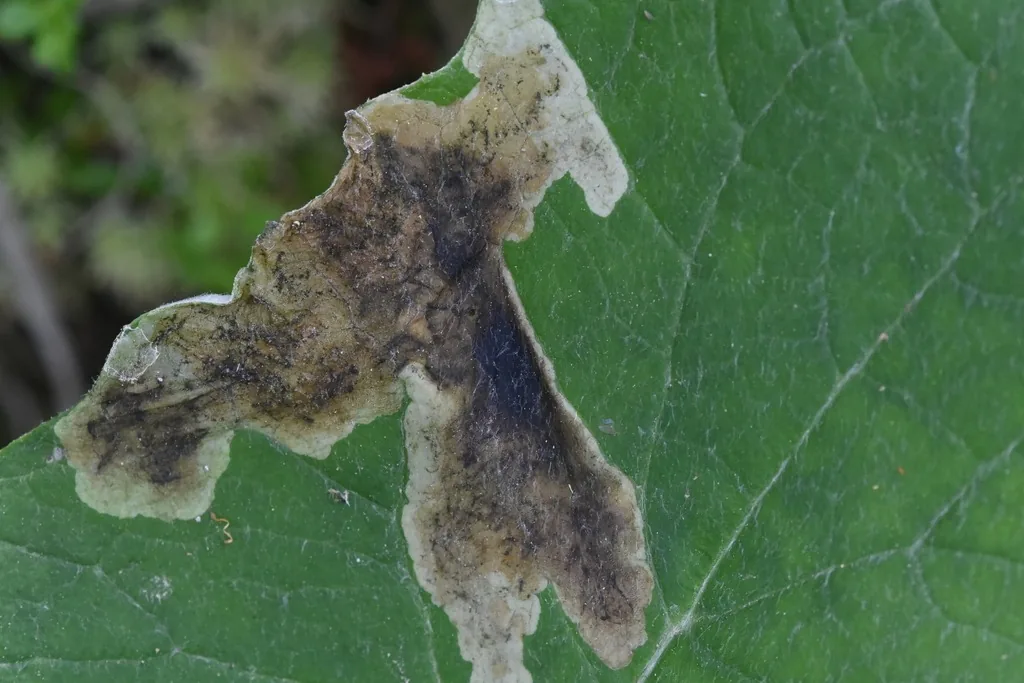
- Mines start long and narrow, or slender and winding, then widen into blotches that are opaque at first and later turn brown. Colorado State calls them large, dark blotch mines.[2][4][6]
Look-alikes
| Look-alike | How to tell them apart |
|---|---|
| Other leafminers | Many insects mine leaves, but Colorado State says the spinach leafminer is the only one that regularly mines edible plant parts, and UMass says these two attack the beet and spinach family and weeds such as lambsquarters.[6][4] |
Where it lives
Extension services in Minnesota, Illinois, Massachusetts, Montana and Colorado all cover it. None of these sources describes its full range.[2][3][4][5][6]
Biology and life cycle
Pupae spend the winter in the soil. UMN and Illinois say adults emerge in April and May (from mid-April, per Illinois); UMass says around mid-May in Massachusetts.[2][3][4]
Larvae feed for about two to three weeks and then drop to the ground to pupate, though UMass says they may also pupate in the leaf. UMass says eggs hatch in 3 to 6 days and a generation takes 30 to 40 days.[2][3][4]
Sources give different generation counts: a second generation in June (UMN's diagnostic page), several a year (UMN, Illinois), two or more (Colorado State), and three to four in Massachusetts, peaking in mid to late May, late June and mid-August (UMass). Montana State says activity stops around midsummer.[1][2][3][6][4][5]
Damage and signs
- Hosts include spinach, chard and beets and weeds such as lambsquarters. UMN and Illinois also list tomato, cucumber and celery, and UMass says the spinach leafminer may damage solanaceous crops such as peppers.[1][2][3][4]
- UMN says it has little impact on beets grown for their roots and treating beet root crops isn't necessary, but it can be destructive to leafy greens. Illinois says the first generation does the most damage.[1][2][3]
- UMass says damage is usually minimal but can be severe in some years, and eggs on greenhouse transplants can carry the pest into the field. Colorado State says problems are worst where spinach or beets are overwintered or grown continuously.[4][6]
Health risk
It feeds on plants, and no cited source describes any risk to people or pets.[1][2][4]
Control
Prevention
Rotate plantings and put row covers on before adults fly. UMN and UMass say row covers won't help where leafminers were a problem in the past year, because pupae already in the soil emerge under the cover.[2][4][3]
UMass recommends scouting leaves for eggs and mines starting in mid-May.[4]
Sanitation
Crush egg masses and pick off and destroy mined leaves early; Colorado State says leaves left on the ground let larvae finish developing. Remove weed hosts such as lambsquarters, chickweed and nightshade, and till or destroy crop debris after harvest.[2][3][5][6][4]
Pesticides
UMN says pesticides stop adults from laying eggs but don't kill larvae already feeding in the leaves. It suggests spinosad, which has little impact on natural enemies, and warns that broad-spectrum products such as permethrin, bifenthrin and carbaryl kill natural enemies too.[2]
Other sources say some products can reach larvae in mines: UMass says spinosad (e.g. Entrust) applied before egg hatch has some translaminar activity, and Montana State says azadirachtin or spinosad can kill larvae, though the damage is usually done by then. Read and follow the label.[4][5]
Common questions
- What are the brown blotches inside my spinach and chard leaves?
- Often spinach or beet leafminer mines, which start narrow and widen into blotches that turn brown.[1][2][4]
- Do leafminers hurt beet roots?
- Very little. UMN says they have little impact on beets grown for roots and treatment isn't needed on beet root crops; the damage is to the leaves.[1][2]
- How do I prevent them?
- Remove mined leaves and egg masses early, control weed hosts, rotate, till after harvest, and use row covers where leafminers weren't a problem the year before.[2][3][4][6]
- Will spraying kill the maggots already in the leaves?
- Sources disagree. UMN says pesticides don't kill larvae already feeding in leaves, while UMass says spinosad has some translaminar activity and may reach larvae in mines. Montana State says the damage is usually done by then.[2][4][5]
Sources
- University of Minnesota Extension, “Spinach leafminer (What insect is this? diagnostic pages).” apps.extension.umn.edu/garden/diagnose/insect/garden/flies/small/spinachleafminer.html (accessed 2026-11-13)
- University of Minnesota Extension, “Leafminers in home gardens (Yard and Garden Insects).” extension.umn.edu/yard-and-garden-insects/leafminers (accessed 2026-11-13)
- University of Illinois Extension, “Leafminer (Insects).” extension.illinois.edu/insects/leafminer (accessed 2026-11-13)
- UMass Amherst Extension (Center for Agriculture, Food, and the Environment), “Beet and Spinach Leafminer (Vegetable fact sheet, updated October 28, 2025).” www.umass.edu/agriculture-food-environment/vegetable/fact-sheets/beet-spinach-leafminer (accessed 2026-11-13)
- Montana State University Extension (Urban IPM), “Spinach Leafminer (Pegomya hyoscyami) (Urban IPM fact sheet).” urbanipm.montana.edu/entomology/resources/fact-sheets/spinach-leafminer.html (accessed 2026-11-13)
- Colorado State University Extension, “Leafmining Insects (Fact Sheet 5.548).” extension.colostate.edu/resource/leafmining-insects/ (accessed 2026-11-13)
- Global Biodiversity Information Facility (GBIF), “Pegomya hyoscyami (Meigen & Panzer, 1809) (GBIF Backbone Taxonomy).” api.gbif.org/v1/species/1576260 (accessed 2026-11-13)
- Global Biodiversity Information Facility (GBIF), “Pegomya betae (Curtis, 1847) (GBIF Backbone Taxonomy).” api.gbif.org/v1/species/11241968 (accessed 2026-11-13)