On this page
How to identify it
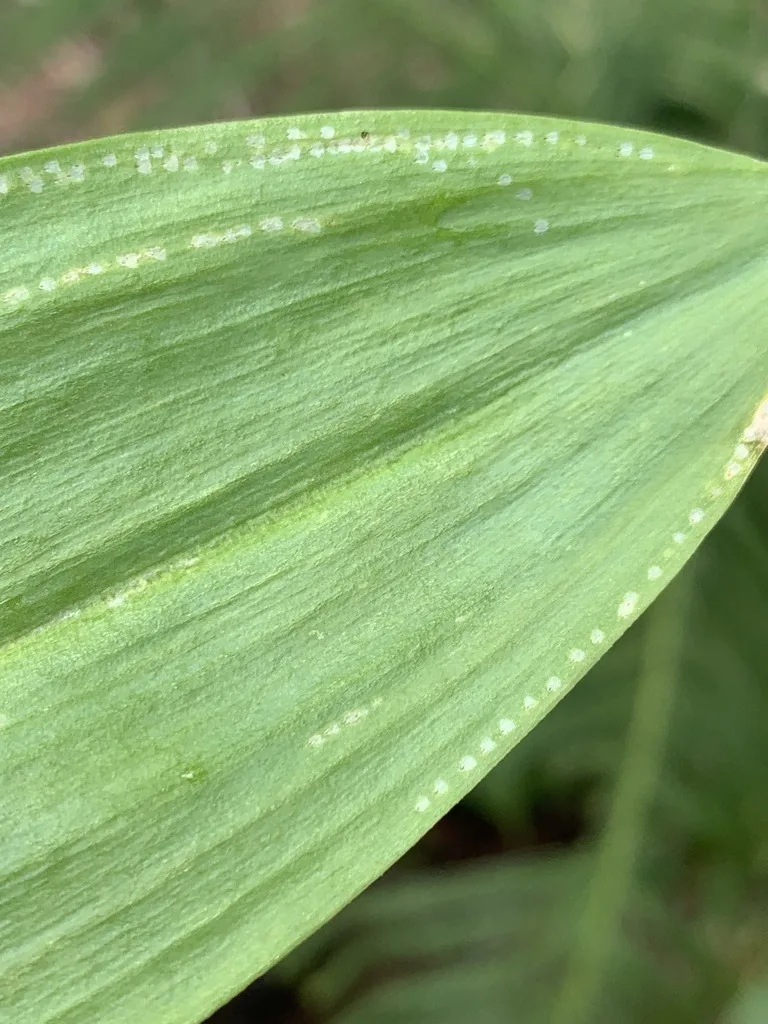
- The first sign is a straight line of round white dots on allium leaves, where females punctured them to feed and lay eggs.[2]
- Adults are small gray and black flies, about 1/10 to 1/8 inch long, with a yellow to orange head; they fold their wings flat over the back and often sit at leaf tips in the morning.[2][3][4]
- Larvae are cream to yellow, legless maggots up to about 1/3 inch long, and the pupae are reddish brown. The adult fly is only about 1/10 inch long.[3][4]
Look-alikes
| Look-alike | How to tell them apart |
|---|---|
| Leek moth | Leek moth larvae are yellow-green caterpillars with legs and a distinct head. Allium leafminer larvae are legless maggots with no distinct head.[3] |
| Seedcorn maggot | Seedcorn maggots are usually found at the base of the plant, while allium leafminer larvae are generally in the upper parts.[3] |
Where it lives
Native to Europe, it was first found in the Western Hemisphere in Lancaster County, Pennsylvania, in 2015. Lists of where it has spread differ: CFIA names Pennsylvania, New Jersey, New York, Maryland, Delaware and Massachusetts; Ontario's agriculture ministry adds Connecticut (2020), Virginia (2021) and North Carolina (2023); and NC State Extension also lists Washington, D.C. In Canada it was confirmed in Niagara, Ontario, in 2025 and in Perth, Ontario, in 2026.[1][5][3][4]
Biology and life cycle
There are two generations a year: Penn State says adults fly for 4 to 5 weeks in spring and again in fall, and Oregon's Department of Agriculture expects the spring flight around March to May and the fall flight around September to October.[2][12]
Fall populations overwinter as pupae in plant tissue or nearby soil, and summer pupae rest until fall.[2][5][12]
Wild onions and green onions or leeks are good places to check for its leaf punctures.[1][2]
Hosts include onions, leeks, garlic, chives, shallots, scallions, ramps, ornamental alliums and wild onions and garlic.[4][6][5]
A Mid-Atlantic study found the spring flight lasts about five weeks and that checking wild alliums is the best way to catch its start.[7]
NC State says the flies are weak fliers and that the pest spreads mainly by people moving infested garlic and other alliums.[4]
Damage and signs
- Larvae mine down the leaves toward the base and into the bulb, twisting and stunting plants. The wounds let rot fungi and bacteria in, and pupae can end up inside garlic wrapper leaves.[1][4][8]
- Leeks and chives suffer most. Ontario's agriculture ministry says losses of up to 100% have been reported, mainly in leeks, and NC State says some New York organic growers have stopped growing fall leeks and scallions.[3][4]
Health risk
It feeds on onions, garlic and other alliums, and no cited source describes any risk to people or pets.[1][4][3]
Control
Prevention
Plant garlic as late in fall as possible, around November 1 in southeastern Pennsylvania, so plants are too small for fall egg laying.[1]
Keep them out
Cover alliums with fine insect netting or floating row cover before flies emerge, sealed to the ground and kept on through the whole egg-laying period; Penn State says 4 to 6 weeks in spring, or until the first hard freeze in fall. Don't cover a bed where pupae may be overwintering. In a Cornell study, row covers or netting over reflective mulch cut larvae and pupae by 76% compared with no barrier, while reflective mulch alone cut them by 40%, which Ontario's ministry says does not keep injury below economic thresholds.[2][4][3][9]
Sanitation
Rotate alliums as far as possible from last year's infested beds, since the flies are weak fliers. Bury or destroy crop debris, and don't bring in garlic or other alliums from infested areas, which NC State says is the main way the pest spreads.[4][3]
Pesticides
Control is only needed during and just after adult flight. Penn State lists foliar sprays of Scorpion or Venom (dinotefuran), Exirel (cyantraniliprole) and Radiant (spinetoram) as the most effective, and in Cornell and Penn State trials these cut damage 84 to 89%; the same products did not work when applied through drip irrigation. For organic plantings Penn State lists two sprays of Entrust (spinosad) mixed with soap. Always follow the product label.[2][8]
Regulation
USDA APHIS lists allium leafminer as a pest regulated under Federally Recognized State Managed Phytosanitary (FRSMP) programs in California, Idaho, Oregon and Texas, and records the pest as not present in any of those four states.[11]
Oregon's Department of Agriculture says USDA has deregulated the pest, so there are no federal restrictions on moving it. Oregon has its own quarantine that prohibits importing untreated host material from infested states, and the department says states without an FRSMP program are not protected.[12]
Ontario's agriculture ministry says the pest can't be eradicated once established, because wild alliums keep it going. In Canada it is a regulated pest, which limits moving host plants out of infested areas, and suspected finds should be reported to CFIA.[3][5]
Where the sources disagree
Where it has spread: CFIA lists Pennsylvania (2015), New Jersey (2016), New York and Maryland (2017), and Delaware and Massachusetts (2019). Ontario's ministry adds Connecticut (2020), Virginia (2021) and North Carolina (2023), and NC State also lists Washington, D.C.[5][3][4]
FRSMP status: Oregon's Department of Agriculture says Idaho, Oregon and Texas have temporary FRSMP programs and California has an active one; the APHIS list gives all four states without making that distinction.[12][11]
Head color: Penn State describes an orange patch on the head, Ontario's ministry a yellow head, and NC State a mostly yellow to orange head.[2][3][4]
How well covers work: NC State quotes Cornell's Brian Nault as saying covers can give close to 100% control in New York, and Ontario rates exclusion netting very highly, while a Cornell field study measured a 76% reduction compared with no barrier.[4][3][9]
Organic sprays: Penn State says an extra application of pyrethrins plus azadirachtin is also needed after the spinosad sprays, but Cornell and Penn State trials found azadirachtin and pyrethrin never controlled the pest.[2][8]
Garlic planting date: Penn State recommends planting around November 1 in southeastern Pennsylvania, and about two weeks earlier in colder areas; Ontario's ministry suggests planting around the first fall frost.[1][3]
Product names: Penn State names Exirel for cyantraniliprole, while NC State's conventional list names cyantraniliprole as Coragen.[2][4]
Common questions
Sources
- Penn State Extension, “Plant Garlic Late to Avoid Allium Leafminer.” extension.psu.edu/plant-garlic-late-to-avoid-allium-leafminer (accessed 2026-11-13)
- Penn State Extension, “Allium Leafminer Emerging Now in Southeastern PA.” extension.psu.edu/allium-leafminer-emerging-now-in-southeastern-pa (accessed 2026-11-13)
- Ontario Ministry of Agriculture, Food and Agribusiness, “Allium leafminer is confirmed in Ontario (Crop Protection Hub).” cropprotectionhub.omafra.gov.on.ca/en-ca/blog/allium-leafminer-is-confirmed-in-ontario (accessed 2026-11-13)
- NC State Extension, Chatham County Center, “Allium Leafminer (Growing Small Farms, updated Feb. 21, 2026).” growingsmallfarms.ces.ncsu.edu/growingsmallfarms-allium-leafminer/ (accessed 2026-11-13)
- Canadian Food Inspection Agency, “Allium leaf miner.” inspection.canada.ca/node/6909 (accessed 2026-11-13)
- Virginia Cooperative Extension Master Gardener Program, “Allium Leafminer Scouting: Community Engaged Science Project.” mastergardener.ext.vt.edu/allium-leafminer/ (accessed 2026-11-13)
- Environ Entomol 2021;50(4):878-887, via PubMed, “Phenology and degree-day model of allium leafminer in the Mid-Atlantic and Northeastern United States (Lingbeek et al., 2021).” pubmed.ncbi.nlm.nih.gov/34043759/ (accessed 2026-11-13)
- J Econ Entomol 2020;113(5):2300-2309, via PubMed, “Managing allium leafminer (Diptera: Agromyzidae) in onion and leek (Nault et al., 2020).” pubmed.ncbi.nlm.nih.gov/32533179/ (accessed 2026-11-13)
- J Econ Entomol 2024;117(1):259-267, via PubMed, “Evaluation of reflective mulch and insect exclusion coverings for allium leafminer (Diptera: Agromyzidae) management in allium crops (Lai et al., 2024).” pubmed.ncbi.nlm.nih.gov/38142131/ (accessed 2026-11-13)
- Global Biodiversity Information Facility (GBIF), “Phytomyza gymnostoma Loew, 1858 (GBIF Backbone Taxonomy).” api.gbif.org/v1/species/1554694 (accessed 2026-11-13)
- USDA Animal and Plant Health Inspection Service, “Pests Regulated under a Federally Recognized State Managed Phytosanitary Program (FRSMP).” www.aphis.usda.gov/frsmp/pests-regulated-under-frsmp (accessed 2026-11-13)
- Oregon Department of Agriculture, “Quarantine Pest Alert: Allium or onion leafminer, Phytomyza gymnostoma.” oregon.gov/oda/Documents/Publications/IPPM/AlliumLeafminerPestAlert.pdf (accessed 2026-11-13)