On this page
How to identify it
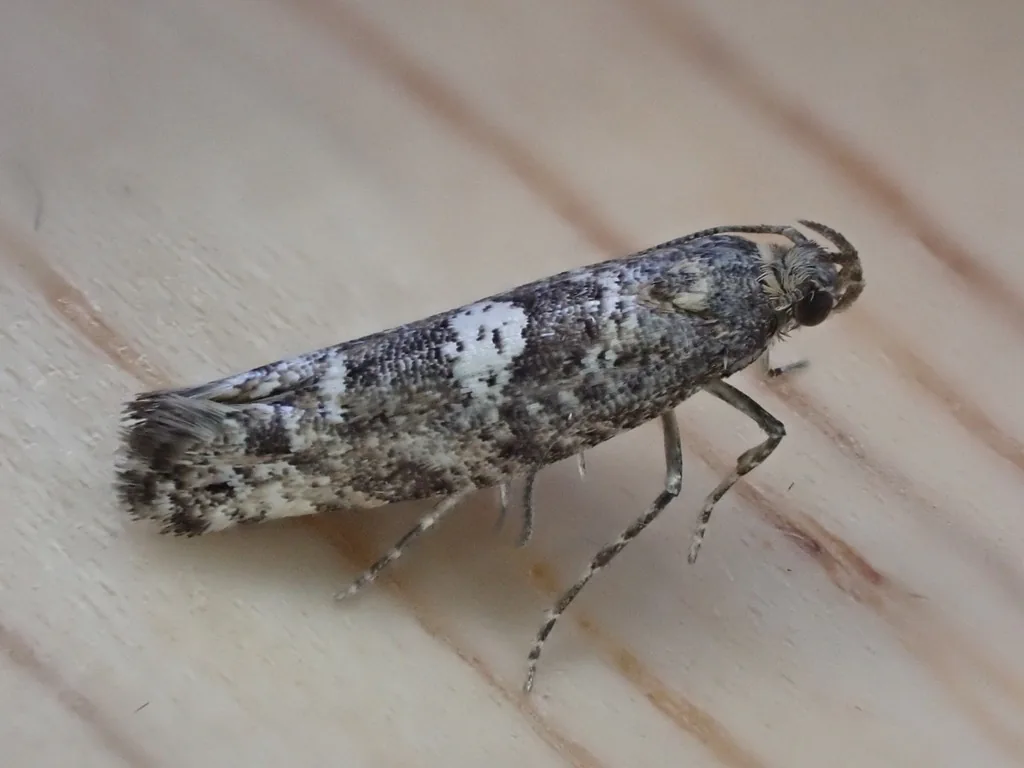
- Adults are about 3/8 inch (10 mm) long, brown speckled with white and black, with a distinct white triangle halfway down the wings that sits in the middle of the back when the moth is at rest.[2][3]
- Larvae are slender, creamy yellow caterpillars with a brown head and eight small gray spots on each abdominal segment, about 1/2 inch (13 mm) long when grown; male larvae also show an orange spot on the back.[2]
- Damage shows as windowpane patches where larvae eat leaf tissue but leave the outer skin. In onions, chives and shallots they tunnel inside the hollow leaves, so split damaged leaves to find larvae, frass and debris, which stay behind after the larvae leave.[2][3]
- Eggs are white, iridescent and only about 1/64 inch (0.4 mm) long, so they are very hard to see. Pupae are reddish brown inside a tan, net-like cocoon, usually on the stem or leaves of the host.[2]
Where it lives
UVM Extension lists it in Europe, Russia, Japan, Algeria, Ontario and Quebec. In the United States it was first confirmed in Plattsburgh, New York, in 2009 and in St. Lawrence County, New York, in 2010; it has since been reported in Vermont, New Hampshire and Maine, where UMaine Extension first found larvae on garlic in Jackman in 2017. CDFA says it has never been found in California.[1][2][3][4]
Biology and life cycle
Adults overwinter in crop residue and become active when spring temperatures reach about 50 °F. They typically live about 23 days and start mating within a day, and each female lays about 100 to 200 eggs; see where the sources disagree on how long egg-laying lasts.[2][3]
Eggs hatch after about 7 days, larvae feed for 11 to 23 days, and adults emerge about 12 days after the larvae spin their cocoons. Damage first shows in June and, in later generations, through September.[2]
UMaine Extension reports three generations a year in Maine, each taking 30 to 50 days, with damage building as the season goes on; see where the sources disagree on generations.[3]
Damage and signs
- Leeks are by far the most susceptible, and feeding can cut leek yields significantly. Damage rarely kills plants; for garlic and onions, which are grown for their bulbs, the main concern is larvae carried into curing and storage, where they damage the bulbs.[2]
- In Maine, garlic damage was mostly on the scapes as they emerged, causing them to collapse, while onion damage was more extensive.[3]
Health risk
CDFA says it feeds only on plants in the onion genus (Allium). UVM Extension, UMaine Extension and CDFA describe crop damage only and don't mention any risk to people or pets.[4][2][3]
Control
Keep them out
On smaller plots, row cover or insect netting keeps egg-laying moths off. The moths fly only at night, so covers can come off by day for weeding and scape removal; onions need wire hoops so wind-flapped cover doesn't damage their tops.[2][3]
Sanitation
Before curing garlic and onions, remove as much foliage as possible so larvae stay in the field instead of reaching the bulbs; UVM says research found this topping doesn't affect bulb quality or shelf life.[2]
Biological control
UVM reports research showing that timely releases of the parasitoid wasp Trichogramma brassicae can significantly reduce leek moth damage in leeks and other alliums.[2]
Pesticides
UVM says sprays suit larger plantings and work best 7 to 10 days after peak moth flights, which can be tracked with pheromone-baited traps. UMaine Extension says Bacillus thuringiensis (Bt) is used in other states and that timing is very important.[2][3]
Regulatory status
The California Department of Food and Agriculture's pest rating profile gives leek moth an A rating, after scoring its likely harm to California's garlic and onion crops and to home gardens as high. The review was prompted by a July 2018 USDA New Pest Advisory Group report proposing to make leek moth non-actionable within the continental United States.[4]
CDFA notes that leek moth spreads long distances when eggs, larvae or pupae are moved on plants or harvested plant parts, and that 14 countries, including Mexico, Japan and the Republic of Korea, list it as a harmful organism.[4]
Where the sources disagree
Origin: UVM Extension says leek moth is native to Europe, UVM's 2022 fact sheet says England, and CDFA says it is presumably native to Eurasia.[1][2][4]
Generations: UMaine Extension reports three a year in Maine; CDFA says populations can complete as many as eight a year, depending on climate.[3][4]
Egg-laying: UVM's fact sheet says 100 to 200 eggs over up to 28 days, UMaine Extension says 100 to 200 per generation over about two weeks, and CDFA gives an average of 100 eggs per female.[2][3][4]
Common questions
- What is making windowpane holes in my leek and garlic leaves?
- In the Northeast, windowpane patches with small caterpillars, frass and debris inside the leaves point to leek moth.[2][3]
- How do I protect garlic and leeks from leek moth?
- Cover them with row cover or insect netting so the night-flying moths can't lay eggs on them, and strip foliage from garlic and onions before curing.[3][2]
Sources
- University of Vermont Extension, “Leek Moth Host Plants and Distribution.” www.uvm.edu/extension/leek-moth-host-plants-and-distribution (accessed 2026-11-13)
- University of Vermont Extension and Cornell Cooperative Extension, “Leek Moth (fact sheet, 2022; UVM Extension and Cornell, SARE-funded).” projects.sare.org/wp-content/uploads/2022-Leek-Moth-Fact-Sheet-op.pdf (accessed 2026-11-13)
- Maine Organic Farmers and Gardeners Association, “Leek Moth (D. Fuller, UMaine Cooperative Extension, Franklin County; Maine Organic Farmer & Gardener, Winter 2017-2018).” www.mofga.org/resources/pest-control/leek-moth/ (accessed 2026-11-13)
- California Department of Food and Agriculture, Plant Health, “California Pest Rating for Leek Moth, Acrolepiopsis assectella (Zeller) (pest rating profile; rating A).” blogs.cdfa.ca.gov/Section3162/?p=5801 (accessed 2026-11-13)
- Global Biodiversity Information Facility (GBIF), “Acrolepiopsis assectella (Zeller, 1839), listed by GBIF as a synonym of Acrolepia assectella (GBIF Backbone Taxonomy).” api.gbif.org/v1/species/4525339 (accessed 2026-11-13)
- iNaturalist, “Acrolepiopsis assectella taxon page (order and family).” www.inaturalist.org/taxa/317685 (accessed 2026-10-06)