On this page
How to identify it
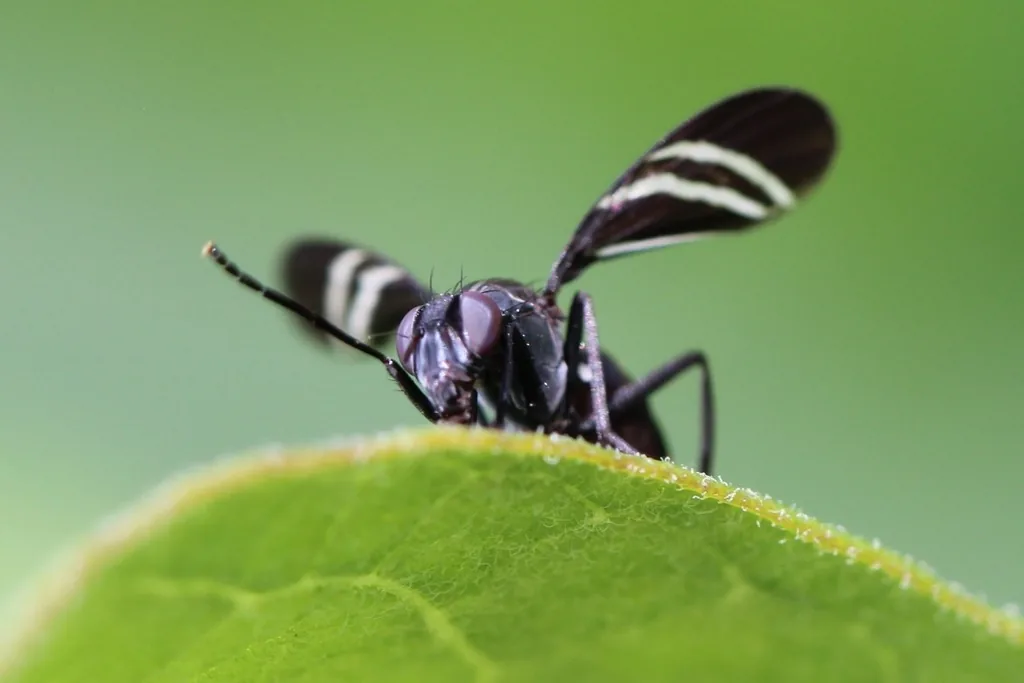
- Adults are medium-sized black flies, 1/4 to 3/8 inch long, about the size of a house fly.[1]
- Each dark wing has three white crossbands; the inner band is small and straight.[1]
- A 2021 revision of the genus describes it as entirely dark brown to black, with broad dark-brown wings crossed by a narrow, arched clear band near the tip.[2]
- It belongs to the picture-winged flies, a family of about 130 North American species named for their spotted or banded wings.[3][1]
- Seven Tritoxa species are now recognized in North America. Wing patterns separate them all, but telling some species that share a range apart with confidence requires examining the male genitalia.[2]
- Fun fact: picture-winged flies use their patterned wings like semaphore flags during courtship.[4]
- The maggots look like house fly maggots and can be told apart only by their host plant and microscopic features.[1]
- Adults turn up in landscapes, fields and meadows.[1]
Look-alikes
| Look-alike | How to tell them apart |
|---|---|
| Other picture-winged flies | Other picture-winged flies also have patterned wings, but most breed in decaying plant matter such as compost. The black onion fly is black with three white crossbands on each dark wing and breeds in onions and their close relatives.[1][3] |
| House fly maggots | Black onion fly maggots look like house fly maggots, but they are found feeding inside allium bulbs.[1] |
Where it lives
A native fly of eastern North America. The 2021 Zootaxa revision maps it from southeastern Saskatchewan and southern Manitoba south to Mississippi, with photo records from Alabama, North and South Carolina and Massachusetts; in eastern Canada it is known only from Manitoulin and Pelee Islands in Ontario. UW-Milwaukee describes its present range as Iowa and Minnesota to New England and the near South. In 1927 Chittenden noted it had drawn attention as a pest only in Ohio, Illinois, Indiana, Pennsylvania, Wisconsin and Minnesota.[2][4][5]
Biology and life cycle
Females lay tiny, narrow, cylindrical eggs, singly or in groups, under a leaf sheath, and the maggots feed on the bulb.[1]
Third-stage maggots spend the winter inside the infested bulb, then pupate in the soil around its base in spring. Adults emerge 5 to 17 days later.[1]
In North Carolina, adults have been collected in May, July and September and maggots in February, March, April and August, so ornamental alliums can be infested almost anytime during the growing season. See where the sources disagree on the number of generations.[1][2]
Adults probably sip flower nectar.[1]
Only one parasitoid is known to attack it, Tachinaephagus zealandicus.[2]
A close relative, Tritoxa incurva, breeds in wild garlic and can also develop in commercial onions; where the two species overlap, they may compete for wild garlic in September.[2]
Damage and signs
- Its main host is the commercial onion, and the larvae may also feed on wild garlic. NC State lists onions, garlic and other alliums, including ornamental alliums, as its only host plants.[2][1]
- The maggots live in the onion and keep feeding after the onions are harvested.[4]
- By the time maggots are found damaging an ornamental allium, it is too late to save that plant.[1]
- It has been recognized as an onion pest since at least the mid-1800s; see where the sources disagree on the earliest record.[5][2][4]
- UW-Milwaukee notes that older sources called it a common agricultural pest and an enemy of onions; see where the sources disagree on how serious it is today.[4]
- History: the 1912 Yearbook of Agriculture advised fumigating stored onions with carbon bisulfide, a gas that a 1916 University of Illinois bulletin warned is very explosive when mixed with air.[4]
Health risk
NC State describes it only as a pest of onions and other alliums and doesn't mention any risk to people or pets.[1]
Control
Sanitation
Step 1, check the bulbs: by the time maggots are found in an ornamental allium, it is too late to save that plant, so focus on protecting the rest of the bed and future plantings.[1]
Pesticides
Step 2, repel adults: NC State suggests spraying the foliage of the remaining plants with a pyrethroid insecticide to repel adults before they lay eggs. All pyrethroid active ingredients end in "-thrin," listed on the front of the label. Pyrethroids are hazardous to fish, so keep them away from pools, ponds and streams.[1]
Step 3, a drench for a bed: if a few plants in a bed are infested, the bed can be drenched with imidacloprid, a systemic insecticide.[1]
Pyrethrum, an extract of the pyrethrum daisy, repels and kills flies but lasts only a very short time after it is applied.[1]
Where the sources disagree
Generations: NC State reports at least three generations a year in North Carolina, with third-stage maggots overwintering in the bulb; the 2021 Zootaxa revision, citing a 1977 study, gives two and a partial third generations a year, with larvae and pupae overwintering.[1][2]
First records as a pest: Chittenden (1927) and the 2021 revision date the first reports of onion injury to 1865; UW-Milwaukee says American agricultural writings mention it as an onion competitor as early as 1830.[5][2][4]
Range: the 2021 revision maps it from southeastern Saskatchewan and southern Manitoba to Mississippi; UW-Milwaukee describes its present range as Iowa and Minnesota to New England and the near South; Chittenden (1927) said it had drawn attention as a pest only in Ohio, Illinois, Indiana, Pennsylvania, Wisconsin and Minnesota.[2][4][5]
How serious a pest: the 2021 revision says it breeds in commercial onions and causes economic damage; NC State calls it a minor pest of commercial onions, and UW-Milwaukee says more recent sources call it an occasional pest.[2][1][4]
Common questions
- What are the black flies with white-banded wings around my onions?
- They may be black onion flies: black, house-fly-sized picture-winged flies with three white bands on each dark wing, whose maggots feed in the bulbs of onions, garlic and ornamental alliums.[1]
- Can I save an allium that has black onion fly maggots?
- No. NC State notes that by the time the maggots are found, it is too late for that plant, so protect the rest of the bed and future plantings instead.[1]
- Does the black onion fly attack garlic?
- Yes. NC State lists garlic among its hosts, and the 2021 Zootaxa revision says the larvae may feed on wild garlic, though commercial onion is the main host.[1][2]
- How many generations does it have a year?
- Sources differ: at least three in North Carolina, according to NC State; the 2021 revision cites two and a partial third generations a year.[1][2]
Sources
- NC State Extension, “Black Onion Fly (PDIC factsheet, J. Baker; reviewed May 8, 2025).” content.ces.ncsu.edu/black-onion-fly (accessed 2026-11-13)
- Zootaxa 4920(3), 2021 (Sinclair, Macleod & Wheeler), “Revision of the Nearctic genus Tritoxa Loew (Diptera: Ulidiidae).” doi.org/10.11646/zootaxa.4920.3.3 (accessed 2026-11-13). PMID 33756655
- Missouri Department of Conservation, “Picture-Winged Flies (Field Guide).” mdc.mo.gov/discover-nature/field-guide/picture-winged-flies (accessed 2026-11-13)
- University of Wisconsin-Milwaukee Field Station, “Bugs Without Bios VII (Bug of the Week: black onion fly).” uwm.edu/field-station/bug-of-the-week/bugs-without-bios-vii/ (accessed 2026-11-13)
- Entomological Society of Canada / Cambridge University Press, “Tritoxa flexa Wied., the Black Onion Fly (Ortalidae, Dipt.) (F. H. Chittenden, The Canadian Entomologist 59(1): 1-4, 1927; extract).” www.cambridge.org/core/journals/canadian-entomologist/article/tritoxa-flexa-wied-the-black-onion-fly-ortalidae-dipt/D06CEB9B1BA665CBC0CC1462202A2909 (accessed 2026-11-13)
- Global Biodiversity Information Facility (GBIF), “Tritoxa flexa (Wiedemann, 1830) (GBIF Backbone Taxonomy).” api.gbif.org/v1/species/1523474 (accessed 2026-11-13)
- iNaturalist, “Tritoxa flexa taxon page (order and family).” www.inaturalist.org/taxa/325644 (accessed 2026-11-08)