On this page
How to identify it
- Larvae are small, legless, white to pale yellow maggots with no visible head, tapered toward the head end and blunt at the rear. Size estimates vary: UC IPM gives less than 0.33 inch when grown, Minnesota and Iowa State about ¼ inch. UF/IFAS gives fully grown maggots as 1/5 to 1/4 inch, dirty white with a yellow tint, with two black mouth hooks and two brown to black breathing spots (spiracles) at the blunt rear end.[1][3][2][4]
- Iowa State notes a black mouth with hook-like mouthparts.[2]
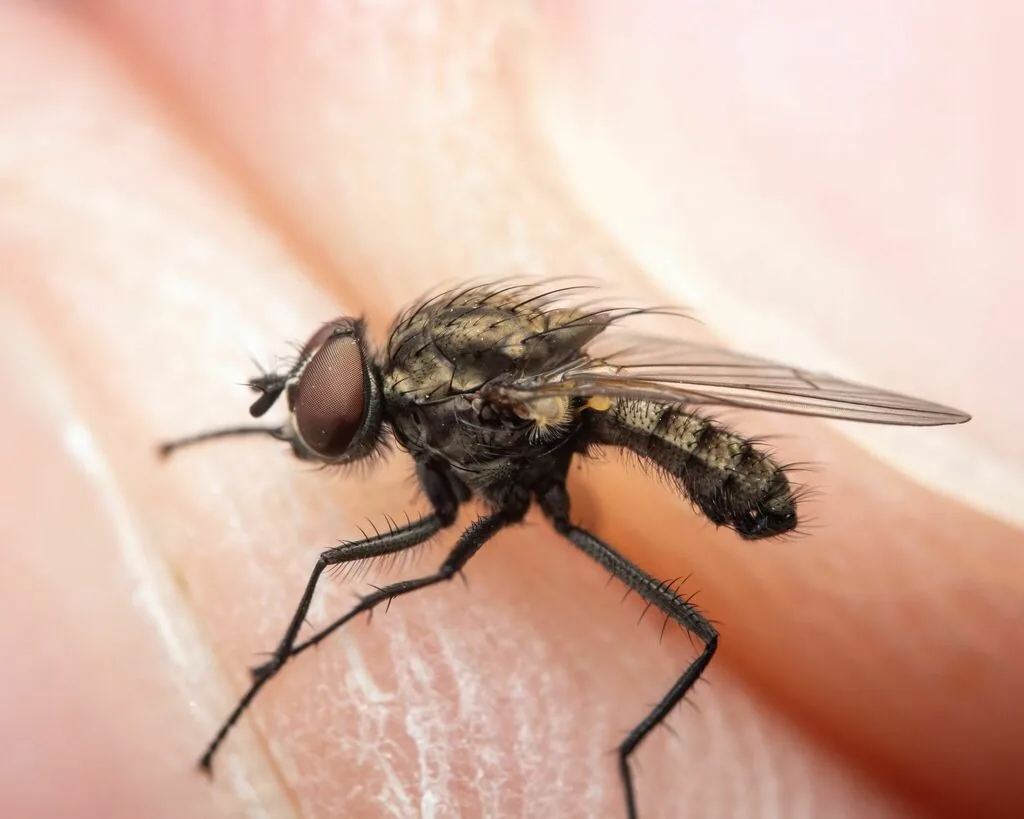
- Adults are gray flies that look like a small, slender house fly. UC IPM says about half the size of a house fly; Iowa State gives 1/5 inch, grey to brown, with red eyes. UF/IFAS describes brownish-gray flies with three stripes on the back, about 3/16 to 1/4 inch long, that hold their wings crossed over the abdomen at rest.[1][3][2][4]
- Pupae are brown and egg-shaped, about like a wheat seed, and are found in roots or nearby soil; Minnesota says they start orange and darken to dark brown. UF/IFAS gives the puparia as 3/16 to 1/4 inch, dark brown to black and barrel shaped.[1][2][3][4]
- Eggs are white, elongated and about 1/16 inch long, laid in loose groups among debris and around plant stems near the soil surface.[4]
Look-alikes
| Look-alike | How to tell them apart |
|---|---|
| House fly | Seedcorn maggot adults look like house flies but are only about half their size.[1][3] |
| Cabbage maggot | A related Delia fly whose maggots are limited to cabbage-family crops, while the seedcorn maggot attacks a wide range of seeds.[3] |
| Bean seed maggot | Delia florilega is so similar in its immature stages that the two can only be told apart reliably with DNA tests.[5] |
| Onion maggot | UF/IFAS says the seedcorn maggot fly is nearly identical to the onion maggot and cabbage maggot flies but becomes active earlier in the season.[4] |
Where it lives
Minnesota Extension says it occurs worldwide. In most California growing areas the maggots are active all year, while in Minnesota and Iowa it overwinters in the soil and flies in spring. UF/IFAS calls it the most widespread fly in its family, found on every continent except Antarctica; first reported in Germany, it is now well established throughout the United States, including Alaska and Hawaii, and in southern Canada.[3][1][2][4]
Biology and life cycle
In the Midwest it overwinters as a pupa in the soil, and adults emerge in April and May.[3][2]
Females lay eggs in moist soil, in stems at the soil line or in soil cracks near plants. They are drawn to freshly tilled fields and to soil with decaying organic matter, such as manure, cover crops or weeds that were just worked in.[1][3][2][6]
Eggs hatch in a few days (2 to 4 days in Iowa) and the maggots burrow into germinating seeds or roots. Iowa State says they feed for 2 to 3 weeks and pupate in the soil for 7 to 14 days, so the whole cycle can take as little as 21 days.[1][2]
Generation counts vary with climate: at least two in Minnesota, 4 to 5 in Iowa, and several in California.[3][2][1]
Development starts above about 39°F, and Iowa State gives an upper threshold of 84°F. Degree-day models from Minnesota, Iowa and New York are used to time fly flights.[3][2][7]
Flies mate within two to three days of emerging. UF/IFAS says each female lays an average of 270 eggs in soil rich in decaying organic matter or on seeds and seedlings in moist soil, and eggs hatch in two to four days at temperatures as low as 50°F.[4]
Egg to adult takes three to four weeks. Larvae can develop from 52°F to 92°F, while many adult flies die when temperatures go above 84°F.[4]
In northern areas adults are very numerous in spring and fall off sharply by midsummer; in the southern United States they are common in fall, early winter and spring but scarce in midsummer. In central Iowa, spring emergence peaked in early June and flies disappeared from late July until the next spring.[4]
Damage and signs
- Maggots kill germinating seeds and very small seedlings, often by hollowing out the seed and eating the embryo. Surviving seedlings are often weak, and the feeding can let in damping-off infections.[1][2]
- Hosts include corn, soybean, beans, melons and other large-seeded crops, plus onions and canola. In soybeans and beans the maggots tunnel into the seed leaves and stem, and damaged plants may grow two tops.[3]
- Damage is worse when emergence is slow. Once seedlings have a few leaves, economic damage is unlikely.[3][1][2]
- UF/IFAS says usually no more than 2% of seedlings are infested, yet field plant losses of 30% to 60% can occur, and stand loss shows up within a week after plants emerge. Seedlings that do come up are often spindly, with few leaves, and die before maturing.[4]
- UF/IFAS counts more than 40 host plants, including soybeans, corn, beans, peas, cucumber, melon, onion, pepper and potato. On alfalfa, cotton, strawberry, tobacco and wheat it is often a secondary pest, following damage from other insects or diseases.[4]
- Conservation tillage hasn't increased injury. Live green plant matter or manure worked into the soil in spring attracts egg-laying flies, but damage potential is minimal in no-till fields, because germinating seeds alone don't draw many flies.[4]
Health risk
The maggots attack seeds and seedlings. UC IPM, Minnesota and Iowa State describe it only as a crop pest; none of them mentions bites or any effect on people or pets.[1][3][2]
Control
Prevention
Plant when soil conditions promote fast germination, or use transplants or pregerminated seed. Avoid planting during peak fly activity in spring.[1][3][2]
In a Pennsylvania organic study, delaying corn planting by 1 to 2 weeks reduced fly emergence, and about 15 times more flies came from corn where cover crops were tilled in than where they were rolled down and planted no-till.[6]
Other preventive steps UF/IFAS lists include shallow planting, higher seeding rates, a well-prepared seedbed, aging manure and mixing it thoroughly into the soil before planting, and removing nearby flowering weeds and sweet-smelling attractants, though that also takes nectar away from beneficial insects.[4]
Keep them out
Cover seedbeds with fabric or cover individual plants so flies can't lay eggs nearby.[1]
Sanitation
Avoid heavy manure applications and work in weeds or cover crops well ahead of planting: UC IPM says at least two weeks, and Minnesota says waiting 2.5 weeks or more lets the maggots reach the harmless pupal stage.[1][3]
Biological control
Ground beetles, predatory nematodes and fungal diseases attack seedcorn maggots; small dead flies stuck to tall plants are often adults killed by a fungus.[3]
Pesticides
There are no rescue treatments once seeds are attacked. Minnesota Extension does not recommend insurance insecticide treatments on farms because damaging infestations are sporadic, and suggests treated seed for high-risk fields. Iowa State says insecticidal seed treatments can manage the maggots unless densities are high, and in-furrow insecticides may be an option where fields have a history of infestation. Replanting is an option after significant stand loss.[3][2]
Where the sources disagree
Larva and adult size: UC IPM says larvae are less than 0.33 inch and adults about half the size of a house fly; Minnesota says under 1/4 inch for both; Iowa State says 1/4-inch larvae and 1/5-inch adults; UF/IFAS gives 1/5 to 1/4 inch for grown larvae and 3/16 to 1/4 inch for adults.[1][3][2][4]
Generations: at least two in Minnesota, 4 to 5 in Iowa, and several in California, where UC IPM says maggots are active throughout the year in most growing areas; UF/IFAS says up to five a year, but only three have been reported in Spain.[3][2][1][4]
Spring emergence: Minnesota says half the overwintering flies emerge at 371 degree-days (39°F base, 2-inch soil temperature); Iowa State puts peak first-generation emergence at 360 degree-days from January 1; a New York study found first emergence at an average of 471 degree-days in 2022 and 68 in 2023.[3][2][7]
Wait after working in residue or manure: UC IPM says disc weeds at least 2 weeks before planting; Iowa State says two weeks or 450 growing degree-days; Minnesota says 2.5 weeks or more.[1][2][3]
Natural enemies: Minnesota says ground beetles, predatory nematodes and fungal diseases attack seedcorn maggots, while UF/IFAS says that because most of its life is spent underground few natural enemies are reported, and that the spiders, ants, birds and fungi seen attacking it aren't considered significant in control.[3][4]
Common questions
- Why didn't my bean seeds come up?
- In cool, wet weather, seedcorn maggots may have hollowed out the germinating seeds. Dig up a few seeds and look for small white maggots or brown, seed-like pupae.[1][2]
- Do I need to treat established plants?
- Usually not. Once seedlings have a few leaves, the maggots are unlikely to do economic damage, and there is no rescue treatment anyway.[1][3]
- Does manure make seedcorn maggots worse?
- Yes. Females prefer rich soil and decaying organic matter, so fields or beds with heavy manure or freshly worked-in plant residue are at higher risk.[1][3][2]
Sources
- University of California Statewide IPM Program, “Seedcorn Maggot (Pests in Gardens and Landscapes).” ipm.ucanr.edu/PMG/GARDEN/VEGES/PESTS/seedcornmaggot.html (accessed 2026-11-13)
- Iowa State University Extension and Outreach, “Seedcorn Maggot (Integrated Crop Management encyclopedia).” crops.extension.iastate.edu/encyclopedia/seedcorn-maggot (accessed 2026-11-13)
- University of Minnesota Extension, “Seedcorn maggot (Corn pest management).” extension.umn.edu/corn-pest-management/seedcorn-maggot (accessed 2026-11-13)
- University of Florida IFAS Extension (EDIS), “Seedcorn maggot, Delia platura (Meigen), EENY 566/IN1002 (H. Gill, G. Goyal and J. Gillett-Kaufman; Featured Creatures).” ask.ifas.ufl.edu/publication/IN1002 (accessed 2026-11-14)
- Journal of Economic Entomology, via PubMed, “Van der Heyden H, Fortier AM, Savage J (2020), A HRM assay for rapid identification of members of the seedcorn maggot complex (Delia florilega and D. platura), Journal of Economic Entomology 113(6):2920-2930.” pubmed.ncbi.nlm.nih.gov/33080027/ (accessed 2026-11-13). Cited from the PubMed abstract.
- Journal of Economic Entomology, via PubMed, “Regan KH, Voortman CA, Barbercheck ME (2024), Seedcorn maggot response to planting date, cover crops, and tillage in organic cropping systems, Journal of Economic Entomology 117(2):555-563.” pubmed.ncbi.nlm.nih.gov/38381578/ (accessed 2026-11-13). Cited from the PubMed abstract.
- Journal of Economic Entomology, via PubMed, “Olaya-Arenas P et al. (2024), Degree-day models for predicting adult Delia platura spring flight and first emergence in New York State, Journal of Economic Entomology 117(5):2181-2185.” pubmed.ncbi.nlm.nih.gov/39024035/ (accessed 2026-11-13). Cited from the PubMed abstract.
- Global Biodiversity Information Facility (GBIF), “Delia platura (Meigen, 1826) (GBIF Backbone Taxonomy).” api.gbif.org/v1/species/5077529 (accessed 2026-11-13)
- iNaturalist, “Delia platura taxon page (order and family).” www.inaturalist.org/taxa/243756 (accessed 2026-11-11)