On this page
How to identify it
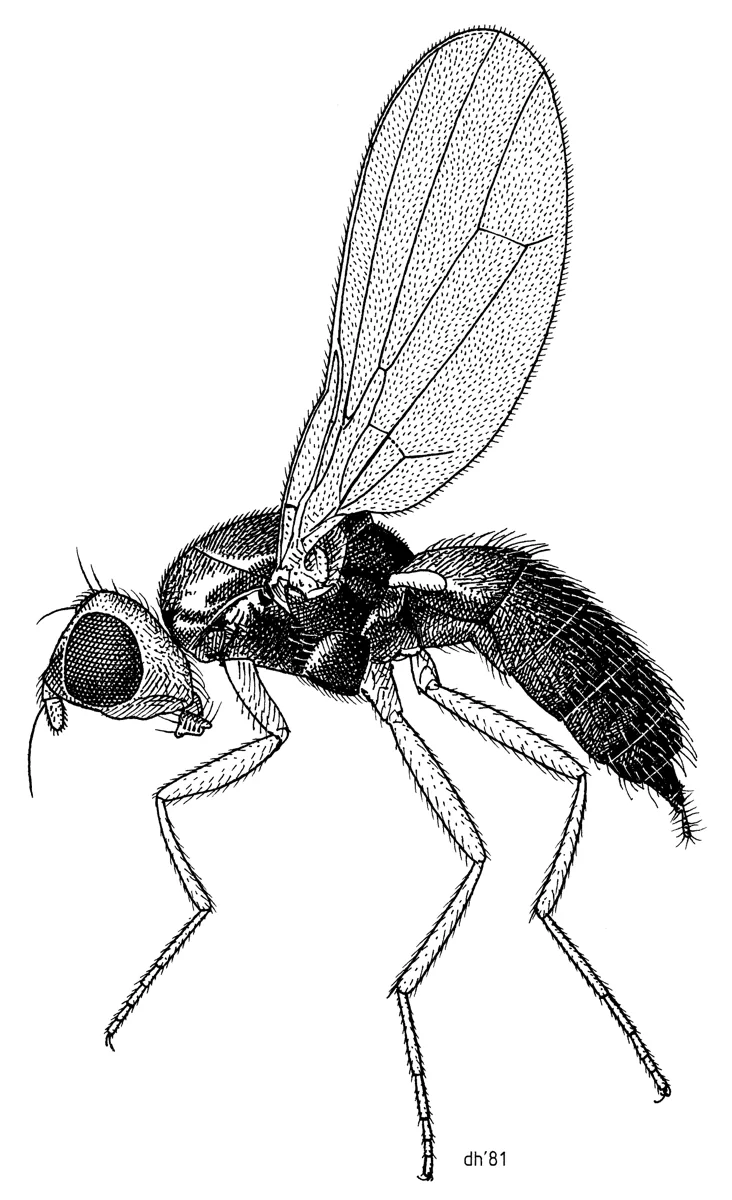
- Adults are small, slender, shiny black flies with yellowish legs and a reddish-yellow (Utah State) or brownish (PNW) head. PNW says they're about 0.25 inch long with a 0.5-inch wingspan; BC says about 6 mm, with clear wings and a hunchbacked thorax.[2][3][4]
- Larvae are legless, tapered, creamy-white maggots. Sources give different sizes: UC IPM about 0.33 inch, BC 6 to 7 mm, and PNW 0.12 to 0.25 inch for mature larvae, which it calls dusty straw-colored.[1][2][3][4]
- Damage shows as narrow, rusty tunnels in the root, mostly in the lower part: Utah State says the lower third and BC the lower two-thirds. UC IPM says there are no aboveground symptoms.[1][2][4]
Look-alikes
| Look-alike | How to tell them apart |
|---|---|
| Cabbage maggot | Another root-feeding maggot; PNW covers both in its vegetable pest list. The carrot rust fly is the one these sources tie to carrots, parsnips, celery and parsley, though Utah State and PNW also list turnip as a host.[3][2][1] |
| Wireworms | BC says wireworm damage can be confused with carrot rust fly damage, but wireworm holes are larger and deeper and often hollow, while carrot rust fly tunnels are narrow and winding.[4] |
Where it lives
UC IPM, Utah State, PNW and the BC Ministry of Agriculture cover it in California, Utah, the Pacific Northwest and British Columbia, and Utah State calls it sporadic there. A published study calls it an economic pest of carrots in Ontario's Holland Marsh.[1][2][3][4][5]
Biology and life cycle
Sources differ on how it overwinters: BC says as pupae in the soil, PNW says as larvae in roots left in the field, and Utah State says as pupae in the soil or occasionally as larvae in roots.[4][3][2]
PNW says spring adults emerge from mid-April to mid-June and shelter in hedges, eggs are laid at or just below the soil surface at the base of plants, and larvae feed on the roots for about 30 days before pupating in nearby soil. BC says each female lays 30 to 90 eggs and larvae feed for 3 to 4 weeks.[3][4]
Utah State says there are 2 or 3 generations a year, with flies present from May until harvest. BC describes usually three peaks: late April to late May, late July to early August and mid-October; PNW describes spring, mid-July and late September to mid-October broods.[2][4][3]
Damage and signs
- Hosts are carrots, parsnips, celery and parsley. Utah State and PNW also list turnip, and PNW names the related weed hemlock.[1][2][3]
- Larvae can kill young seedlings; more often older roots are scarred, stunted, forked or misshapen, and rot can get in through the wounds. PNW says on parsnips and celery the larvae are more often near the crown and in the bases of the leaf stalks.[2][3][4]
- BC says the second-generation maggots, in August and September, generally cause the most damage.[4]
Health risk
It feeds on plants, and no cited source describes any risk to people or pets. UC IPM says to peel off damaged areas before using carrots.[1]
Control
Prevention
Time plantings to miss egg-laying. UC IPM says to plant in early summer in cold areas and in late winter or late summer in mild areas; BC says plantings after June 1 may avoid first-generation damage and harvesting by early September can avoid the third.[1][4]
Keep them out
Cover seedbeds with row cover, or individual plants with protective cones (UC IPM). BC says properly anchored row covers installed at planting keep flies off the crop, and trap counts show when they can come off.[1][4]
Sanitation
Harvest as soon as possible and in blocks rather than selectively, don't leave carrots in the ground over winter, and remove nearby parsley, celery and related plants. BC adds rotation, saying new carrot plantings need to be at least 1,000 m from the previous year's carrots and other hosts to be effective.[1][2][4]
Biological control
BC suggests minimizing tillage to protect ground beetles and rove beetles, which eat carrot rust fly eggs and larvae. An Ontario study found known natural enemies of carrot rust fly in abundance in commercial carrot fields, with similar ground-beetle diversity in IPM-sprayed and insecticide-free plots.[4][5]
Pesticides
Sprays are timed with yellow sticky traps. Utah State starts monitoring in late April and suggests considering treatment at 2 to 3 adults per trap; BC uses 0.1 to 0.2 flies per trap per day and says sprays aren't needed within a few weeks of harvest. Follow the label.[2][4]
Common questions
- What are the rusty tunnels in my carrots?
- Carrot rust fly larvae, which leave tunnels filled with rusty frass.[1][2][3]
- Can I still eat damaged carrots?
- UC IPM says to peel off the damaged areas before using them.[1]
- How do I keep carrot rust flies away?
- Use row covers, time plantings to miss the egg-laying peaks, harvest promptly and don't leave carrots in the ground over winter.[1][4]
- Is it Psila rosae or Chamaepsila rosae?
- Both names are in use. PNW uses Psila rosae, and GBIF's backbone taxonomy treats Psila rosae Fabricius, 1794 as the accepted name with Chamaepsila rosae as a synonym.[3][6]
Sources
- UC Statewide IPM Program, “Carrot Rust Fly (Home and Landscape).” ipm.ucanr.edu/home-and-landscape/carrot-rust-fly/ (accessed 2026-11-13)
- Utah State University Extension (Integrated Pest Management), “Carrot Rust Fly (vegetable pest fact sheet).” extension.usu.edu/planthealth/ipm/notes_ag/veg-carrot-rust-fly.php (accessed 2026-11-13)
- Pacific Northwest Pest Management Handbooks (Oregon State, Washington State and University of Idaho Extension), “Vegetable crop pests: Carrot rust fly (Pacific Northwest Insect Management Handbook).” pnwhandbooks.org/insect/vegetable/vegetable-pests/common-vegetable/vegetable-crop-carrot-rust-fly (accessed 2026-11-13)
- Government of British Columbia, Ministry of Agriculture and Food, “Carrot Rust Fly: A BC Small-Scale Farmer's IPM Guide (March 2021).” www2.gov.bc.ca/assets/gov/farming-natural-resources-and-industry/agriculture-and-seafood/animal-and-crops/plant-health/disease-factsheets/integrated-pest-management-factsheets/carrot_rust_fly_small_scale_ipm_guide.pdf (accessed 2026-11-13)
- Environmental Entomology (via PubMed), “The Impact of the Carrot Rust Fly and Carrot Weevil Integrated Pest Management Program on the Ground-Dwelling Beetle Complex in Commercial Carrot Fields at the Holland Marsh, Ontario, Canada. Lemay et al. 2018 (abstract).” pubmed.ncbi.nlm.nih.gov/29846540/ (accessed 2026-11-13)
- Global Biodiversity Information Facility (GBIF), “Psila rosae Fabricius, 1794 (GBIF Backbone Taxonomy).” api.gbif.org/v1/species/5713486 (accessed 2026-11-13)