On this page
How to identify it
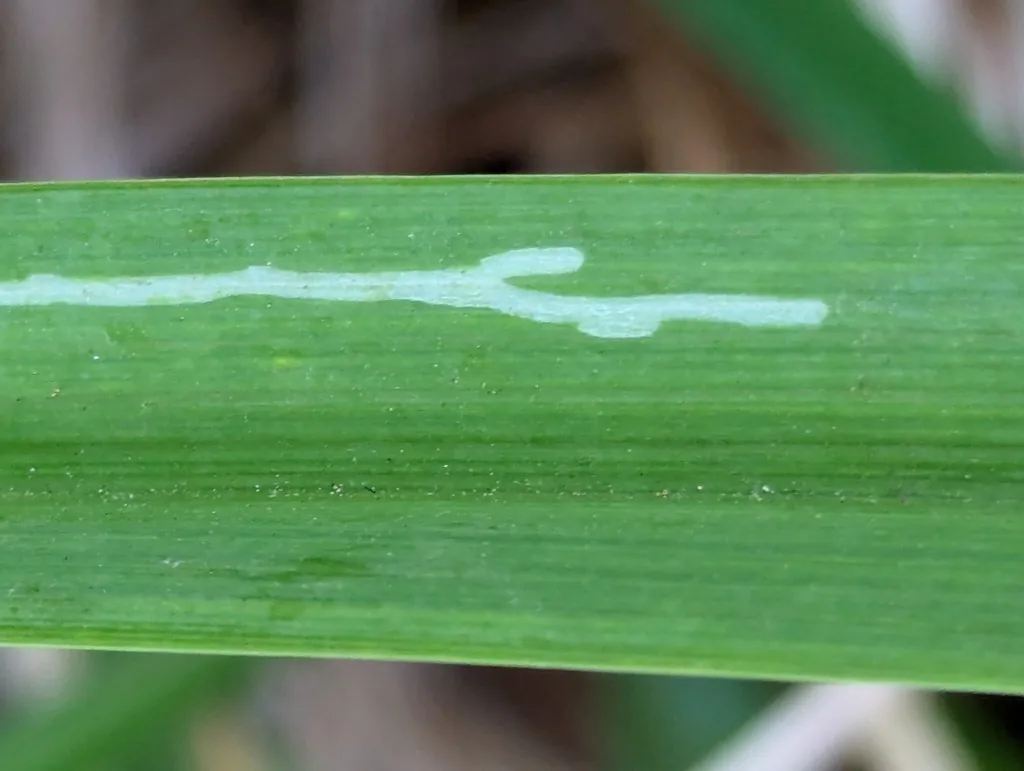
- The first sign is pale lines in the leaves: long, gently winding mines that usually run down the leaf, roughly parallel to the midrib, and show clearly through the leaf surface.[2][1]
- When two or three or more maggots share a leaf, the mines can zigzag, circle or crisscross.[2]
- Inside the mine is a pale yellow maggot up to about 3/16 inch long; with a hand lens you can see a black structure in its head and two black knobs (breathing spiracles) on its thorax. The orange to brown pupae look like tiny seeds inside the mine.[2][1]
- Adults are tiny shiny black flies, about 3/32 inch long, with dark red eyes and clear wings.[2][1]
Where it lives
It is native to Japan and Taiwan. It was first confirmed in North America in 2011 at a nursery in Apopka, Florida, and by 2013 it had been reported from 13 states, mostly along the Gulf and Atlantic coasts; Texas A&M noted it in Texas that year. CDFA says that by 2014 it had also been found in 25 other states, from Maine and New York to Texas, Oklahoma and Illinois, and that it has spread to Europe. NC State calls it a relatively new pest in North Carolina.[1][3][2]
Biology and life cycle
Daylily is the only host plant known.[2]
Females insert their eggs into the lower surface of the leaf, usually one per leaf and usually near the tip. The maggot mines down toward the base of the leaf, where it pupates.[2]
There are at least three generations a year in North Carolina.[2]
Tiny parasitic wasps attack leafminers, and an infestation will probably die away gradually if it isn't sprayed.[2]
CDFA says it can fly short distances and be carried long distances as eggs, larvae or pupae in infested daylilies, and that eggs and young larvae are very hard to find by looking at plants.[3]
Damage and signs
- Mined leaves look unthrifty, may wither, and stay disfigured for the rest of the season, until they are removed or replaced by new growth.[2][1]
- It is mainly a nuisance. The leafminer is not reported to kill daylilies, and except perhaps in extreme infestations it does little harm to the health of the plant.[1][2]
Health risk
It feeds only inside daylily leaves. Texas A&M, NC State and CDFA describe it only as a plant pest and don't mention any risk to people or pets.[1][2][3]
Control
Sanitation
Remove and destroy infested leaves as they appear. Badly mined leaves won't recover their looks anyway.[1][2]
Biological control
Hold off on spraying after the first alarm. Parasitic wasps attack leafminers, and the population will probably die away gradually on its own.[2]
Pesticides
A systemic insecticide such as imidacloprid, applied to the leaves or to the soil under infested plants, can control the maggots, but leaves already damaged won't improve. Watch treated plants afterward, because spider mites can flare up.[2]
Regulatory status
California rates it a B pest. CDFA's rating followed its first interception by CDFA, in 2015, on daylilies shipped from Delaware; at the time no official samples had been collected in California, and CDFA said no state or nation listed it as a harmful organism or had it under official control.[3]
Where the sources disagree
Generations: NC State says there are at least three a year in North Carolina; CDFA says two to three a year in cooler climates and continuous breeding where it is warm.[2][3]
Insecticides: in 2013 Texas A&M said little was known about insecticidal control beyond removing infested leaves; NC State says a systemic insecticide such as imidacloprid can control the maggots, though damaged leaves won't improve.[1][2]
How much it matters: NC State calls it primarily a nuisance that does little harm to plant health except perhaps in extreme infestations; CDFA's rating expects it to significantly affect daylilies as ornamental plants and to lower the value of daylily nursery stock.[2][3]
Common questions
- What are the pale winding lines inside my daylily leaves?
- They are probably daylily leafminer tunnels. A tiny maggot mines down the leaf, roughly parallel to the midrib, and pupates near the base; you may see seed-like pupae inside the mine.[2][1]
- Will daylily leafminers kill my plants?
- No. They are not reported to kill daylilies; the damaged leaves just stay disfigured until they are removed or new growth replaces them.[1][2]
- Do they attack other lilies?
- Daylily is the only host plant known for this leafminer.[2]
Sources
- Texas A&M AgriLife Extension Service, “New pest of lilies in Texas (Insects in the City, May 22, 2013).” citybugs.tamu.edu/2013/05/22/new-pest-of-lilies-in-texas/ (accessed 2026-11-13)
- NC State Extension, “Daylily Leafminer (J. Baker; published December 2018, reviewed September 2023).” content.ces.ncsu.edu/daylily-leafminer (accessed 2026-11-13)
- California Department of Food and Agriculture (Pest Ratings), “California Pest Rating for Ophiomyia kwansonis Sasakawa: Daylily Leafminer (Pest Rating: B).” blogs.cdfa.ca.gov/Section3162/?p=1644 (accessed 2026-11-13)
- Global Biodiversity Information Facility (GBIF), “Ophiomyia kwansonis Sasakawa, 1961 (GBIF Backbone Taxonomy).” api.gbif.org/v1/species/1553230 (accessed 2026-11-13)
- iNaturalist, “Ophiomyia kwansonis taxon page (order and family).” www.inaturalist.org/taxa/552046 (accessed 2026-11-08)