On this page
How to identify it
Look-alikes
| Look-alike | How to tell them apart |
|---|---|
| Columbine sawfly | Its larvae eat leaves from the edge rather than mining inside them.[2] |
Where it lives
Native to North America, with different species in the Midwest, East and West. University of Wisconsin-Madison Extension covers them in Wisconsin, where Phytomyza aquilegivora is the most common species in the Midwest, and NC State Extension covers them in North Carolina.[2][1]
Biology and life cycle
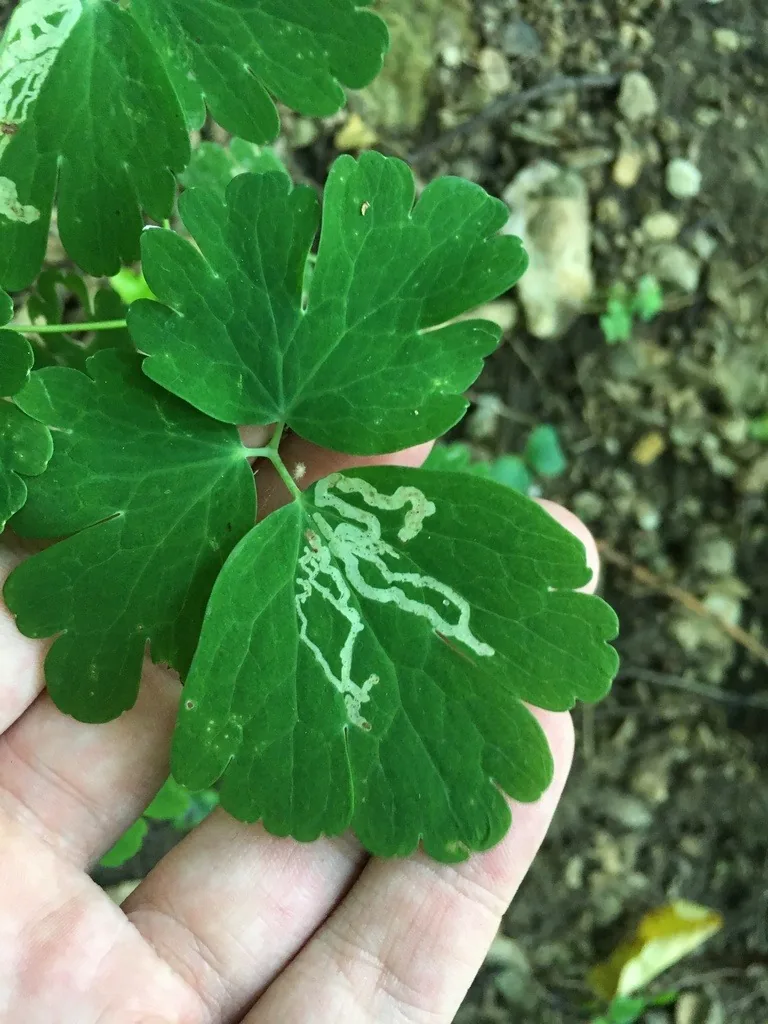
Females lay eggs singly on leaves in spring as plants begin to flower; maggots mine the leaves, then pupate on the leaf underside after cutting a crescent-shaped hole.[2]
There can be up to three generations a year, with the last overwintering as pupae in soil.[2]
NC State notes infestations are less severe in sunny spots than in shade.[1]
Damage and signs
Health risk
Control
Traps and physical control
Ignore light mining, or pick off and destroy mined leaves early, before the larvae pupate.[2]
Biological control
Many parasitic wasps kill the maggots, and populations often collapse without pesticides, though often too late to save the season's looks.[1][2]
Pesticides
Any spray must be timed to the first adults, since it cannot reach maggots inside leaves; NC State has had good results with an early-spring imidacloprid soil drench.[1][2]
Common questions
Sources
- NC State Extension, “Columbine Leafminers (PDIC Factsheet).” content.ces.ncsu.edu/columbine-leafminers-1 (accessed 2026-11-12)
- University of Wisconsin-Madison Extension, “Common Columbine Pests: Columbine Leafminer and Columbine Sawfly.” hort.extension.wisc.edu/articles/common-columbine-pests-columbine-leafminer-and-columbine-sawfly/ (accessed 2026-11-12)
- iNaturalist, “Phytomyza aquilegivora taxon page (order and family).” www.inaturalist.org/taxa/499395 (accessed 2026-10-06)