On this page
How to identify it
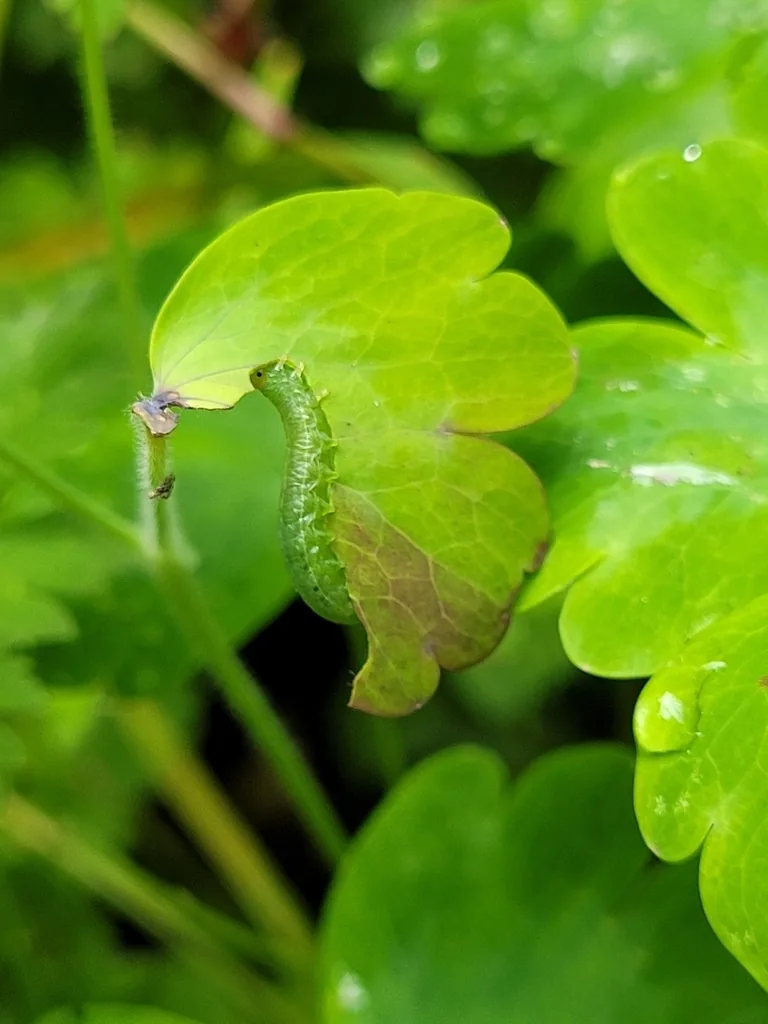
- Larvae are green with dark heads, almost the same shade as the leaves. Sources differ on size: UW-Madison says they grow to about 1/2 inch, while Minnesota Extension says up to 3/4 inch.[1][2]
- Adults are about 1/4 inch, wasp-like with no waist, mostly black with whitish head markings and pale orange legs.[1]
- Larvae often feed on the undersides of leaves in daytime, so they're easy to overlook until much of the plant is bare.[1]
Look-alikes
| Look-alike | How to tell them apart |
|---|---|
| Columbine leafminer | Its maggots tunnel inside the leaf and leave winding pale trails, instead of chewing in from the edge. The adult is a small dark fly native to North America.[1] |
| Small gooseberry sawfly | Was once mistakenly called Pristiphora rufipes, but it feeds only on currants and gooseberries and has several generations a year.[1] |
Where it lives
Native to Europe. It was first found in North America at Ottawa in 1963, reached New York by 1985 and has since spread west as far as Minnesota.[1][2]
Biology and life cycle
Females lay eggs on the leaves in late spring. UW-Madison puts the larvae on plants from about April to June, and Minnesota Extension says May. After a few weeks of feeding they drop to the ground and pupate in brown, oblong cocoons in the leaf litter.[1][2]
It has one generation a year in the upper Midwest.[1]
Damage and signs
- Larvae start at leaf edges and eat inward until only the main veins remain, and can defoliate plants.[1][2]
- The harm is mostly cosmetic. A severe infestation can kill a plant, but that's rare; even columbines stripped bare usually put out new leaves within a few weeks unless something else is stressing them.[1]
- Hybrid columbines (Aquilegia × hybrida) tend to be hit hardest.[1]
Health risk
The larvae feed only on columbine leaves. Neither UW-Madison nor Minnesota Extension mentions any risk to people or pets.[1][2]
Control
Sanitation
If most leaves are gone, cut the plant to the ground and destroy the remains.[1]
Traps and physical control
Check plants often in spring, especially where sawflies turned up before, and pick or knock the larvae into a container of soapy water.[1]
Pesticides
If hand-picking isn't practical, insecticidal soap kills small larvae it actually covers and doesn't affect other animals. Bt products do nothing here, because sawfly larvae aren't true caterpillars.[1]
Birds eat sawflies and feed them to their nestlings, so UW-Madison suggests keeping longer-lasting insecticides as a last resort for severe infestations.[1]
Naming
GBIF's backbone taxonomy accepts Pristiphora rufipes and treats Pristiphora aquilegiae as a synonym. Minnesota Extension's page still uses that older name.[3][2]
Common questions
- What stripped my columbine overnight?
- Very often columbine sawfly larvae. They match the leaves and feed underneath, so the damage is usually noticed before the larvae are.[1][2]
- Will Bt kill sawflies?
- No. Bt products are aimed at true caterpillars, and sawfly larvae belong to a different insect order.[1]
- Will my columbine come back after sawflies strip it?
- Usually. UW-Madison says even fully defoliated plants generally leaf out again within a few weeks; if most leaves are already gone, cut the plant to the ground and destroy the debris.[1]
Sources
- University of Wisconsin-Madison Extension, “Common Columbine Pests: Columbine Leafminer and Columbine Sawfly.” hort.extension.wisc.edu/articles/common-columbine-pests-columbine-leafminer-and-columbine-sawfly/ (accessed 2026-11-13)
- University of Minnesota Extension (What insect is this?), “Columbine sawfly.” apps.extension.umn.edu/garden/diagnose/insect/garden/caterpillars/medium/columbinesawfly.html (accessed 2026-11-13)
- Global Biodiversity Information Facility (GBIF), “Pristiphora rufipes Serville, 1823 (GBIF Backbone Taxonomy).” api.gbif.org/v1/species/6097023 (accessed 2026-11-13)
- iNaturalist, “Pristiphora rufipes taxon page (order and family).” www.inaturalist.org/taxa/447107 (accessed 2026-10-06)