On this page
How to identify it
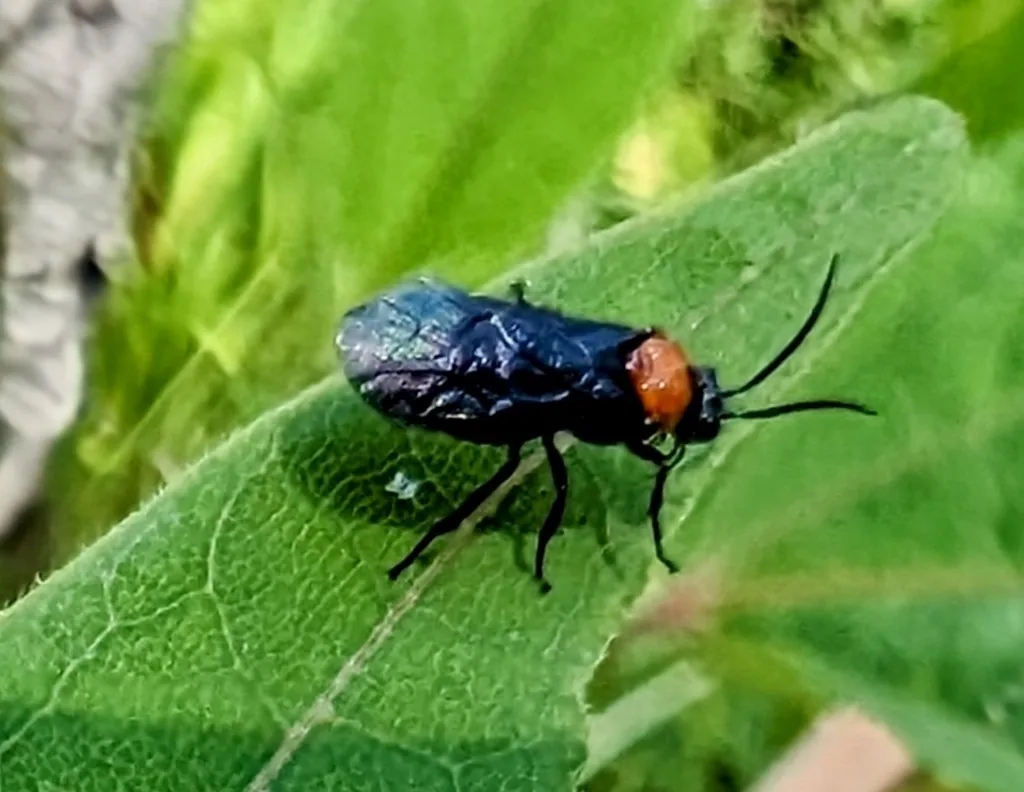
- Adults are tiny, less than 1/4 inch, black and fly-like with a reddish-brown to orange thorax.[1][2]
- The spiny green larvae feed on leaf undersides and are easy to overlook; Mississippi State says they are less than 3/8 inch when fully grown.[2][4]
- Sawfly larvae can be told from caterpillars by their prolegs: caterpillars have five or fewer pairs, and the hibiscus sawfly larva has six pairs.[4]
- Females are black with a distinct orange spot on top of the thorax; males are entirely black.[6][4]
- Each body segment carries a crosswise row of short black glands or bristles.[4][5][6]
Look-alikes
Where it lives
Covered on hibiscus by extension services in North Carolina and Mississippi; larvae have been found from May to October.[1][2]
Biology and life cycle
Females insert eggs into leaves, usually near the tip; there are multiple generations a year.[2]
Mature larvae spin tough brownish cocoons, usually at the base of the host plant.[1]
Eggs hatch in about a week. Young larvae scrape the lower leaf surface, leaving a thin see-through window, and older larvae eat everything but the veins.[4][5][6]
A generation takes about 28 days in Connecticut, so several generations overlap through the summer; adults are active from mid spring or late May until frost.[4][5][6]
Fun fact: the black bristles on the larvae ooze droplets of defensive liquid; Ohio State reports the glands make toxic peptides that mainly keep ants away.[6]
Botanists moved hardy hibiscus out of Hibiscus in December 2025: rose mallow is now Muenchhusia moscheutos, but the sawfly still attacks it.[6]
Damage and signs
- Larvae skeletonize leaves to a lacy network of veins and can completely defoliate plants.[1][2]
- Dinner-plate rose mallow (Hibiscus moscheutos) cultivars such as Luna and Lord and Lady Baltimore are very susceptible; rose of Sharon and tropical hibiscus are usually not attacked.[2]
- Large numbers leave small black droppings, can strip a plant in a matter of days, and if left untreated for several seasons can kill an otherwise healthy plant.[4]
Health risk
It feeds only on mallow-family plants; none of the extension sources list any risk to people or pets.[1][4][2]
Control
Prevention
Check leaf undersides from late spring on; adults gathering on leaves warn that larvae will soon follow.[2]
Traps and physical control
Handpick larvae on a few plants, and look for the brown blisters where eggs were laid near leaf tips.[4]
Pesticides
For small larvae, insecticidal soap or horticultural oil works if the spray coats every sawfly, since they kill by contact.[4]
Larvae are not hard to control with labeled landscape insecticides, but several sprays may be needed through summer; avoid spraying open blossoms to protect pollinators.[1][2]
Actives that work include spinosad, pyrethrins, carbaryl and pyrethroids such as bifenthrin, permethrin and cyfluthrin, plus acephate. A 2004 Mississippi State list gave examples such as Sevin Concentrate Bug Killer (carbaryl), Bonide Eight (permethrin), Bayer Advanced Garden Multi-Insect Killer (cyfluthrin) and a Ferti-lome spinosad spray; product names change, so check the label. Spray must cover the leaf undersides.[4][2][1]
All of these except spinosad can kill predatory mites and set off spider mite outbreaks. Don't spray during bloom while bees or hummingbirds are visiting.[4][1]
Where sources disagree
Larva size: Mississippi State says less than 3/8 inch when fully mature, while the CT Agricultural Experiment Station says up to 1/2 inch and Arkansas about half an inch.[2][4][5]
Glands per segment: CAES describes rows of six or eight; Arkansas says four to six.[4][5]
Generations: NC State says probably six per year and Arkansas up to six; CAES, in Connecticut, says multiple generations are possible with a 28-day life cycle.[1][5][4]
Common questions
- What is skeletonizing my hardy hibiscus?
- Most likely hibiscus sawfly larvae feeding under the leaves.[1][2]
- Which hibiscus does it attack?
- Mostly dinner-plate rose mallow types; rose of Sharon and tropical hibiscus are usually spared.[2]
- Can I get rid of hibiscus sawfly without spraying?
- On a few plants, yes: check the undersides of older leaves as soon as leaves come out and handpick larvae, though they are small and well camouflaged. Insecticidal soap or horticultural oil also works on small larvae if it coats them.[4]
- Are some hardy hibiscus resistant?
- Some. Researchers in Mississippi found three resistant hardy hibiscus species, and in breeding work hybrids with hairier leaves had less damage than smooth-leaved ones.[4][6]
Sources
- NC State Extension, “Hibiscus Sawfly (PDIC Factsheet).” content.ces.ncsu.edu/hibiscus-sawfly (accessed 2026-11-12)
- Mississippi State University Extension, “Bug-Wise No. 7: Hibiscus Sawfly (May 3, 2004).” extension.msstate.edu/sites/default/files/newsletter/bw0704.pdf (accessed 2026-11-12)
- iNaturalist, “Atomacera decepta taxon page (order and family).” www.inaturalist.org/taxa/130013 (accessed 2026-11-12)
- The Connecticut Agricultural Experiment Station, “Hibiscus Sawfly (Atomacera decepta) fact sheet (Rose Hiskes).” portal.ct.gov/-/media/caes/documents/publications/fact_sheets/entomology/hibiscus_sawfly_atomacera.pdf (accessed 2026-11-12)
- University of Arkansas Arthropod Museum, “Mallow or hibiscus sawfly.” arthropod.uark.edu/mallow-or-hibiscus-sawfly/ (accessed 2026-11-12)
- Ohio State University Extension, Buckeye Yard & Garden onLine, “A Hibiscus That's Not a Hibiscus, and a Sawfly That Doesn't Care (Joe Boggs, Aug. 11, 2026).” bygl.osu.edu/node/2684 (accessed 2026-11-12)