On this page
How to identify it
Where it lives
Extension services describe it on rose of Sharon and hibiscus in North Carolina, Mississippi and Arkansas, and it was newly reported for Illinois in 2017 from specimens in the Illinois Natural History Survey collection.[1][2][4][5]
Biology and life cycle
Adults overwinter in leaf litter on the ground. Starting in late April and early May, females lay eggs in masses of 1 to 36 on the undersides of leaves, and each female can lay over 700 eggs.[1]
Newly hatched nymphs feed on developing flowers and last year's seed pods. North Carolina has at least three to four generations a year, and by the end of the season every life stage is on the plants. Males live about 50 days and females about two months.[1]
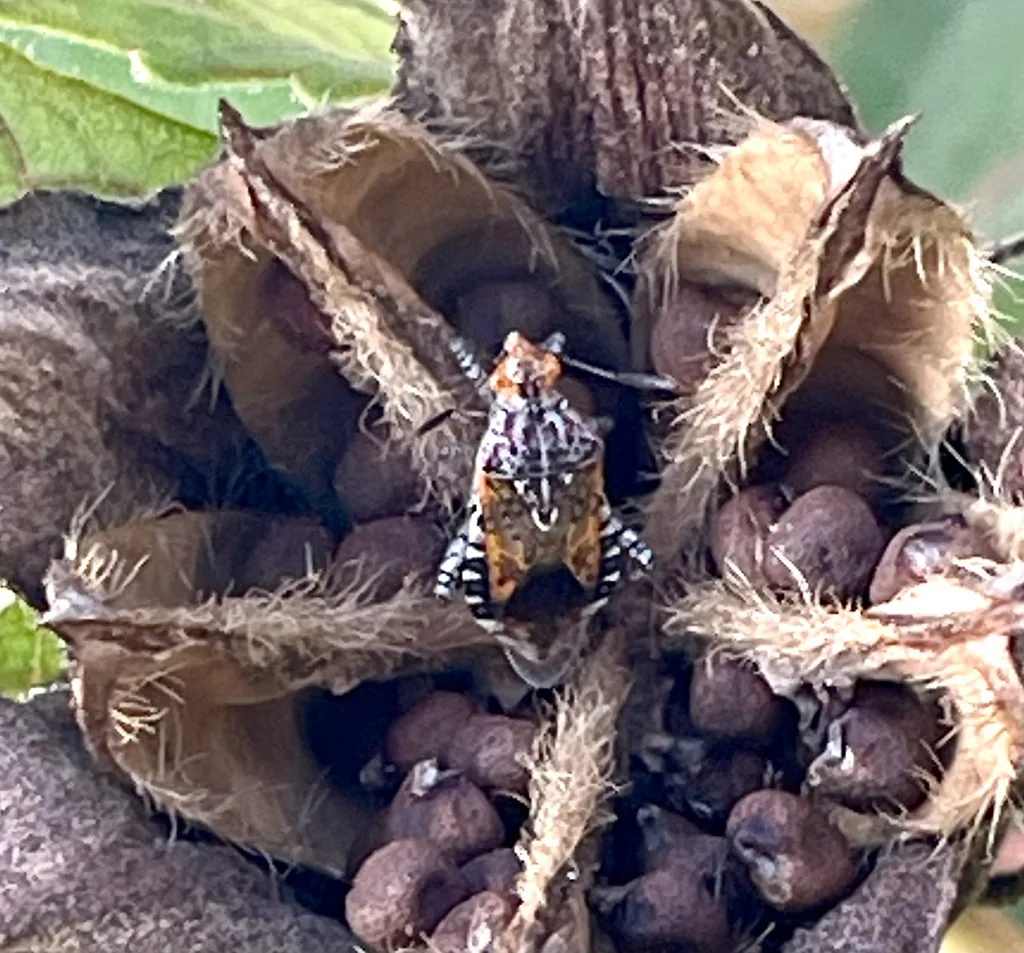
The bugs are most noticeable in late summer and fall, congregating on seed pods.[2]
A tiny parasitic wasp in the genus Telenomus attacks the eggs.[1]
Damage and signs
- They feed on flower buds and seeds of rose of Sharon, hibiscus, hollyhock and other mallows, but damage to blooms is uncommon and seldom affects plant health.[1][2]
- Mallow flowers normally last only a day or two before wilting to show the young seed pod, which then dries and turns brown, so the bugs are often wrongly blamed for flowers that never opened. They much prefer seed pods and the seeds inside, and seeds they feed on often fail to germinate, which matters little on ornamentals.[2]
- Bud damage is most likely when large numbers arrive on plants that have not yet started blooming, forcing them to feed on the buds.[2]
- Because they destroy seeds of velvetleaf, a weedy mallow, they have been tried as biological control of that weed, and Arkansas Extension calls them beneficial for that reason.[1][2][4]
Health risk
The extension sources describe it only as a plant feeder on mallow buds and seeds; none mentions any risk to people or pets.[1][2][4]
Control
Prevention
Usually do nothing: the bugs are not common or damaging enough to be a real pest and rarely affect plant health.[1][2]
Traps and physical control
If they bother you, hand removal is effective where practical.[1]
Pesticides
Only if they become abundant enough to threaten flower buds, treat flower buds, spent blooms and leaf undersides (where eggs are seen) with an insecticide labeled for plant bugs on ornamentals. Mississippi State names pyrethroids such as bifenthrin, zeta-cypermethrin, cyfluthrin or permethrin. Do not spray open blooms, to protect bees and other pollinators, and follow the label.[1][2]
Common questions
- Are the orange and white bugs on my rose of Sharon pods harmful?
- Usually not. They mostly feed on seed pods and seeds, rarely damage blooms enough to matter, and control is not normally required.[1][2][4]
- Did these bugs make my rose of Sharon flowers turn brown?
- Probably not. Each flower lasts only a day or two and then wilts to show a seed pod, which dries and turns brown naturally; the bugs gather there because they prefer seeds.[2]
Sources
- NC State Extension, “Hibiscus Scentless Plant Bug (PDIC Factsheet).” content.ces.ncsu.edu/hibiscus-scentless-plant-bug (accessed 2026-11-12)
- Mississippi State University Extension (Bug's Eye View), “Hibiscus Plant Bug (Bug's Eye View, Vol. 5, No. 29, 2019).” extension.msstate.edu/newsletters/bugs-eye-view/2019/hibiscus-plant-bug-vol-5-no-29 (accessed 2026-11-12)
- iNaturalist, “Niesthrea louisianica taxon page (order and family).” www.inaturalist.org/taxa/479475 (accessed 2026-11-12)
- University of Arkansas System Division of Agriculture, Cooperative Extension Service, “Plant Health Clinic Newsletter, Issue 27 (August 27, 2018): Rose of Sharon Scentless Plant Bug.” www.uaex.uada.edu/yard-garden/plant-health-clinic/docs/2018_Plant_Health_Clinic_Newsletters/Plant%20Health%20Clinic%20Newsletter-Issue%2027.pdf (accessed 2026-11-12)
- Zootaxa (2017), via PubMed, “Nine true bugs (Heteroptera) newly-discovered in Illinois.” pubmed.ncbi.nlm.nih.gov/28610319/ (accessed 2026-11-12). Cited from the PubMed abstract.