On this page
How to identify it
- Adults are somewhat flattened and about 3/8 to 5/8 inch long by Kansas State's measure, or about 1/2 inch by Texas A&M's; a 2013 review gives 9.5 to 14.5 mm. UF/IFAS gives 9.5 to 13.5 mm (about 1/3 to 1/2 inch) long and 3 to 4 mm wide for normal-winged adults, and usually 7 to 8 mm for the short-winged form.[2][4][1][5]
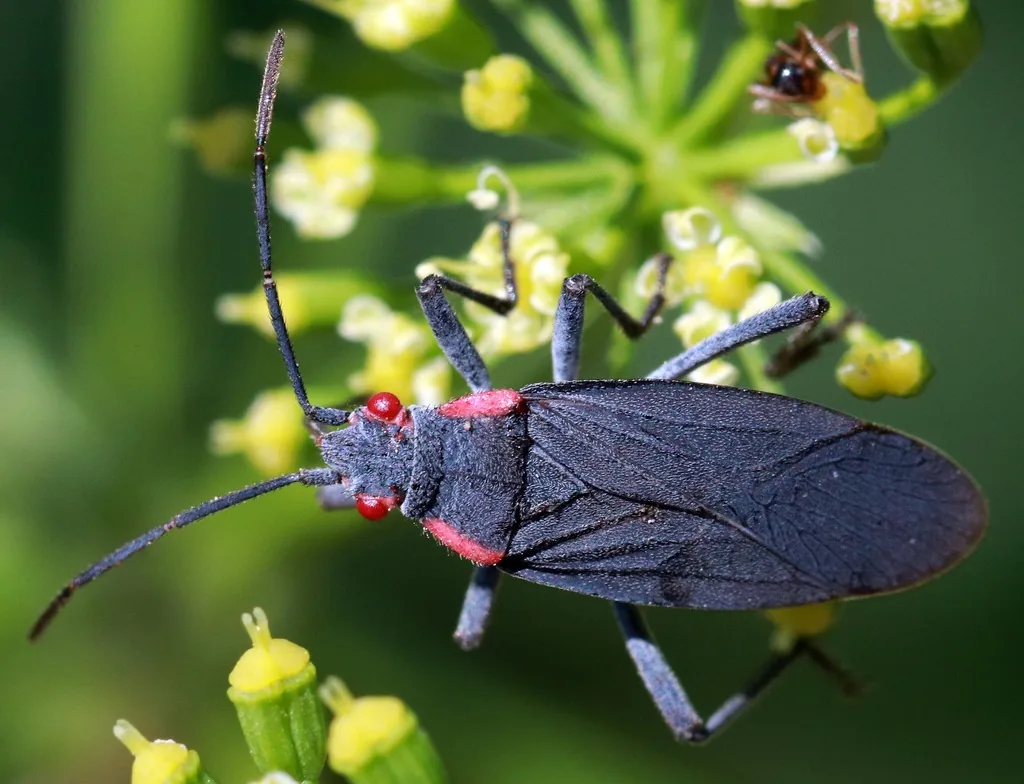
- The back is black to dark brownish gray, with red eyes and a red edge along each side of the pronotum, the 'shoulders'. Underneath, the abdomen is black with broad red side margins. UF/IFAS adds that the eyes and the simple eyes are reddish.[4][2][1][5]
- Unlike the boxelder bug, it has no red stripe down the middle of the pronotum and no red markings on the wings.[2][3]
- Nymphs are bright red with black legs and antennae; as they grow, the head, thorax and wing pads turn dark gray to black. They are more oval than adults and have wing pads instead of wings. UF/IFAS describes them as mostly red with a brown thorax, antennae, beak and legs, with small dark bristles spread evenly over the body.[3][2][5]
- Both long-winged adults and short-winged, flightless adults occur.[1][6]
Look-alikes
| Look-alike | How to tell them apart |
|---|---|
| Boxelder bug | Same family and similar habits, including gathering on sunny walls in fall, but the boxelder bug has three red lines on the pronotum (one down the middle) plus red markings on the wings, and it feeds mainly on boxelder and maple seeds. UF/IFAS notes that the two are often confused.[3][2][4][7][5] |
| Jadera antica | A rare relative in far southern Florida (UF/IFAS lists only a few records, from Monroe, Dade and Osceola counties). It is smaller, 7.5 to 11 mm, and brownish salmon with many dark dots, not black with red shoulders.[5] |
Where it lives
Native to the Americas, it is the only Jadera species that reaches temperate North America. It occurs across the Gulf Coast plain and north into the western Interior Plains, with a separate population in peninsular Florida, and since the 1970s it has spread northeast along the Atlantic Coast as far as Maryland; there are also records from Arizona and California. It was introduced to Hawaii in the 1960s and found in Taiwan in 2012. Kansas State calls it native to the United States. UF/IFAS also lists Mexico and the West Indies south through Central America to Colombia. In Florida it is found over the peninsula, seems scarce in the north and has not been recorded in the panhandle, based on Florida State Collection of Arthropods records.[1][2][5]
Biology and life cycle
It feeds on the mature and nearly mature seeds of soapberry-family plants, chiefly goldenrain trees, balloonvine and western soapberry, both in the tree and on fallen seed on the ground. UF/IFAS says it prefers balloonvine, but in some areas it feeds on goldenrain tree seeds so often that it's called the goldenrain tree bug.[1][2][4][5]
In North Carolina, adults spend the winter in plant debris or inside homes. In spring, females lay eggs in the soil under a goldenrain tree; nymphs hatch about two weeks later and become adults in July, and a second generation matures and overwinters. Texas can have two or more generations a year.[3][4]
In Oklahoma, adults and nymphs overwinter in dense clusters, mostly in leaf litter on the ground; they leave in February or March, the new generation appears in late July, and they enter diapause in October. In Florida, populations on balloonvine breed year round, with two main reproductive periods that follow the seed crops.[1]
Females usually dig a hole about 1 cm deep in dry soil near the host and bury the eggs, laying clutches of 1 to 20 eggs every day or two for two to three weeks.[1]
The bright red nymph clusters are a warning signal: in experiments, toads and blue jays that tasted the nymphs avoided them afterward.[1]
Adults also drink nectar from their host plants' flowers and pollinate them, though their young later eat the seeds.[8]
In Florida it has been collected in every month, with a May peak, mostly in central Florida; southern Florida records are spread more evenly through the year.[5]
Damage and signs
- They are considered harmless to goldenrain trees and don't seem to damage the foliage; Texas A&M notes they seldom gather in numbers large enough to harm trees.[3][4]
- The problem is nuisance: large groups around houses alarm people, and in fall the bugs enter homes looking for places to overwinter, gathering on south and west walls. UF/IFAS notes a report of the bugs as a nuisance in Texas and invading homes from nearby chinaberry trees in Oklahoma.[1][3][2][5]
- Crushed bugs leave a red stain, and Texas A&M notes that large numbers indoors can stain curtains, furniture and walls with their excrement. UF/IFAS says children playing on infested lawns can come home with clothes stained red by squashed bugs.[3][4][5]
Health risk
None of the sources describes them biting people, and Kansas State says they don't transmit any diseases it is aware of. The main complaint is red stains from crushed bugs.[2][3][1]
Control
Prevention
Removing host trees may cut down breeding nearby, but bugs can fly in from neighboring trees. A 2013 review notes that no control is usually needed beyond clearing fallen seed and collecting the bugs. UF/IFAS agrees that in most cases no control is needed and says a small group on a plant can often be hand-collected; if nonchemical methods aren't practical, it suggests asking the local Cooperative Extension office for insecticide recommendations.[4][1][5]
Keep them out
Seal and caulk cracks and crevices, gaps where pipes and wires enter, damaged screens and weatherstripping before bugs move in for the winter; Texas A&M suggests copper mesh or weep-hole screening for brick weep holes.[2][4]
Sanitation
Rake up and dispose of fallen seeds under host trees, and clear boards, leaf piles and debris near the house where bugs shelter. UF/IFAS says raking up the seeds should help where the bugs are a nuisance in lawns or playgrounds.[4][1][5]
Traps and physical control
Vacuum bugs that get indoors instead of crushing them, which stains. Empty the canister soon afterward, since rotting bugs can leave a lasting odor.[3][2]
Pesticides
Kansas State says an insecticide applied to the outside of a building may reduce how many adults get in, and NC State notes the bugs are much easier to kill in late spring and summer than in fall, when they are preparing to overwinter. Once they're indoors, vacuuming is the main option.[2][3]
Where sources disagree
Host plants: a 2013 review describes the bug as feeding only on soapberry-family seeds, with occasional reports from other plants. NC State also lists chinaberry, and Texas A&M lists althaea, arborvitae, bluebonnets and ficus along with goldenrain tree and western soapberry. UF/IFAS lists Ficus and Althaea as additional hosts.[1][3][4][5]
Where eggs go: NC State and the review say females lay eggs in soil under or near the host, while Texas A&M's combined boxelder and red-shouldered bug sheet says eggs go on leaves, grass, rocks or bark.[3][1][4]
Size: Kansas State gives 3/8 to 5/8 inch and Texas A&M about 1/2 inch. UF/IFAS gives 9.5 to 13.5 mm for normal-winged adults, and the 2013 review 9.5 to 14.5 mm.[2][4][5][1]
Nymph legs: NC State and Kansas State describe nymphs with black legs and antennae, while UF/IFAS describes the legs and antennae as brown.[3][2][5]
A textbook case of fast evolution
Researchers study this bug because the length of its beak differs between populations on native and introduced host plants, matching the fruits it feeds on. In some populations the average beak length shifted by nearly 25%, and museum specimens suggest the change took roughly 20 to 50 years.[1][9]
A 2016 study found that bugs in its study region have lost their adaptations to the native host, balloonvine, and are specializing on the introduced goldenrain tree (Koelreuteria elegans), even in populations still living on balloonvine.[9]
After a hurricane flood wiped out local populations, long-winged forms built up in the recolonized sites, and because of a genetic link their mouthparts became longer too.[6]
Common questions
- What are the red and black bugs under my goldenrain tree?
- Most likely red-shouldered bugs, also called goldenrain tree bugs or soapberry bugs. They gather on the trunk and on fallen seeds under the tree.[3][2][1]
- Do they damage plants?
- No. They feed on seeds and are considered harmless to goldenrain trees. UF/IFAS says there is no documentation that it is a plant pest of any consequence.[3][4][5]
- Why are they getting into my house in the fall?
- They are looking for sheltered places to spend the winter. Sealing cracks and gaps before fall keeps most out, and the ones inside can be vacuumed up.[2][3][4]
- Where should I look for them?
- UF/IFAS suggests checking the ground under trees that are dropping seed, especially goldenrain trees. Adults are dark with red shoulders and about 1/2 inch long; nymphs are a conspicuous red.[5]
Sources
- ZooKeys, via PubMed Central, “The soapberry bug, Jadera haematoloma: first Asian record, with a review of bionomics (Tsai, Hsieh and Redei 2013).” pmc.ncbi.nlm.nih.gov/articles/PMC3689129/ (accessed 2026-11-14)
- Kansas State University Extension Entomology, “Red-Shouldered Bug (Cloyd, Aug. 2018).” www.k-state.edu/news/kansasbugs/articles/2018/08/red-shouldered-bug.html (accessed 2026-11-14)
- NC State Extension, “Red Shouldered Bug or Golden Rain Tree Bug (PDIC Factsheet).” content.ces.ncsu.edu/publication/red-shouldered-bug-or-goldenraintree-bug (accessed 2026-11-14)
- Texas A&M AgriLife Extension, “Boxelder Bugs and Red-Shouldered Bugs (ENTO-PU-049).” extensionentomology.tamu.edu/wp-content/uploads/2025/03/boxelder-bugs-and-red-shouldered-bugs.pdf (accessed 2026-11-14)
- University of Florida/IFAS Extension (Featured Creatures), “Scentless Plant Bugs, Jadera sp., EENY-130/IN287.” ask.ifas.ufl.edu/publication/IN287 (accessed 2026-11-14)
- Nature Ecology & Evolution, via PubMed, “Spatial sorting promotes rapid (mal)adaptation in the red-shouldered soapberry bug after hurricane-driven local extinctions (Comerford et al. 2023).” pubmed.ncbi.nlm.nih.gov/37813943/ (accessed 2026-11-14)
- USDA Forest Service, “Forest Insect & Disease Leaflet 95: Boxelder Bugs (Ciesla and Hanavan, revised February 2011).” www.fs.usda.gov/foresthealth/docs/fidls/FIDL-95-BoxelderBugs.pdf (accessed 2026-11-14)
- The American Naturalist, via PubMed, “A New Twist on an Old Story: Pollination and Seed Predation in Jadera haematoloma (Comerford, Carroll and Egan 2025).” pubmed.ncbi.nlm.nih.gov/40720855/ (accessed 2026-11-14)
- Peer-reviewed literature (PubMed), “Adaptation to an invasive host is driving the loss of a native ecotype (Cenzer ML, Evolution, 2016).” pubmed.ncbi.nlm.nih.gov/27508331/ (accessed 2026-11-14)
- iNaturalist, “Jadera haematoloma taxon page (order and family).” www.inaturalist.org/taxa/127669 (accessed 2026-11-14)