On this page
How to identify it
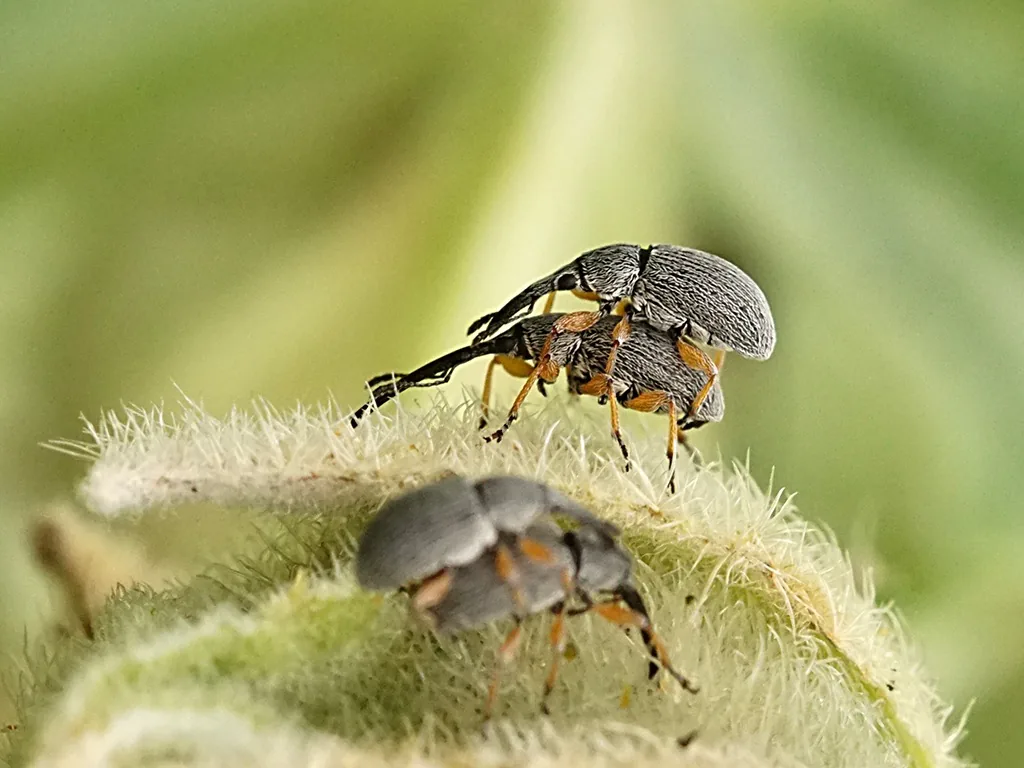
- Adults are 0.10 to 0.15 inch long, gray and slightly hairy, with orangish legs and a long snout.[1]
- Look for leaves with small holes and pairs of weevils around flowers and buds; holes in seed pods are another sign.[1]
- NC State measures them including the snout: females about 1/4 inch and males about 1/8 inch, with the female's snout almost as long as the rest of her body.[5]
Where it lives
Accounts of its origin differ. The PNW handbook says it is native to southern and southeastern Europe and Asia Minor, was found in Georgia in 1914 and is now well distributed across the U.S.; Colorado State calls it native to Europe and says it has been spread largely in infested hollyhock seed and can likely occur wherever hollyhock is grown in Colorado. A 2025 study says that since the 1960s its range has spread from central Asia across almost all of Europe, and that it has been introduced to North America.[1][6][2]
Biology and life cycle
Adults mate in July and August, and females drill deep into developing buds to lay eggs.[1]
Larvae develop in 4 to 6 weeks and pupate in August; most overwinter as adults in duff and litter.[1]
In spring, Colorado State says, adults move to growing hollyhocks and chew buds, tender stems and emerging leaves, so the leaves open with a shot-holed look. The cream-colored grub eats the developing seed and pupates when it finishes feeding.[6]
NC State says the weevils feed at night, readily drop from the plant when disturbed, and that hollyhock seems to be their only host.[5]
Damage and signs
- Weevils reduce flowering and may cut natural reseeding, though the PNW handbook calls their feeding damage to hollyhock relatively minor; holes in seed pods are a sign of them.[1]
- NC State says heavily infested leaves take on a lacy look, and that the small holes resemble flea beetle injury on eggplant or tomato.[5]
Health risk
It feeds on hollyhocks, and no cited source describes any risk to people or pets.[1][5][6]
Control
Prevention
Watch for the first holes in leaves, or for paired weevils around flowers and buds.[1]
Sanitation
Remove and destroy buds before adults emerge in late summer, or through winter to catch adults that emerge in spring.[1]
Colorado State says regularly removing and disposing of seed pods destroys the developing larvae.[6]
Traps and physical control
Bend flower heads over a box and strike the stem sharply to knock adults off, or pick them off; they cling tightly.[1]
NC State suggests spreading a piece of fabric under the plant and shaking it, then collecting the fallen weevils into soapy water.[5]
Pesticides
NC State says the hollyhock weevil is not reported to be resistant to pesticides and that insecticides labeled for landscape use should control the adults, but not to spray open flowers, since pollinators may be harmed.[5]
More from the research literature
A 2025 study in the journal Insects, which collected 73 larvae and 67 pupae from 20 hollyhock plants, ties its feeding and development to hollyhocks (Alcea) and recorded caterpillars of the moth Pexicopia malvella developing in the same hollyhock fruit, which limited weevil numbers.[2]
A 2021 taxonomic revision also links the genus to Alcea and split off a new species, Rhopalapion celatum, from populations in Turkey, Iran and Central Asia that had been treated as R. longirostre.[3]
Where the sources disagree
Color: the PNW handbook and Colorado State call the adults gray, while NC State calls them black.[1][6][5]
Size: the PNW handbook gives 0.10 to 0.15 inch, while NC State, measuring with the snout, gives about 1/4 inch for females and 1/8 inch for males.[1][5]
Where eggs go: the PNW handbook says the female drills into the developing bud, while NC State and Colorado State describe her chewing into the seed pods or developing seed.[1][5][6]
Winter: the PNW handbook says most overwinter as adults in duff and litter, while Colorado State says adults winter near previously infested hollyhocks and some late developers winter inside seed pods.[1][6]
Family: GBIF, Colorado State and the 2025 study place it in Brentidae, while the 2021 revision treats the group as Apionidae.[4][6][2][3]
Common questions
- What tiny gray weevils are on my hollyhock buds?
- Probably hollyhock weevils, which feed on leaves and lay eggs in developing buds.[1]
- How do I get rid of hollyhock weevils without spraying?
- Knock them into a box or onto a cloth by striking or shaking the stem, hand-pick them, and remove infested buds and seed pods.[1][5][6]
Sources
- Pacific Northwest Pest Management Handbooks (OSU, WSU, University of Idaho), “Hollyhock (Alcea rosea): Hollyhock weevil (Insect Management Handbook).” pnwhandbooks.org/insect/hort/landscape/hosts-pests-landscape-plants/hollyhock-alcea-rosea-hollyhock-weevil (accessed 2026-11-13)
- Peer-reviewed literature (PubMed), “Immature Stages and Breeding Behaviour of the Hollyhock Weevil-Rhopalapion longirostre (Olivier 1807) (Coleoptera, Brentidae, Apioninae) (Gosik R, Insects, 2025).” pubmed.ncbi.nlm.nih.gov/40003773/ (accessed 2026-11-13)
- Zootaxa 2021;4908(1), via PubMed, “Taxonomic revision of the genus Rhopalapion Schilsky, 1906 (Coleoptera, Apionidae) with description of Rhopalapion celatum n. sp. from the Turanian Region (2021).” pubmed.ncbi.nlm.nih.gov/33756632/ (accessed 2026-11-13)
- Global Biodiversity Information Facility (GBIF), “Rhopalapion longirostre (Olivier, 1807) (GBIF Backbone Taxonomy).” api.gbif.org/v1/species/4463518 (accessed 2026-11-13)
- NC State Extension, “Hollyhock Weevil (PDIC Factsheet, August 10, 2016).” content.ces.ncsu.edu/hollyhock-weevil (accessed 2026-11-13)
- Colorado State University Extension, “Hollyhock Weevil (Colorado Insect of Interest).” wci.extension.colostate.edu/wp-content/uploads/sites/14/2017/03/Hollyhockweevil.pdf (accessed 2026-11-13)