On this page
How to identify it
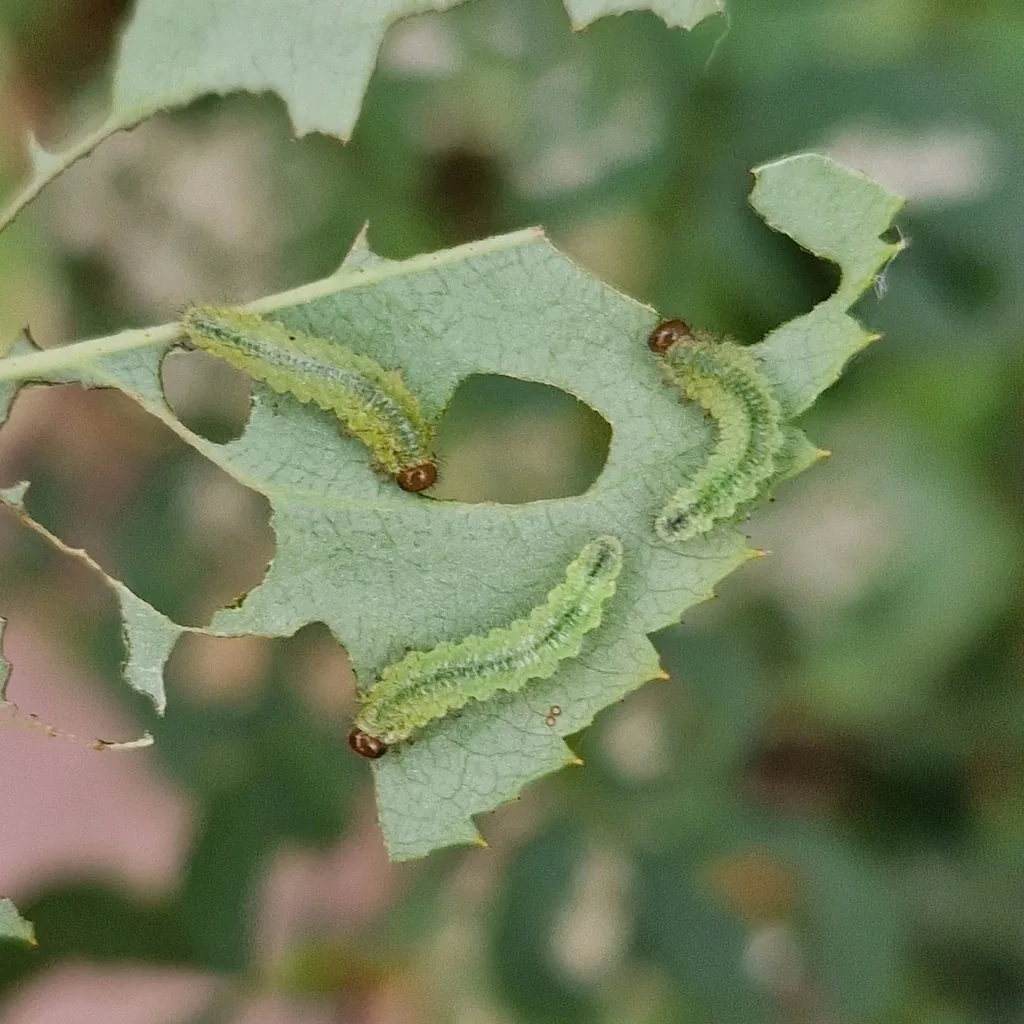
- Bristly roseslug larvae are pale to lime green with a brown or orange head and short bristles that NC State and Ohio State say are best seen with a hand lens. Full-grown size varies by source, from about 1/2 inch (Illinois) to 3/4 inch (UC IPM, UGA).[1][5][2][3][4]
- Sawfly larvae have prolegs on at least six abdominal segments and relatively large eyes; caterpillars have five or fewer pairs of prolegs and tiny eyes.[1][2]
- The roseslug, also called the common or European roseslug (Endelomyia aethiops), is smaller, about 1/2 inch and green, and scrapes the upper leaf surface.[1][2]
- The curled rose sawfly is green with rows of pale bumps and often coils its body while feeding.[1][2]
- Adults are stout, black, wasp-like sawflies about 1/2 inch long with a thick waist.[5][3]
Look-alikes
| Look-alike | How to tell them apart |
|---|---|
| Caterpillars | Caterpillars have five or fewer pairs of prolegs, and Bt kills them; roseslugs have more prolegs and Bt has no effect on them.[2][1] |
| Hover fly (syrphid) larvae | Syrphid larvae have no true legs, live among aphids and eat them instead of chewing leaves; roseslugs have three pairs of short legs and sit near chewed leaves. Leave syrphids alone, since they are beneficial.[1] |
| Japanese beetle | Japanese beetles often get blamed for chewed rose leaves in summer, but roseslugs are small green larvae usually found on the leaf undersides.[2][5] |
| Pine sawflies | Related sawfly larvae that feed on pine needles instead of rose leaves; UKY says European pine sawfly larvae feed in groups on pines in spring.[6] |
Where it lives
The bristly roseslug is native to Europe and was accidentally introduced to North America; Ohio State says it is now found across the continent. It's common in Georgia and Ohio and found in Illinois, and UC IPM calls it the most common rose sawfly in California, mainly in cooler coastal areas.[5][4][3][2][1]
Biology and life cycle
Females use a sawlike egg-laying tool to insert eggs into rose leaves or leaf stalks.[2][5][3][1]
Young bristly roseslugs feed on the lower leaf surface. Mature larvae spin a cocoon on the plant or drop to the soil to pupate.[5][3][2]
The bristly roseslug has several generations a year (Illinois says six or more), so feeding builds from spring until frost and can be worst late in the season.[2][5][3][4]
The roseslug and curled rose sawfly feed mainly early in the season; the roseslug has one generation and the curled rose sawfly two.[2][3][4]
Bristly roseslugs spend the winter as pupae in earthen cells in the soil.[5][3]
Damage and signs
- Young larvae scrape away one leaf surface, leaving pale see-through windowpanes that later drop out as holes.[5][1][4][3]
- Older bristly roseslugs chew holes between the main veins and notch leaf edges, and heavy feeding can leave see-through leaves and defoliate plants late in the season.[5][3][4]
- Mature curled rose sawfly larvae bore into stems or pruned twig ends to pupate.[1][2]
- UC IPM says feeding makes roses unsightly and severe damage may reduce later blooming, but it doesn't threaten otherwise healthy roses.[1]
Health risk
Roseslugs feed on rose leaves. UC IPM, UGA, NC State and Illinois Extension describe plant damage only and don't mention any risk to people or pets.[1][5][3][2]
Control
Prevention
Look for windowpane spots on rose leaves and check the undersides, where the larvae feed, from April until frost.[5][3]
Traps and physical control
Handpick larvae or clip off infested leaves when only part of the plant is affected; NC State suggests dropping them into soapy water.[1][5][3]
A forceful spray of water from a hose can dislodge or kill small larvae.[2][5][3]
Tilling soil around roses, including in late fall, can destroy bristly roseslug pupae.[5]
Biological control
UC IPM says birds, parasitic wasps, predaceous beetles and diseases often keep sawflies low, so it advises against broad-spectrum sprays that kill these natural enemies. UGA says there's limited information on effective biological control of the bristly roseslug.[1][5]
Pesticides
Larvae are easy to kill with thorough sprays of horticultural oil, insecticidal soap, neem oil or spinosad, but these leave no residue, so repeat as needed. Ohio State notes soaps need direct contact.[1][5][4]
Bt sprays don't work, because roseslugs are sawfly larvae, not caterpillars.[1][5][2][3][4]
Don't spray open flowers, to protect bees; UC IPM says spinosad stays toxic to bees for hours after it dries. NC State suggests aiming sprays up at the lower leaf surface.[1][2][5][3]
Where the sources disagree
Broad-spectrum sprays: UC IPM advises against persistent broad-spectrum insecticides such as carbaryl and pyrethroids on roses because they kill natural enemies. Illinois and UGA list pyrethroids among the options, and NC State says most insecticides labeled for home landscapes work except Bt.[1][2][5][3]
Whether to treat at all: Ohio State says only the bristly roseslug is worth controlling because it keeps feeding all season, while the other two species come and go early.[4]
Pupation site: UGA says mature larvae usually pupate in a cocoon in the soil and sometimes on dried leaves on the plant; Illinois says in plant debris or on the plant; NC State says on the plant or on the soil surface.[5][2][3]
Common questions
- What is eating holes in my rose leaves?
- If the leaves have see-through windowpanes and holes and small green larvae sit on the undersides, roseslugs are the likely cause.[5][2][3]
- Are rose slugs actually slugs?
- No. They are the larvae of sawflies, which are relatives of bees, ants and wasps.[2][1]
- Why didn't Bt kill my rose slugs?
- Bt only works on true caterpillars, the larvae of moths and butterflies, and sawfly larvae aren't affected.[1][2][4]
Sources
- University of California Statewide IPM Program, “Rose Sawflies (Roseslugs).” ipm.ucanr.edu/home-and-landscape/rose-sawflies-roseslugs/ (accessed 2026-11-13)
- University of Illinois Extension, “Why are there holes in my roses? Roseslugs (Good Growing, June 7, 2024).” extension.illinois.edu/blogs/good-growing/2024-06-07-why-are-there-holes-my-roses-roseslugs (accessed 2026-11-13)
- NC State Extension, “Bristly Roseslug (PDIC Factsheet).” content.ces.ncsu.edu/bristly-roseslug (accessed 2026-11-13)
- Ohio State University Extension, Buckeye Yard & Garden onLine (BYGL), “Slugged Rose Leaves from a Bristly Pest (Joe Boggs, May 16, 2019).” bygl.osu.edu/node/1267 (accessed 2026-11-13)
- University of Georgia Cooperative Extension, “Bristly Roseslugs: Biology and Management (Circular 1329, May 2025).” fieldreport.caes.uga.edu/publications/C1329/bristly-roseslugs-biology-and-management/ (accessed 2026-11-13)
- University of Kentucky Entomology, “ENTFACT-410: Pine Sawflies.” entomology.mgcafe.uky.edu/ef410 (accessed 2026-11-13)
- Global Biodiversity Information Facility (GBIF), “Cladius pectinicornis (Geoffroy, 1785) (GBIF Backbone Taxonomy).” api.gbif.org/v1/species/4491460 (accessed 2026-11-13)
- Global Biodiversity Information Facility (GBIF), “Cladius difformis (Panzer, 1799), heterotypic synonym (GBIF Backbone Taxonomy).” api.gbif.org/v1/species/1249695 (accessed 2026-11-13)
- Global Biodiversity Information Facility (GBIF), “Endelomyia aethiops (Gmelin, 1790) (GBIF Backbone Taxonomy).” api.gbif.org/v1/species/9784589 (accessed 2026-11-13)
- Global Biodiversity Information Facility (GBIF), “Allantus cinctus (Linnaeus, 1758) (GBIF Backbone Taxonomy).” api.gbif.org/v1/species/1249680 (accessed 2026-11-13)
- iNaturalist, “Cladius pectinicornis taxon page (order and family).” www.inaturalist.org/taxa/628325 (accessed 2026-10-06)