On this page
How to identify it
- Adults are 1/8 to 1 inch long; many are black with orange, yellow or white bands or stripes, like bees or wasps.[1]
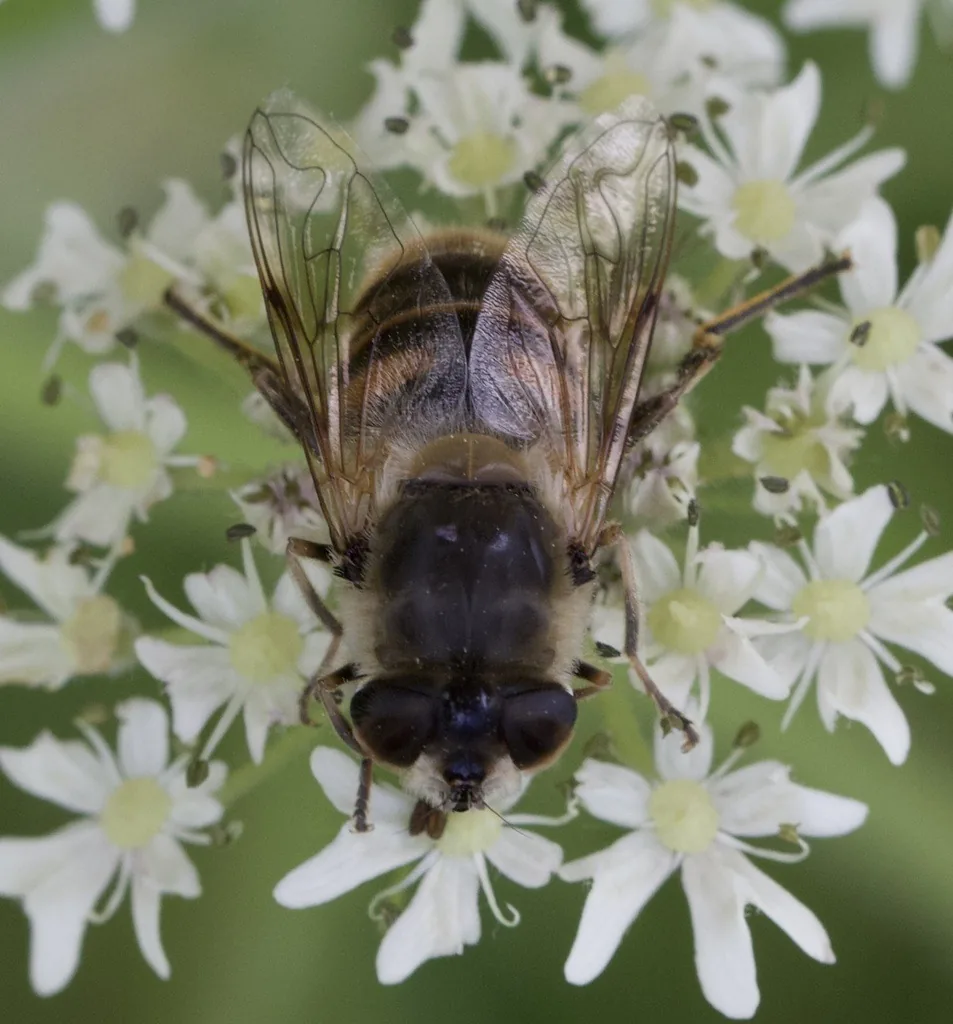
- They have one pair of wings, while bees and wasps have two pairs.[1][2]
- Large eyes and a broad head about as wide as the abdomen; they hover in place and dart suddenly in new directions.[1][3]
- The drone fly is hairy, stout and black and brown, and is named for its resemblance to male honey bees.[1]
- Predatory larvae are legless, maggot- or sluglike, tapered toward the head, and green, yellow, brown or whitish.[1][2]
Look-alikes
Where it lives
Hover flies are common in gardens, crops and landscapes; species live in habitats from freshwater to forests and deserts. In Kentucky adults are seen from mid-spring to early fall, and in mild coastal areas they may be active all year.[3][1]
Biology and life cycle
Females lay small white eggs, often singly, near aphid colonies or other food for the larvae.[1][2]
Aphid-feeding species develop from egg to adult in about 2 to 4 weeks in summer and can have 5 to 7 generations a year.[1]
Overwintering varies by species and region: Kentucky Extension says most overwinter as larvae in soil and leaf litter, Wisconsin Extension says as pupae, and UC IPM notes some spend the winter as adults in protected places or as prepupae.[1][2][3][4]
Adults feed on nectar, pollen and honeydew, and some species carry pollen on specialized hairs like bees.[2][3]
Drone fly larvae live in water or wet decaying matter and are called rat-tailed maggots for their long breathing tube.[1]
Besides aphids, predatory larvae take mealybugs, scales, thrips, froghoppers, psyllids, mites and small caterpillars.[1][3][4]
A female can lay 100 to 1,000 eggs in her life. Eggs hatch in about 5 days, and larvae finish feeding in two to three weeks.[3][4]
Pupae need dampness. In dry weather, mature larvae often leave the plant and burrow several inches into moist litter or loose soil to pupate.[1]
Damage and signs
Health risk
Hover flies don't bite or sting. Those that land on people outdoors are just seeking moisture or salts from skin.[3][2]
Control
Prevention
No control is needed; hover flies are beneficial pollinators and aphid predators.[3][2]
Hover flies avoid flying in wind, so windbreaks give them shelter near the garden.[2]
Biological control
Plant flowers that bloom through the season; small white compound flowers, sweet alyssum, dill, coriander and Queen Anne's lace attract adults.[2][4]
Tolerate some aphids in the garden, since larvae need prey; a single larva can eat hundreds of aphids as it develops.[2][3]
Limit insecticides. Hover fly larvae are highly susceptible, so skip sprays when aphids are below damaging levels and syrphid larvae are feeding on them.[3][2]
If you must spray, choose a selective insecticide; non-selective products kill syrphid flies and other beneficial insects along with the pests. Flowering cover crops also help attract and support adults.[2]
Common questions
- Why is a bee-like fly hovering around me while I work outside?
- It is probably a hover fly seeking moisture or salt from your skin. It can't sting or bite.[3]
- How can I tell a hover fly from a bee?
- Look at the wings: flies have a single pair, while bees and wasps have two. Hover flies also hover in place and change direction abruptly.[1][2][3]
- What are the sluglike green larvae among my aphids?
- They are likely hover fly larvae hunting the aphids. Leave them be: Minnesota and Wisconsin Extension put a larva's appetite at up to 100 to 400 aphids, and Kentucky Extension at 100 to 600.[2][4][3]
Sources
- University of California Statewide IPM Program, “Syrphids (Flower Flies, or Hover Flies) (Natural Enemies Gallery).” ipm.ucanr.edu/natural-enemies/syrphids/ (accessed 2026-11-12)
- University of Minnesota Extension, “Syrphid Flies (reviewed 2026).” extension.umn.edu/beneficial-insects/syrphid-flies (accessed 2026-11-12)
- University of Kentucky Entomology Extension, “Syrphid Flies: Overlooked Pollinating Insects, ENTFACT-710 (May 2023).” entomology.ca.uky.edu/files/ef710.pdf (accessed 2026-11-12)
- University of Wisconsin-Madison Extension, “Hover, Flower or Syrphid Flies, Syrphidae (revised February 2025).” hort.extension.wisc.edu/articles/hover-flower-or-syrphid-flies-syrphidae/ (accessed 2026-11-12)
- iNaturalist, “Eristalis tenax taxon page (order and family).” www.inaturalist.org/taxa/55719 (accessed 2026-10-06)