On this page
How to identify it
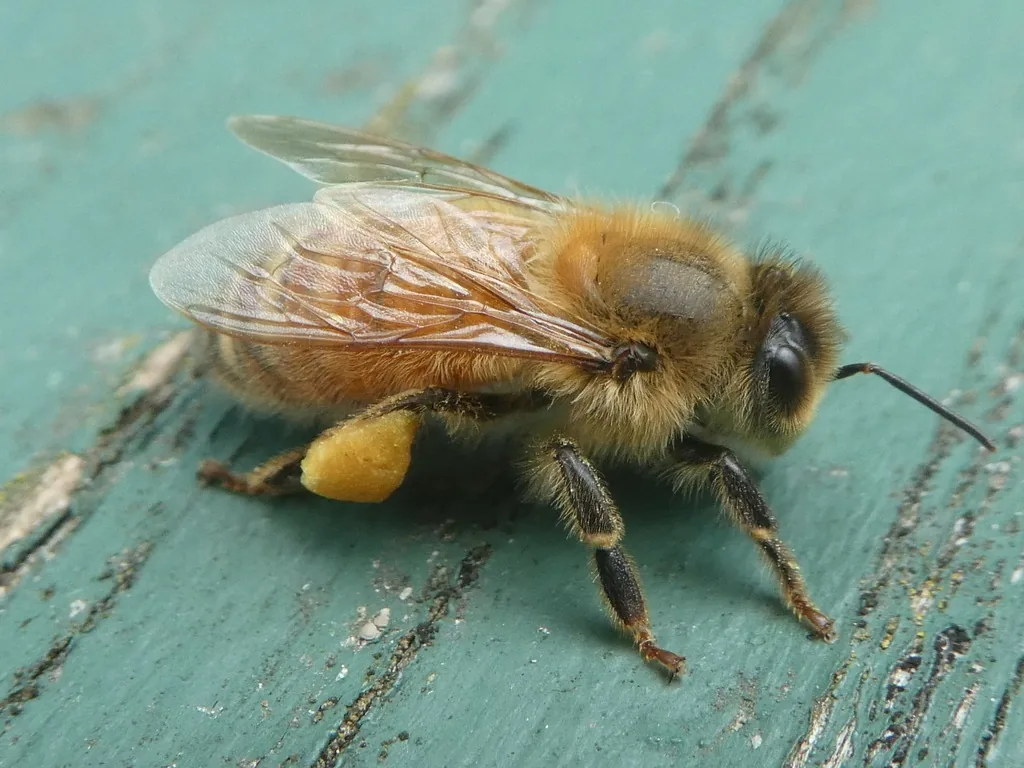
- About 1/2 inch long, golden brown with thin black stripes on the abdomen, and fuzzy, especially on the thorax.[5]
- Part of each hind leg is flattened for carrying pollen, and the wings lie flat over the abdomen at rest.[5][6]
- More slender than a bumble bee, and hairy, unlike yellowjackets and other wasps, which are smooth with narrow waists.[6]
- A swarm is a dense cluster of bees hanging from a branch or structure while scouts look for a new home.[1][5]
- The nest is a series of vertical wax combs.[5]
Look-alikes
| Look-alike | How to tell them apart |
|---|---|
| Yellowjacket | A wasp: smooth, mostly hairless and bright yellow and black with a narrow waist, and it scavenges sweets, meat and garbage around picnics and trash cans.[6][3][2] |
| Bumble bee | Stouter and hairier, with black-and-yellow bands; small annual colonies, usually under 50 bees, nest in soil cavities, old rodent burrows or similar voids.[4][6] |
Where it lives
Colonies usually nest in hollow trees but sometimes choose wall voids or attics; the comb may be some distance from the entrance hole.[1]
Biology and life cycle
Colonies are perennial and can last for many years. In winter, workers and the queen form a cluster and eat stored honey to make heat.[5][6]
When a colony gets crowded it swarms: the old queen leaves with many workers, often about half the colony, and the swarm clusters on a branch or structure while scout bees look for a cavity such as a hollow tree.[5][6][1]
Kentucky says swarms are common from late April through June; Minnesota says late spring and early summer, usually in the warmer hours of the day.[1][5]
Swarms usually settle in a new home within a day or so and leave on their own; a few bees left behind will die within days.[1]
Foragers collect nectar and pollen and visit bird baths and puddles for water; when flowers are scarce they look for syrups, fruit juice and other sweets.[5][1]
The honey bee's stinger is barbed and stays in the skin; it tears out of the bee, which soon dies. Yellowjackets, paper wasps and bumble bees can sting more than once.[5]
Damage and signs
- If an established hive in a wall is killed but the comb is left, the wax can melt or be eaten by wax moth larvae and honey can leak through walls, leaving a permanent stain.[1]
- Leftover comb and honey also draw bees from other colonies, scavenging insects such as carpet beetles, and mice, and colony odors can attract new swarms.[1][5]
Health risk
Bee stings are most often painful at the site, and people allergic to the venom can have anaphylaxis, a severe, life-threatening reaction that can come on quickly and needs emergency care.[9][10]
Control
Prevention
Confirm they are honey bees first: catch one or take a clear photo and have it identified.[5]
Leave a swarm alone and keep people back; it usually moves on within hours to a couple of days.[5][6][1]
Keep them out
Once the colony and comb are out, plug or screen every entrance, and seal cracks in walls and under eaves before swarm season.[1]
Sanitation
Clean up sugary spills and use lids and liners on trash and recycling bins to avoid attracting foraging bees.[1]
When to call a professional
Call a local beekeeper to collect a swarm or remove a colony from a wall; your county extension office or fire station may have a list, and Minnesota Extension links a bee removal list for Iowa, Minnesota and Wisconsin.[1][5]
After a colony is removed or killed, remove the comb and honey and don't eat or save honey from a treated colony; agree in advance on cleanup and repairs.[1][5]
Swarm or established colony?
Swarming bees usually are not aggressive and seldom sting unless disturbed. Once a colony is established in a structure, it becomes much more defensive and likely to sting.[1][6][5]
A colony inside a wall will not move on by itself the way a swarm does; colonies persist year-round, and a feral colony in or near a home may survive for many years.[6][5]
The comb may be some distance from the entrance hole; Kentucky says tapping the wall and listening for an answering buzz can help find it.[1]
Who may remove honey bees: two state examples
Texas: beekeepers registered with the Texas Apiary Inspection Service are exempt from the Texas Structural Pest Control Act (Occupations Code section 1951.056). The service keeps a list of registered beekeepers who do removals but does not license or permit bee removal or vouch for anyone's training; licensed structural pest control operators are listed by the Texas Department of Agriculture.[7]
Florida: rule 5E-14.151 of the Florida Administrative Code, adopted in 2013, exempts live bee removal by registered beekeepers from the performance of pest control, giving them authority to remove live bees in, on or under structures.[8]
Other states have their own rules; Kentucky Extension suggests the county extension office or a local fire station for lists of beekeepers who remove bees.[1]
If a honey bee stings
Remove the stinger by scraping across it with a fingernail, gauze or the edge of a card. Don't squeeze it or use tweezers, which can squeeze more venom out of the sac.[9][10]
Wash with soap and water, then apply ice wrapped in a cloth, 10 minutes on and 10 minutes off. An antihistamine or anti-itch cream may help; scratching can increase swelling, itching and the risk of infection.[9][10]
Have someone stay with the person to watch for an allergic reaction. Call 911 for trouble breathing, wheezing, swelling of the face or mouth, or throat tightness, and use the person's epinephrine auto-injector if they have one.[9][10]
If several bees attack, run away, ideally to shade; stinging bees release a chemical that can attract other bees. Don't jump into water, since insects may hover above it.[10]
Anyone who has had a severe, bodywide reaction to a bee sting should be referred to an allergist and carry an emergency kit.[9]
Where sources disagree
How long a swarm stays: Kentucky says a day or so; Penn State says it departs within two days; Minnesota says an hour to a few days, depending on weather and scouting.[1][6][5]
When a colony must be killed: Kentucky says established colonies are best killed in late winter, when numbers are low; Minnesota says early spring, March to April, when little honey is left.[1][5]
Leftover wax: Kentucky says comb left in a wall can melt or be riddled by wax moth larvae and leak honey, so remove it; Minnesota says remaining wax usually isn't a problem because wax moths destroy it quickly, though leftover combs and honey are.[1][5]
How often colonies use buildings: Minnesota says honey bee colonies are not usually found in buildings; Kentucky says scouts usually choose hollow trees but many times pick wall voids.[5][1]
Common questions
- Should I spray a swarm on my tree?
- No. Swarms are rarely aggressive and usually leave within a day or two; a beekeeper may collect it.[1][5][6]
- How do I get a honey bee stinger out?
- Scrape it out sideways with a fingernail, gauze or a card edge as soon as you can; don't pinch it or use tweezers.[9][10]
- Why does the comb have to come out?
- Comb and honey left in a wall can melt, leak and stain, and they attract robbing bees, scavenging insects, mice and future swarms.[1][5]
- Will bees living in my wall leave on their own?
- Usually not. Honey bee colonies persist year-round and can survive for years; call a beekeeper about removing them with the comb.[6][5][1]
Sources
- University of Kentucky Entomology, “ENTFACT-606: Controlling Nuisance Honey Bees.” entomology.mgcafe.uky.edu/ef606 (accessed 2026-11-11)
- University of California Statewide IPM Program, “Pest Notes: Yellowjackets and Other Social Wasps, Publication 7450 (March 2012).” ipm.ucanr.edu/legacy_assets/PDF/PESTNOTES/pnyellowjackets.pdf (accessed 2026-11-11)
- University of Kentucky Entomology, “ENTFACT-620: Controlling Wasps, Hornets, and Yellowjackets.” entomology.mgcafe.uky.edu/ef620 (accessed 2026-11-11)
- Ohio State University Extension, “Bumble Bees and Solitary Bees & Wasps in Urban Landscapes, HYG-2143 (2011).” ohioline.osu.edu/factsheet/HYG-2143-10 (accessed 2026-11-11)
- University of Minnesota Extension, “Wasps and bees.” extension.umn.edu/insects-infest-homes/wasps-and-bees (accessed 2026-11-11)
- Penn State Extension, “Five-Step Decision Support: Nesting Bees and Wasps Near Homes.” extension.psu.edu/five-step-decision-support-nesting-bees-and-wasps-near-homes (accessed 2026-11-11)
- Texas Apiary Inspection Service, “Bee Removal (registered beekeepers list).” txbeeinspection.tamu.edu/bee-removal/ (accessed 2026-11-11)
- Florida Administrative Code, Florida Department of State, “Rule 5E-14.151: Removal and Relocation of Bees from Structures, Lawns or Ornamentals.” www.flrules.org/gateway/ruleNo.asp?id=5E-14.151 (accessed 2026-11-11)
- MedlinePlus, U.S. National Library of Medicine, “Insect bites and stings (Medical Encyclopedia).” medlineplus.gov/ency/article/000033.htm (accessed 2026-11-11)
- Centers for Disease Control and Prevention, NIOSH, “Insects and Scorpions at Work.” www.cdc.gov/niosh/outdoor-workers/about/insects-and-scorpions.html (accessed 2026-11-11)
- iNaturalist, “Apis mellifera taxon page (order and family).” www.inaturalist.org/taxa/47219 (accessed 2026-11-11)