On this page
How to identify it
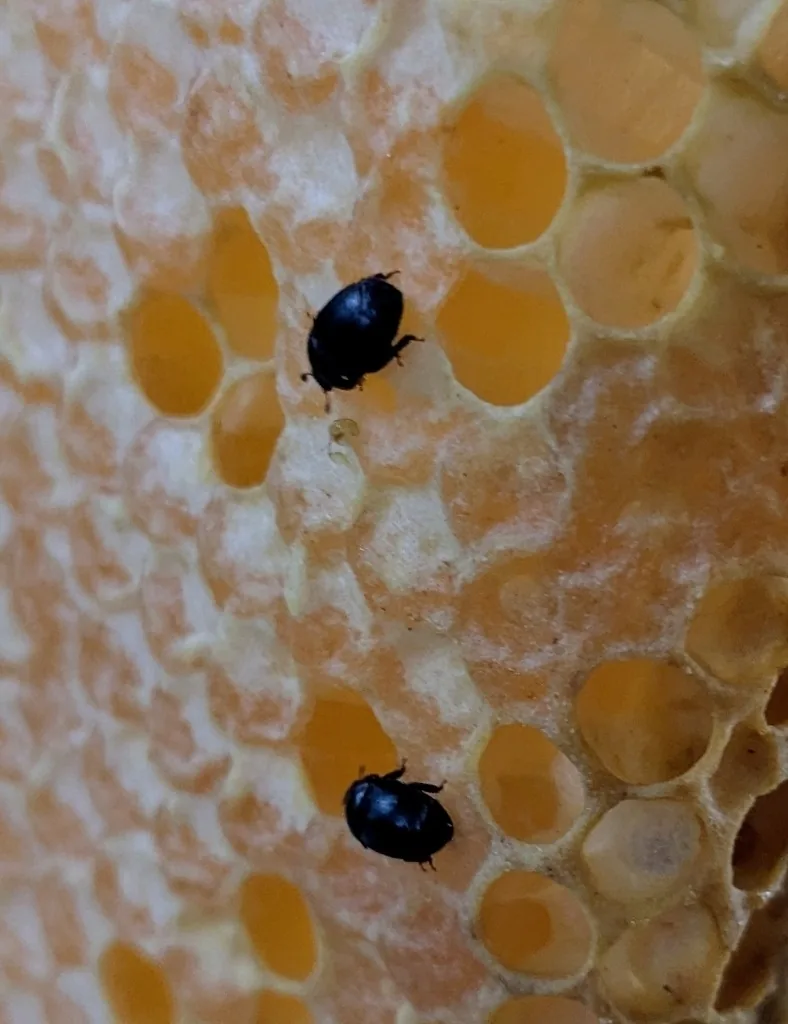
- Adults are oval, light brown to black and about 1/4 inch (5 to 7 mm) long, roughly a third the size of a honey bee, with club-shaped antennae.[1][2][3][4]
- Adults run from light and hide in cracks, under the inner cover or on the bottom board when a hive is opened, so they're easy to miss at low numbers.[2][1][4]
- Larvae are cream-colored and grow to about 1/2 inch (10 to 12 mm). They look like young wax moth larvae but have spines along the back and no prolegs behind the three pairs of true legs, and they cluster in masses and make slime instead of silk webbing.[1][2][3]
Look-alikes
| Look-alike | How to tell them apart |
|---|---|
| Sap beetles | Sap beetles (picnic beetles) are in the same family and have similar club-shaped antennae; other sap beetles and rove beetles around hives are also mistaken for small hive beetles.[1][2] |
| Wax moths | Wax moth larvae have prolegs, no back spines and spin silk webbing; small hive beetle larvae have back spines, travel in masses and leave slime.[1][3][4] |
Where it lives
Native to sub-Saharan Africa. First detected in the US in 1996 near Charleston, South Carolina, and identified in Florida in 1998; it has since spread across most of the contiguous US (Oregon State counts 35 states) and to Canada, Mexico, Australia, Italy and South Korea. Alaska had its first detection in 2025. It is most damaging in the warm, humid Southeast.[2][1][3][5]
Biology and life cycle
Females lay eggs in cracks and crevices in the hive or in cells with brood or pollen. A single female may lay as many as 1,000 eggs in her lifetime.[1][3][4]
Larvae feed for about one to two weeks, then crawl out of the hive to pupate in soil, usually within about 2 to 3 feet of the hive, burrowing about 4 inches deep (Oregon State) or 4 to 8 inches (10 to 20 cm, Montana). Moist, loose or sandy soil suits them best.[1][4]
New adults emerge after a few weeks in the soil, can fly a long way to find hives by smell, and can survive winter inside the bees' cluster. Montana says up to six generations a year are possible in good conditions.[1][2][4][3]
Adults can even beg food from worker bees. Their hard wing covers resist stings, and bees try to confine them with propolis because they can't evict them.[1][4][3]
Damage and signs
- Larvae eat brood, honey and pollen. Severe infestations leave slimy, discolored comb with fermenting honey that may run out of the hive, masses of larvae, a rotten smell, and sometimes a queen that stops laying or a colony that absconds.[1][2][5][4]
- Honey fouled by the beetles is unfit to eat, and stored supers and combs with no bees to guard them are especially vulnerable.[1][4][3]
- Small or stressed colonies are most at risk: splits, nucs, new packages, colonies after swarming or queen loss, and hives with too much empty space or protein patties that the beetles are drawn to.[1][2]
Health risk
It is a pest of honey bee colonies; none of the sources describes any harm to people.[1][2]
Control
Prevention
Keep colonies strong, don't leave burr comb, dead-outs or unused frames in the apiary, extract honey supers promptly, remove extra empty supers, and keep inspections short. Buy package bees and queens carefully from areas where the beetle is established.[1][2][4]
Set the outer cover in direct sun, put the top box on it, then lift it after the inspection to find beetles that fled into the dark. Corrugated cardboard or plastic on the bottom board also shows hiding beetles; varroa sticky boards don't work for this.[1][4][3]
Sanitation
Freeze frames that have beetle eggs or larvae: Oregon State says at least 48 hours, NC State 24 hours, and Alaska notes the beetles can't survive 10°F or lower for more than 24 hours. Kill larvae found on the bottom board in soapy water instead of brushing them onto the ground.[1][2][3]
Traps and physical control
In-hive traps, usually with a lure such as vinegar and oil to keep the beetles from escaping, help keep numbers down. Placing hives on clay, rocky ground or platforms keeps larvae from pupating in soil.[2][1][4]
Pesticides
Chemicals are a last resort and never preventive. Coumaphos strips are the only registered in-hive treatment, but resistance has been reported and NC State no longer recommends them; honey made during treatment can't be eaten. A permethrin soil drench can kill larvae pupating around the hive but is highly toxic to bees. Alaska has no pesticides approved for it. Follow the label.[1][2][3][4]
Reporting and regulations
USDA APHIS lists small hive beetle infestation as a monitored condition, reportable monthly under the National List of Reportable Animal Diseases.[5]
North Carolina's Department of Agriculture set up a quarantine when the beetle arrived but lifted it in July 2003 once the beetle was established statewide. Montana has strict quarantine requirements to protect its beekeeping industry and asks beekeepers to report a find to the State Entomologist right away.[2][4]
Alaska confirmed its first detection in 2025, in package bees from Mississippi, aims to eradicate it, and requires anyone importing bees to have a health certificate signed by an apiary inspector. Oregon State asks Oregon beekeepers to report finds and send alcohol-preserved samples for identification.[3][1]
A 2025 review notes the beetle now damages bee colonies in the Americas, Europe, Asia and Australia and that management has yet to find a lasting solution.[6]
Where sources disagree
Timing varies with temperature and source. Egg hatch: within 24 hours (NC State), 1 to 3 days (Alaska), 2 to 4 days (Oregon State), 3 to 5 days (Montana). Time in the soil: 2 to 3 weeks (Alaska), 3 to 4 weeks (Montana), 3 to 5 weeks (NC State), 3 to 6 weeks (Oregon State).[2][3][1][4]
Soil and climate: Oregon State and USDA APHIS describe it as needing warm, humid conditions; NC State says it has proved able to survive in almost any soil and through extreme winters.[1][5][2]
Common questions
- Why is the honey in my hive slimy?
- Small hive beetle larvae feeding in the comb make honey ferment and turn slimy; bees won't clean slimy comb. Look for masses of spiny, cream-colored larvae.[1][2][3]
- Do I have to report small hive beetles?
- It depends on the state. Where the beetle is new, such as Alaska, Montana and Oregon, officials ask beekeepers to report it; nationally it is a monitored condition that APHIS tracks.[3][4][1][5]
Sources
- Oregon State University Extension, “The Small Hive Beetle: A Potential Pest in Honey Bee Colonies in Oregon (EM 9143).” extension.oregonstate.edu/catalog/em-9143-small-hive-beetle-potential-pest-honey-bee-colonies-oregon (accessed 2026-11-11)
- NC State Extension, “The Small Hive Beetle: A Pest of Honey Bee Colonies.” content.ces.ncsu.edu/the-small-hive-beetle-a-pest-of-honey-bee-colonies (accessed 2026-11-11)
- Alaska Department of Natural Resources, Division of Agriculture (with UAF Extension), “Pest Alert: Small Hive Beetle (Aethina tumida) (September 2025).” dnr.alaska.gov/ag/Inspection/2025/Pest%20Alert-Small%20Hive%20Beetle.pdf (accessed 2026-11-11)
- Montana Department of Agriculture, “Small Hive Beetle (Aethina tumida) info sheet.” agr.mt.gov/_docs/bees-docs/Small-Hive-Beetle-Info-Sheet.pdf (accessed 2026-11-11)
- USDA APHIS Veterinary Services, “Case Definition: Small Hive Beetle Infestation (Monitored), December 2023.” www.aphis.usda.gov/sites/default/files/small-hive-beetle-case-definition.pdf (accessed 2026-11-11)
- Journal of Chemical Ecology, via PubMed, “Chemical Ecology and Management of the Small Hive Beetle, Aethina tumida (Bobadoye et al. 2025).” pubmed.ncbi.nlm.nih.gov/39890687/ (accessed 2026-11-11)
- iNaturalist, “Aethina tumida taxon page (order and family).” www.inaturalist.org/taxa/457066 (accessed 2026-11-11)