On this page
How to identify it
- Larvae tunnel through comb, especially old brood comb that holds pollen and bee bread, and leave a trail of silk webbing and droppings. Young larvae often escape notice because they tunnel under the cappings of brood comb, a habit more common in the lesser wax moth.[1][2]
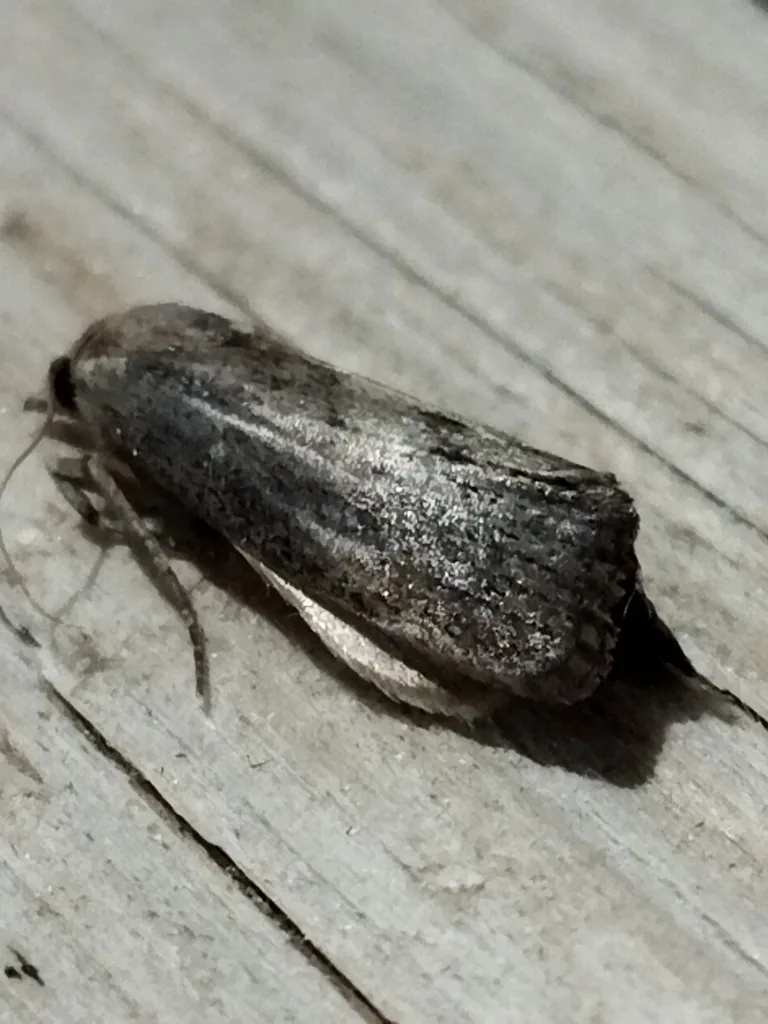
- Kwadha and colleagues describe greater wax moth larvae as about 1 to 3 mm long at hatching and 25 to 30 mm before they pupate. Adult females average 15 to 20 mm long with a wingspan of about 31 mm, and males are smaller and paler.[2]
- Young wax moth larvae are often confused with small hive beetle larvae; both are dirty white with brown heads.[1]
- When bees uncap pupae to reach a tunneling wax moth larva, the exposed pupae are called 'bald brood'. Unless they were damaged, the bees recap them.[1]
Look-alikes
| Look-alike | How to tell them apart |
|---|---|
| Small hive beetle | Mississippi State's rule of thumb: if a larva squishes easily when rolled between thumb and forefinger, it's a wax moth. Hive beetle larvae make honey ferment and leave a slimy mess with a rotten-orange odor.[1] |
Where it lives
Both species occur in Mississippi. Kwadha and colleagues describe the greater wax moth as found wherever beekeeping is practiced, with the most severe damage in tropical and subtropical regions.[1][2]
Biology and life cycle
Only the larva does damage; adults don't feed. Females fly at dusk, enter inactive hives and lay eggs in clumps in cracks and crevices inside and outside the hive. Kwadha and colleagues give clusters of 50 to 150 eggs.[1][2]
Mississippi State says larvae hatch within 5 to 8 days and look for comb; the review gives 3 to 30 days. Larvae feed for anywhere from 28 days to 6 months before spinning a cocoon, and there are four to six generations a year.[1][2]
The greater wax moth does most of the damage to stored comb and woodenware. The review calls the lesser wax moth less destructive and less common.[1][2]
Damage and signs
- Larvae chew silk-lined tunnels through the cell walls and over the comb, letting honey leak out, and the silk can trap emerging bees. Heavy infestations can lead to colony loss or absconding.[2]
- Pupating larvae leave cocoons and webbing nestled into the wooden parts of the hive, which have to be cleaned out by hand.[1]
- The larvae have been studied as possible carriers of honey bee pathogens: spores of the bee pathogen Paenibacillus larvae have been found in their droppings, and two honey bee viruses in the larvae.[2]
Health risk
They feed on comb, pollen and bee products; none of these sources reports bites or other harm to people or pets.[1][2]
Control
Sanitation
Pick up combs from dead or absconded colonies right away, keep colonies strong with enough food, replace old combs regularly and destroy badly infested ones.[1][2]
Traps and physical control
Freeze stored combs to kill hidden eggs and larvae before storing them. Mississippi State advises 48 hours at 0°F, then stacking the boxes on a solid floor; the review cites home freezers at −7 to −15 °C for 2 to 4.5 hours.[1][2]
Biological control
A Bacillus thuringiensis product that targets moth larvae can be applied to comb after the honey harvest and stays active for months; larvae must eat it to die. A 2023 field study found a Bt strain combined with a trap that keeps bees away from the bait reduced greater wax moth larvae.[1][3]
Pesticides
For stored comb only, Mississippi State recommends wax moth crystals (paradichlorobenzene) in a tightly sealed stack about five boxes high, placed on the top bars because the fumes sink. Never use naphthalene mothballs, which leach into honey and make it unfit to eat.[1]
Where sources disagree
Fumigants: Mississippi State recommends paradichlorobenzene crystals for stored comb. Kwadha and colleagues report that paradichlorobenzene does not kill eggs, that it and most older fumigants can leave residues in hive products, and that only carbon dioxide is currently recommended.[1][2]
Strong or weak colonies: Mississippi State says wax moths are far more common in dead colonies and co-infest mainly very weak ones. The review notes a finding that egg-laying females prefer strong colonies, while still listing a strong colony as the best defense.[1][2]
Bt: Mississippi State says its Bt product stays active for months; the review cites studies in which Bt lost effectiveness after the first season or after about 13 months.[1][2]
Common questions
- What are the worms and webbing in my stored bee frames?
- Silk webbing, tunnels and droppings through stored comb are the work of wax moth larvae.[1][2]
- How do I keep wax moths out of stored comb?
- Freeze the frames to kill any eggs and larvae, then store them where moths can't reach them; Mississippi State also recommends a protective treatment after freezing.[1][2]
- Is it a wax moth larva or a small hive beetle larva?
- Roll it gently between thumb and forefinger. If it squishes easily, it's a wax moth.[1]
Sources
- Mississippi State University Extension, “Wax Moths, Greater and Lesser (Publication 3195).” extension.msstate.edu/sites/default/files/publications/P3195_web.pdf (accessed 2026-11-11)
- Insects, via PubMed, “Kwadha and others (2017), The biology and control of the greater wax moth, Galleria mellonella (full text, PMC5492075).” pubmed.ncbi.nlm.nih.gov/28598383/ (accessed 2026-11-11)
- Nature Communications, via PubMed, “Han and others (2023), Greater wax moth control in apiaries can be improved by combining Bacillus thuringiensis and entrapments.” pubmed.ncbi.nlm.nih.gov/37925529/ (accessed 2026-11-11)
- iNaturalist, “Galleria mellonella taxon page (order and family).” www.inaturalist.org/taxa/122940 (accessed 2026-10-06)