On this page
How to identify it
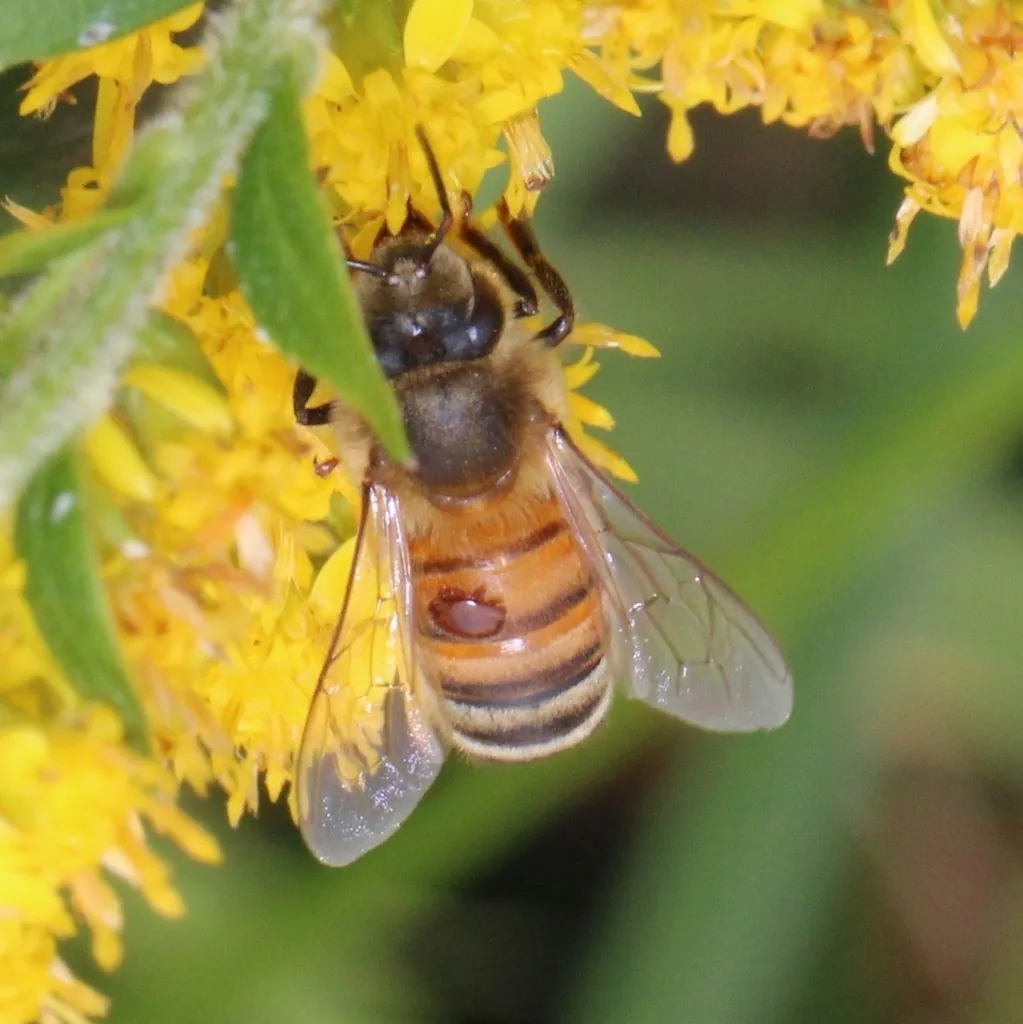
- In heavily infested hives the mites can be seen clinging to the bodies of adult bees.[2]
- Bees with crumpled, deformed wings are a warning sign, because the mites spread deformed wing virus.[2]
- By the time mites are easy to see, numbers are often already high, so beekeepers count them with a sampling method such as an alcohol wash or powdered sugar shake rather than waiting for symptoms.[1][2][3]
Where it lives
Originally from Southeast Asia, it was introduced to the United States in the late 1980s; Maine's state apiarist calls it the largest threat to honey bee colonies worldwide.[1]
Biology and life cycle
A female mite reproduces inside a capped brood cell; her first egg becomes a male and later eggs become females, which develop alongside the growing bee.[1]
Mites feed on both adult bees and developing brood, and their numbers can grow quickly through the season.[2][1]
Damage and signs
- Feeding weakens the bees and spreads viruses, especially deformed wing virus; heavily infested colonies decline and can die.[2]
Health risk
It parasitizes honey bees only; none of the sources reports any risk to people or pets.[2][1]
Control
Prevention
Check mite levels regularly, monthly through the season according to Delaware and at least twice a year according to Mississippi State, with an alcohol wash: shake a sample of adult bees in 70 percent rubbing alcohol or soapy water and count the mites that fall out.[2][4]
Mississippi State recommends treating when counts exceed 1 mite per 100 bees in February or 3 mites per 100 bees from May through October, which leaves time to protect the bees that will overwinter.[4]
Biological control
Non-chemical tools include brood interruption and mite-resistant bee stocks such as Varroa Sensitive Hygienic, Russian and Minnesota Hygienic bees.[1]
Pesticides
Miticides labeled for honey bee colonies, such as formic acid strips and other 'soft' treatments that act for 3 to 10 days, are used when counts pass the threshold; rotate products to slow resistance and follow the label.[1][4]
Common questions
- How do I check my hive for Varroa mites?
- Use an alcohol wash: shake a sample of adult bees from a brood frame in 70 percent alcohol or soapy water, count the mites and compare the count with a treatment threshold.[4][2]
- When should I treat for Varroa mites?
- Mississippi State uses thresholds of 1 mite per 100 bees in late winter and 3 per 100 from May through October; treating in time protects the winter bees.[4]
Sources
- Maine Department of Agriculture, Conservation and Forestry, “Honey bee pests: Varroa mite (State Apiarist fact sheet).” www.maine.gov/dacf/php/apiary/documents/factsheets/pests.pdf (accessed 2026-11-12)
- Delaware Department of Agriculture, “Varroa Mites (June 2023).” agriculture.delaware.gov/wp-content/uploads/sites/108/2023/06/Varroa-Mites_Final_6.12.23.pdf (accessed 2026-11-12)
- Virginia Cooperative Extension, “Varroa Mite Sampling Methods (ENTO-332, 2025).” aaec.vt.edu/content/dam/pubs_ext_vt_edu/ENTO/ento-332/ENTO-332.pdf (accessed 2026-11-12)
- Mississippi State University Extension Service, “Sampling for Varroa Mites Using an Alcohol Wash (P4049, J. Harris).” extension.msstate.edu/publications/sampling-for-varroa-mites-using-alcohol-wash (accessed 2026-11-12)
- iNaturalist, “Varroa destructor taxon page (order and family).” www.inaturalist.org/taxa/194693 (accessed 2026-10-06)