The short answer
- Varroa mites are the pest most likely to kill a backyard colony. Wax moths and small hive beetles mostly take over colonies that are already weak and ruin comb in storage. Test for mites with an alcohol wash, treat when the count passes your threshold (sources range from 1 to 3 mites per 100 bees), keep colonies strong, and freeze or properly store spare comb.[1][7][5][4][2][3]
- Check Varroa mite levels every month with an alcohol wash and treat when counts call for it, because an unmonitored infestation can kill a colony.[1][7][6]
- Keep colonies strong and protect stored comb, which guards against both wax moths and small hive beetles.[3][5][4]
Hive pest profiles
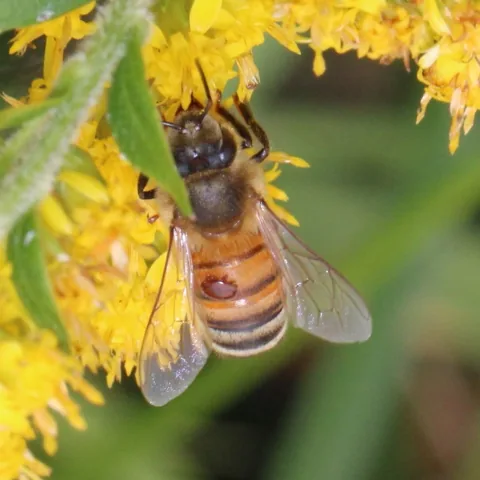 Varroa Mite
Varroa destructor
The Varroa mite is the most damaging pest of honey bees: it feeds on adult bees and developing brood, weakens the colony and spreads viruses, and an unmonitored infestation can kill the hive.
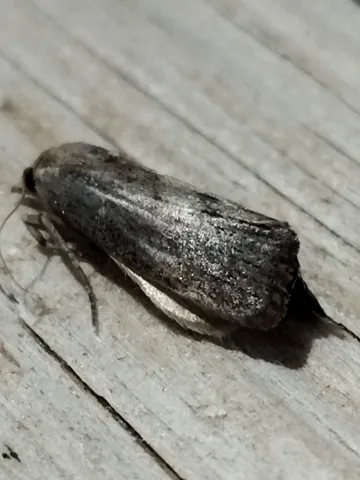 Wax Moths
Galleria mellonella (greater wax moth) and Achroia grisella (lesser wax moth)
Two moths, the greater wax moth (Galleria mellonella) and the lesser wax moth (Achroia grisella), live with honey bee colonies. Their caterpillars tunnel through beeswax comb, leaving silk webbing and droppings, and do most harm in weak or dead colonies and in stored comb.
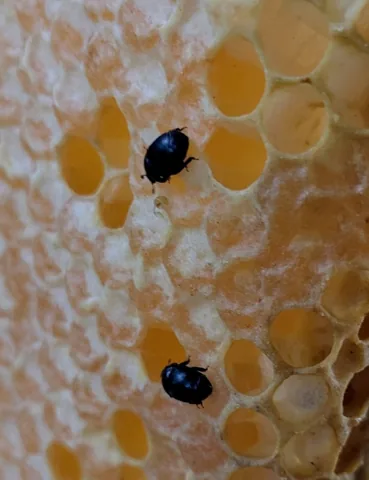 Small Hive Beetle
Aethina tumida
The small hive beetle is an invasive beetle from sub-Saharan Africa. Strong colonies can live with the adults, but in weak or stressed colonies the larvae eat brood, pollen and honey and leave the comb a slimy, fermenting mess.
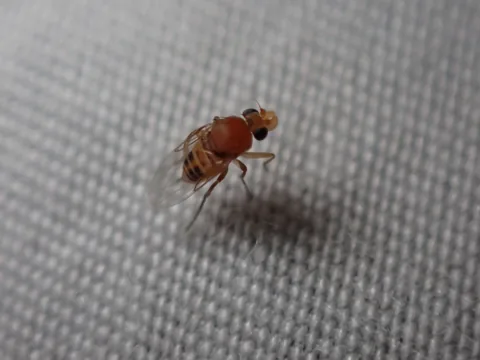 Zombie Fly
Apocephalus borealis
The zombie fly (Apocephalus borealis) is a tiny North American phorid fly whose maggots develop inside bumble bees and paper wasps. In 2012 researchers in San Francisco found that it also attacks honey bees. Infected honey bees leave their hives at night, wander toward lights and die, which earned the fly its name, and researchers have called it a possible emerging threat to beekeeping.
Varroa mites, the most serious threat
Varroa mites are the most damaging pest of honey bees: they feed on adult bees and developing brood, weaken the colony and spread deformed wing virus.[1][4][5]
Varroa jumped from its original host, the Asian honey bee, to the European honey bee kept by beekeepers, and reached the United States in the late 1980s (Penn State gives 1987). A 2020 review calls it the greatest threat to honey bee health.[6][4][5][12]
Sources describe its feeding differently. A 2016 USDA ARS article says the mites feed on the bees' blood. A 2019 study by University of Maryland and USDA ARS scientists found that they feed mainly on the fat body, an organ that works roughly like a liver and matters for immune function and pesticide detoxification, not on blood (hemolymph). Delaware and Maine now describe it that way, and Penn State names both.[10][11][1][4][6]
The mites spread several viruses, including deformed wing virus, acute bee paralysis virus, Israeli acute paralysis virus, black queen cell virus and Kashmir virus. Penn State notes that virus levels rise with mite load from spring to fall, so controlling the mites is how you control the viruses.[4][6]
Varroa breeds only inside capped brood cells and prefers drone brood, because drone cells stay capped longer: 15 days, against 11 days for worker cells by Penn State's figure (Arkansas gives 12). Arkansas puts the average at 1.5 mature daughters per worker cell and 2.5 per drone cell; Penn State gives 1.3-1.4 and 2.2-2.6. While brood is present, most mites are under the cappings, where many treatments can't reach them.[6][5]
Numbers climb fast. Maine's state apiarist says mite populations can increase 12-fold in colonies having brood half of the year and 800-fold in colonies having brood year-round, and they rise most in late summer and early fall. Mites also ride in on robbing and drifting bees: a USDA ARS study in Arizona linked that influx to mite increases of 227 to 336 percent starting in November.[4][10][7]
Colonies with uncontrolled mites are likely to die in fall or over winter, and badly infested weak colonies spread mites and viruses to stronger colonies nearby.[7][12]
- By the time mites are easy to see on bees, levels are often already high, so check monthly with an alcohol wash using rubbing alcohol or soapy water.[1][4]
- How to do an alcohol wash: shake bees from a brood frame (make sure the queen isn't on it), scoop 1/2 cup (about 300 bees) into a jar, cover them with 70% rubbing alcohol or soapy water, shake for 1 minute, then pour the liquid through a #8 mesh lid into a light-colored pan and count the mites. Divide mites by bees and multiply by 100 to get mites per 100 bees.[1][4][5][7]
- How often: Delaware, Penn State and Minnesota say monthly; Maine says every 3-4 weeks starting in spring, and more often in late summer and early fall, when mite numbers rise fastest.[1][6][7][4]
- A powdered sugar roll lets most of the sampled bees live, but it is less reliable than an alcohol wash: humid weather or a nectar flow makes the sugar sticky and the test invalid.[7][6]
- Sticky boards under a screened floor can't give a true infestation rate, but they show whether mites are rising from month to month. Arkansas Extension says fewer than 3 mites per day may be acceptable in early spring, and more than 30 per day in late summer will likely prompt treatment.[5]
- A low count isn't an all-clear. Testing adult bees underestimates the mites when there is a lot of brood, and a colony with zero mites in a test can still build a damaging population later in the year.[7][4]
- Treatment thresholds differ. Delaware says treat at more than 3 mites in a 300-bee sample (1%). Minnesota aims for below 1% all year and says treatment may be warranted above 2%. Maine calls 2% a high risk of colony loss. Penn State aims to keep levels at or below about 2 mites per 100 bees, and Arkansas says to keep them below 3%. Thresholds have trended lower in recent years as mite-borne viruses have done more damage.[1][7][4][6][5][12]
Controlling Varroa without breeding resistant mites
Delaware, Maine, Penn State and Minnesota all recommend integrated pest management: use bee stock and hive practices that slow mite growth, test regularly, treat only when counts call for it, and rotate products so the mites don't become resistant.[1][6][7][4]
- Drone brood trapping: put a drone-comb frame next to the brood nest and remove it after the cells are capped but before the drones emerge in about 24 days, then freeze it for at least 24 hours or scrape it out. Forgetting the frame breeds extra mites, and Penn State says the method may not be enough on its own.[7][4][6][5]
- Brood break: caging or removing the queen for about 3 weeks lets all the brood emerge and forces the mites onto adult bees. Maine says to leave the colony queenless for at least a week. A break works best paired with a treatment such as oxalic acid while there is no sealed brood.[6][4][7]
- Screened bottom boards, developed at the USDA ARS Beltsville Bee Lab, let mites that fall off the bees drop out of the hive. Maine puts the effect at reductions up to 15%, so they need to be combined with other methods.[9][4][6]
- Mite-resistant stock: Varroa Sensitive Hygienic (VSH), Russian and Minnesota Hygienic bees have shown some resistance. Minnesota's Bee Lab cautions that a bred queen is not a guarantee, so keep testing.[4][6][7]
- Soft treatments: formic acid gets through the cell cappings and kills mites in brood, but it can kill brood and the queen above 85°F and works poorly below 50°F. Oxalic acid and thymol don't get through cappings, so oxalic acid works best when there is little or no brood and thymol only kills mites on adult bees. Hop beta acids can be used during the honey flow but are generally less effective.[6][4][1]
- Honey supers: some mite products can't be used while bees are making honey, and others can. Read the label before you apply, because using a miticide other than as the label says is against the law and can harm or kill the colony. Wear what the label requires: chemical-resistant gloves at minimum, and some products also need goggles and a respirator.[4][1][7][5]
- Resistance: mites are widely resistant to fluvalinate and coumaphos. Amitraz still works in many operations, but a 2020 USDA ARS study in Louisiana, New York and South Dakota found apiaries ranging from no resistance to high resistance that caused control failure. Rotate active ingredients each time you treat.[6][5][14][1][4]
- Remove strips when the label says. Arkansas Extension notes the treatment period is often 42 days, or two brood cycles; leaving a product in longer exposes mites to a weaker dose they are more likely to survive.[5]
Wax moths and small hive beetles in the comb
Wax moth larvae tunnel through comb and leave silk webbing, mostly in weak colonies and stored frames; the greater wax moth does most of the damage to stored combs and woodenware.[2][5][4]
- Wax moth life cycle: females lay clumps of eggs in cracks inside and outside the hive, and Mississippi State says the new larvae are out looking for comb within 5 to 8 days (Arkansas: eggs can hatch within a few days, depending on temperature). Larvae feed for 6-7 weeks and grow up to 1 inch long; one female can lay up to 2,000 eggs. Only the larvae do damage, and the adults do not feed.[2][5]
- Dark, older brood combs with pollen and old cocoons attract wax moths most; combs used only for honey are much less attractive.[5][2]
- Signs of wax moths: silk trails on and between combs, tunnels through comb, small brown droppings on the bottom board, and cocoons packed along the edges of boxes and frames. Heavy webbing can drive a colony to abscond.[4][2][5][13]
- Bald brood (a straight line of uncapped pupae) means bees are digging out a wax moth larva. Sources differ on what comes next: Mississippi State says undamaged pupae will be recapped, while Arkansas says the cells are typically not recapped but the pupae still develop and emerge normally.[2][5]
- Small hive beetles are invasive beetles from sub-Saharan Africa whose larvae damage honey bee colonies and stored combs.[3][5]
- Small hive beetle adults are brown to black, oval and about 1/4 inch long (Oregon State gives 5.7 millimeters, Maine 5-6 mm). They were first found in the United States in the late 1990s and are most troublesome in the hot, humid Southeast.[3][4][5]
- Small hive beetle life cycle: eggs hatch in two to four days. Sources give different larval feeding times: 7-10 days (Arkansas), 10-16 days (Maine), or as little as five days and generally within two weeks (Oregon State). Mature larvae leave the hive, burrow about 4 inches into soil, usually within about 2 feet of the hive, and pupate for 3-6 weeks. One female can lay up to 1000 eggs.[3][5][4]
- A slimed hive: beetle larvae carry a yeast that makes honey ferment and run out of the cells, the comb turns slimy, and the hive smells of rotten oranges. The bees often abscond, and honey contaminated by beetle larvae is not fit to eat.[2][5][3][4]
- Colonies at most risk: small splits, nucs, new packages and colonies that just swarmed, colonies that lost their queen, hives with too many empty supers, and hives given protein patties the bees don't eat right away. Very frequent inspections also seem to make infestations worse.[3][5]
- Sources disagree on how serious the beetle is. Mississippi State calls it a minor pest biologically, because it doesn't spread disease and hundreds of adults can live in a strong hive without breeding much, and Maine calls it a secondary pest. Oregon State calls it invasive and damaging, and a 2021 USDA ARS and Florida A&M study calls it a serious threat to the honey bee industry.[2][4][3][15]
- Young wax moth larvae are often confused with small hive beetle larvae; Mississippi State compares the two side by side.[2][3]
- Telling the larvae apart: small hive beetle larvae have spines on their backs, no fleshy prolegs past their three pairs of true legs, and leave slime. Wax moth larvae have prolegs and leave silk webbing, and they squish easily when rolled between thumb and finger.[3][2]
Small hive beetle control
- There is no set number of beetles that calls for treatment. The best defense is strong colonies: requeen, combine or remove weak colonies, and don't make splits from heavily infested hives.[3][5][4]
- Checking for beetles: they run from light, so set the top box on the upturned outer cover in the sun and look in the shaded cover when you lift it, or lay strips of corrugated cardboard or plastic on the bottom board and check them for hiding beetles. The sticky boards used for Varroa don't work for beetles.[3][4]
- Traps: most in-hive traps let beetles hide in oil or soapy water and drown, some with apple cider vinegar as bait. Keep oil trays clean, because a dry tray full of debris becomes a breeding site. Don't use roach bait stations containing fipronil, which is highly toxic to honey bees.[5][4][2]
- Siting: place hives in the sun. Beetles reproduce well in moist, loose or sandy soil, so rocky or clay ground or a platform that keeps larvae from reaching soil can cut breeding.[3]
- Soil treatment after a slime-out: a permethrin soil drench applied as the label directs keeps larvae in the soil from emerging. Arkansas Extension says to apply it in late evening, drench the soil 18-24 inches in front of the hives with a sprinkler can, never use a pressurized sprayer and keep it off the hive equipment. Permethrin is highly toxic to bees.[5][4][3][2]
- Beneficial nematodes (Heterorhabditis indica and Steinernema carpocapsae) applied to the soil under hives may help by killing beetle pupae, though results depend on soil type and moisture.[5]
- In-hive chemical: coumaphos is the only insecticide registered for beetles inside the hive. Mississippi State does not highly recommend it because it can harm queens, Oregon State notes resistance has been reported, and the 2021 Florida study measured 43.7-fold resistance to coumaphos built up over 10 years.[2][3][15]
- Once larvae have pupated in an apiary's soil, it becomes a beetle reservoir. Mississippi State says it takes about 3 years for numbers to reach critical levels without control, at which point hives must be moved.[2]
- In the honey house: extract honey within two days of removing it from the hive, cover or freeze wet cappings, and freeze frames with beetle eggs or larvae. USDA ARS found that keeping humidity below 50% kills beetle eggs, and Oregon State suggests a fluorescent light near the floor to draw wandering larvae out for collection.[5][3][9]
Prevention that covers all three
Strong, healthy, queenright colonies are the best defense against wax moths and small hive beetles.[3][5][4]
- Freeze stored combs to kill wax moths (Mississippi State: 0°F for 48 hours; Arkansas: 48-72 hours), and freeze frames with beetle eggs or larvae for at least 48 hours. Then keep comb frozen, or store it in a cool, bright, well-ventilated place, which moths tend to avoid. Don't leave boxes sealed in plastic after they come out of the freezer, because trapped moisture grows mold.[2][3][5][4]
- Keep the apiary clean of abandoned combs and equipment from dead colonies.[3][2]
- Combs with pollen or honey should be kept frozen or given back to a strong colony; left in storage, they attract small hive beetles and ants.[5]
- Fumigating stored comb: paradichlorobenzene (PDB) moth crystals, used as the label directs on a sealed stack of empty, extracted supers, kill wax moth larvae. Never use mothballs (naphthalene), which gets into honey and makes it unfit to eat. Never put crystals on combs with honey, and air the boxes out for 2 weeks before they go back on a hive.[2][5]
- A Bt insecticide made for moth larvae can be applied to comb after the honey harvest; larvae must eat it, and Mississippi State says it is nontoxic to bees and people.[2]
- Keep the queen out of honey supers so they don't fill with old cocoons that attract moths, and keep boxes in good repair without cracks or holes.[5]
- Wax moths are rarely a problem after the first hard freeze as long as temperatures stay low.[5]
Other mites and hive pests
- Tracheal mites live and breed inside the bees' breathing tubes and can only be seen under a microscope. They caused large losses for about 10 years after reaching the United States in the mid-80s, but Maine says losses from them are now minimal, and treating for Varroa usually controls them too. Mississippi State still counts them, with Varroa, as the only major honey bee pests in North America.[4][2]
- Tropilaelaps mites from Asian honey bees are not currently found in North America. They breed faster than Varroa, and Arkansas Extension asks beekeepers to report any suspected find to their state entomologist or apiary inspector right away.[5]
- Skunks scratch at hive entrances at night and eat guard bees; Mississippi State says raising hives more than 18 inches off the ground discourages them. A mouse guard of 6-mesh hardware cloth over the entrance keeps mice out over winter.[2]
- Ants: keep hives on stands with legs in a moat of water or oil, or coat the legs with petroleum jelly, and keep weeds trimmed so ants can't climb up.[5][2]
- Not sure what you have? The USDA ARS Bee Research Laboratory in Beltsville runs a free diagnosis service that checks bee and comb samples from anywhere in the U.S. for diseases, parasitic mites and small hive beetles. Your state apiarist or local Extension office can also identify samples.[8][1][3]
Common questions
- What is the most serious pest of honey bees?
- Varroa mites: they feed on bees and brood and spread viruses, and an unchecked infestation can kill the colony.[1][7][12]
- What are the worms in my stored bee frames?
- Silk webbing and tunnels point to wax moth larvae; small hive beetle larvae also damage stored comb, and the two are easy to confuse.[2][3][5][4]
- How often should I test for Varroa mites?
- About once a month during the season. Delaware, Penn State and Minnesota say monthly, and Maine says every 3-4 weeks from spring on, with more frequent counts in late summer and early fall.[1][6][7][4]
- I don't see any mites. Do I still need to test?
- Yes. Maine's state apiarist says not to rely on looking for mites, because by the time you see them on bees the colony may be near collapse. Most mites are hidden in capped brood, so an alcohol wash is the reliable check.[4][5][7]
- Can I eat honey from a hive slimed by small hive beetles?
- No. Honey contaminated by beetle larvae ferments and is not fit for people to eat.[3][4][5]
- Is the beetle in my hive a small hive beetle?
- Possibly not. Sap beetles and rove beetles look similar and are often found in or near hives. Preserve a few beetles or larvae in alcohol and take them to your local Extension office, or send samples to the USDA ARS Bee Research Laboratory's free diagnosis service.[3][8]
Photo credits
- Varroa Mite: (c) Adrienne van den Beemt, some rights reserved (CC BY) — via iNaturalist, CC BY 4.0
- Wax Moths: (c) SteveM4560, some rights reserved (CC BY) — via iNaturalist, CC BY 4.0
- Small Hive Beetle: (c) Justine Anderson, some rights reserved (CC BY) — via iNaturalist, CC BY 4.0
- Zombie Fly: (c) Jared Shorma, some rights reserved (CC BY) — via iNaturalist, CC BY 4.0
Sources
- Delaware Department of Agriculture, “Varroa Mites (June 2023).” agriculture.delaware.gov/wp-content/uploads/sites/108/2023/06/Varroa-Mites_Final_6.12.23.pdf (accessed 2026-11-10)
- Mississippi State University Extension, “Wax Moths, Greater and Lesser (Publication 3195).” extension.msstate.edu/sites/default/files/publications/P3195_web.pdf (accessed 2026-11-10)
- Oregon State University Extension, “The Small Hive Beetle: A Potential Pest in Honey Bee Colonies in Oregon (EM 9143).” extension.oregonstate.edu/catalog/em-9143-small-hive-beetle-potential-pest-honey-bee-colonies-oregon (accessed 2026-11-10)
- Maine Department of Agriculture, Conservation and Forestry, “Honey Bee Pests (J. Lund, Maine State Apiarist, revised 12/5/24).” www.maine.gov/dacf/php/apiary/documents/factsheets/pests.pdf (accessed 2026-11-10)
- University of Arkansas Cooperative Extension Service, “Honey Bee Health (MP547).” www.uaex.uada.edu/publications/pdf/MP547.pdf (accessed 2026-11-10)
- Penn State Extension, “Methods to Control Varroa Mites: An Integrated Pest Management Approach.” extension.psu.edu/methods-to-control-varroa-mites-an-integrated-pest-management-approach (accessed 2026-11-10)
- University of Minnesota Bee Lab, “Varroa Mite Testing & Management.” beelab.umn.edu/varroa-mite-testing (accessed 2026-11-10)
- USDA Agricultural Research Service, Bee Research Laboratory (Beltsville, MD), “Bee Disease Diagnosis Service.” www.ars.usda.gov/northeast-area/beltsville-md-barc/beltsville-agricultural-research-center/bee-research-laboratory/docs/bee-disease-diagnosis-service/ (accessed 2026-11-10)
- USDA Agricultural Research Service, Bee Research Laboratory (Beltsville, MD), “Bee Research Laboratory: Highlights.” www.ars.usda.gov/northeast-area/beltsville-md-barc/beltsville-agricultural-research-center/bee-research-laboratory/docs/highlights (accessed 2026-11-10)
- USDA Agricultural Research Service, Carl Hayden Bee Research Center, “Science Detectives Investigate a 'Mitey' Big Problem (June 22, 2016).” www.ars.usda.gov/news-events/news/research-news/2016/science-detectives-investigate-a-mitey-big-problem/ (accessed 2026-11-10)
- Proceedings of the National Academy of Sciences, via PubMed, “Ramsey SD et al. (2019), Varroa destructor feeds primarily on honey bee fat body tissue and not hemolymph. PNAS 116(5):1792-1801.” pubmed.ncbi.nlm.nih.gov/30647116/ (accessed 2026-11-10)
- Trends in Parasitology, via PubMed, “Traynor KS et al. (2020), Varroa destructor: A Complex Parasite, Crippling Honey Bees Worldwide. Trends Parasitol 36(7):592-606.” pubmed.ncbi.nlm.nih.gov/32456963/ (accessed 2026-11-10)
- Insects, via PubMed, “Kwadha CA et al. (2017), The Biology and Control of the Greater Wax Moth, Galleria mellonella. Insects 8(2):61.” pubmed.ncbi.nlm.nih.gov/28598383/ (accessed 2026-11-10)
- PLoS One (USDA ARS Honey Bee Breeding, Genetics, and Physiology Laboratory), via PubMed, “Rinkevich FD (2020), Detection of amitraz resistance and reduced treatment efficacy in the Varroa mite within commercial beekeeping operations. PLoS One 15(1):e0227264.” pubmed.ncbi.nlm.nih.gov/31951619/ (accessed 2026-11-10)
- Journal of Economic Entomology (Florida A&M University and USDA ARS), via PubMed, “Kanga LHB et al. (2021), First Report of Insecticide Resistance to Organophosphates and Pyrethroids in the Small Hive Beetle. J Econ Entomol 114(2):922-927.” pubmed.ncbi.nlm.nih.gov/33686398/ (accessed 2026-11-10)