The short answer
- Learn to recognize the common predators before you spray, and avoid broad-spectrum insecticides that kill them.[1][9]
- Green lacewing larvae look like tiny alligators and eat mites and soft-bodied insects such as aphids; some lacewings are sold commercially.[5]
- Predaceous ground beetles hunt caterpillars, soil insects, slugs and snails at night.[4]
- Praying mantids eat any insect they can catch, including bees and other beneficials, and UC IPM says they're of no benefit for biological pest control.[3]
Beneficial insect and mite profiles
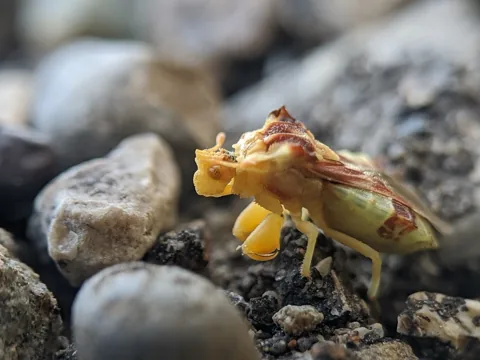 Ambush Bugs
Phymata species (jagged ambush bugs)
Ambush bugs are chunky little relatives of assassin bugs, usually under 1/2 inch long, that wait motionless and perfectly camouflaged on flower heads such as goldenrod for an insect to land within reach. They grab bees, flies and butterflies with their thick front legs and suck them dry. They are not aggressive toward people and bite only if mishandled, so no control is needed: look, but don't touch.
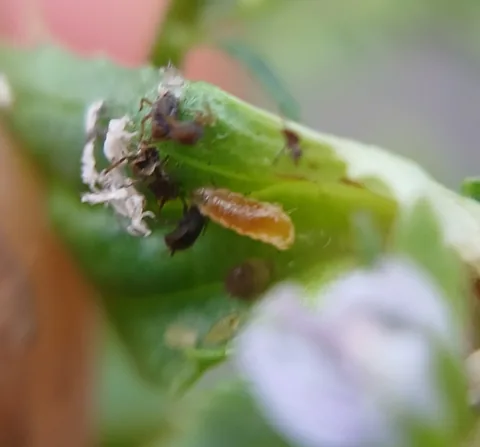 Aphid Midge
Aphidoletes aphidimyza
The aphid midge is a tiny fly whose orange larvae paralyze aphids and suck them dry. It attacks more than 60 aphid species and is sold for aphid control in greenhouses.
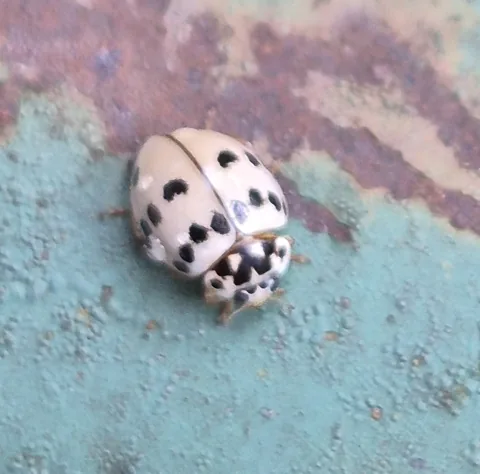 Ashy Gray Lady Beetle
Olla v-nigrum
A gray lady beetle covered in black spots is likely the ashy gray lady beetle, a predator of aphids and psyllids on trees and shrubs. It is a helpful insect, not a pest; UC IPM advises avoiding broad-spectrum insecticides that persist on leaves, which kill natural enemies like it.
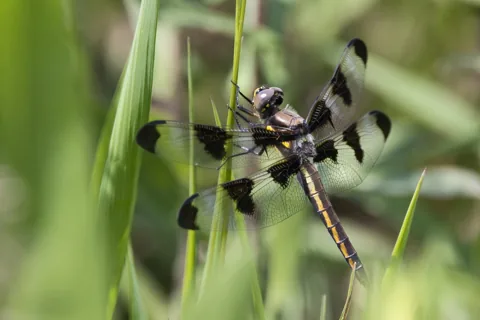 Dragonflies
Anisoptera (shown: Libellula pulchella)
Dragonflies are harmless to people and catch mosquitoes and other small insects on the wing. Their aquatic young eat mosquito larvae too, but sources disagree on how much they can do about a mosquito problem.
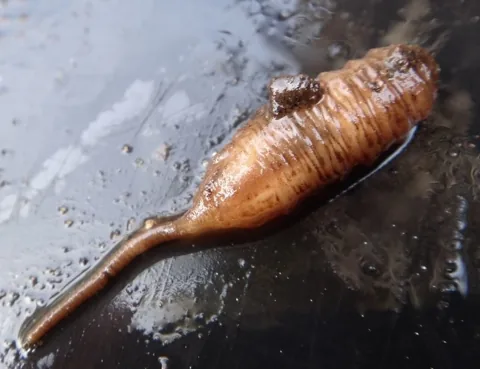 Drone Fly and Rat-Tailed Maggot
Eristalis tenax
Rat-tailed maggots, found at the edges of sewage lagoons, stagnant pools and drainage ditches, grow into drone flies: stingless hover flies that look like honey bees and visit flowers.
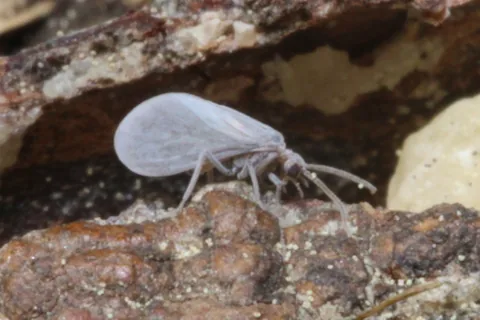 Dustywings
Coniopterygidae (dustywing family)
Dustywings are among the smallest lacewings and are beneficial predators of mites, aphids, scales and other small plant pests. Their powdery white wings make them easy to mistake for the whiteflies they eat.
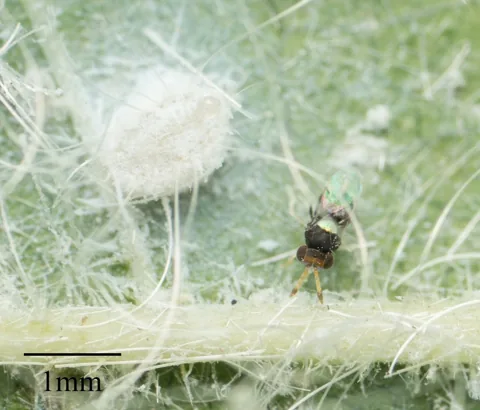 Encarsia Wasps
Encarsia species (e.g., E. formosa)
Encarsia are minute wasps that develop inside immature whiteflies. Encarsia formosa, less than 1/16 inch long, was first described from Colorado and now turns up worldwide because growers release it in greenhouses to control whiteflies.
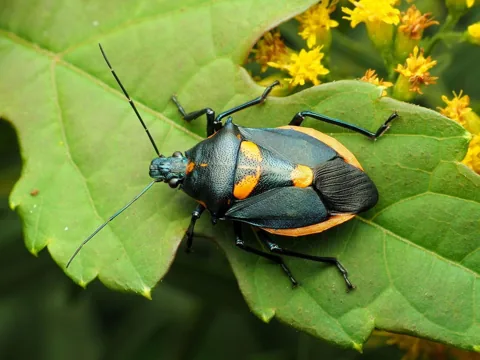 Florida Predatory Stink Bug
Euthyrhynchus floridanus
Unlike most stink bugs, the Florida predatory stink bug hunts other insects. Most of its prey are plant-damaging bugs, beetles and caterpillars, and extension entomologists count it as a beneficial insect. UF/IFAS Featured Creatures also calls it beneficial, though it seldom plays a major role in natural control in Florida.
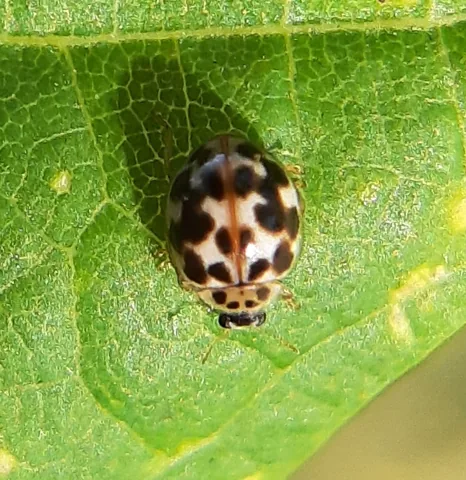 Mildew-Eating Lady Beetles
Psyllobora species (mainly P. vigintimaculata)
Unlike most lady beetles, Psyllobora species won't eat insects. They feed on powdery mildew, so finding them means the fungus is present.
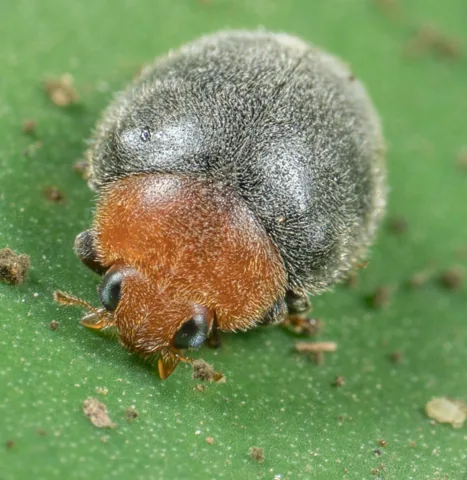 Mealybug Destroyer
Cryptolaemus montrouzieri
The mealybug destroyer is a small lady beetle introduced from Australia. Its white, waxy larvae look so much like mealybugs that they're easily mistaken for the pest.
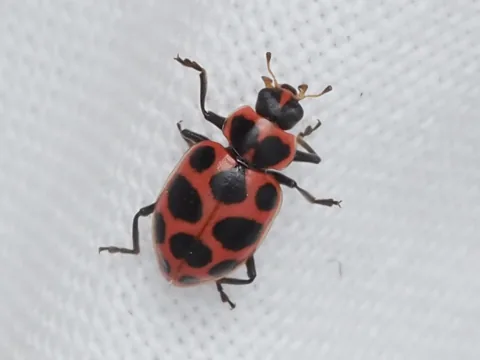 Pink Spotted Lady Beetle
Coleomegilla maculata
The pink spotted lady beetle is a native North American predator of aphids and insect eggs, and unlike most lady beetles it eats a lot of pollen, up to about half its diet.
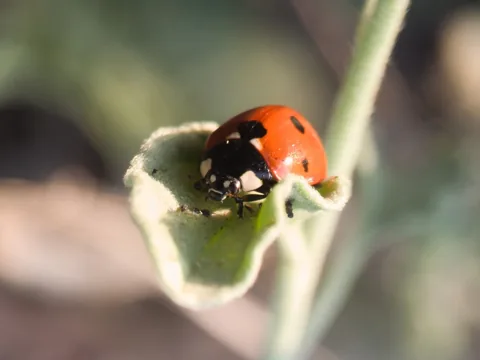 Sevenspotted Lady Beetle
Coccinella septempunctata
The sevenspotted lady beetle is native to Eurasia and is said to be the most common lady beetle in Europe. It was brought into North America on purpose to fight aphids and is now established here.
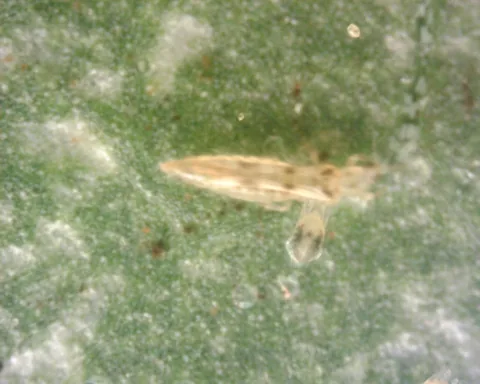 Sixspotted Thrips
Scolothrips sexmaculatus
Not all thrips are pests. The sixspotted thrips eats spider mites and their eggs and is common wherever mites are abundant.
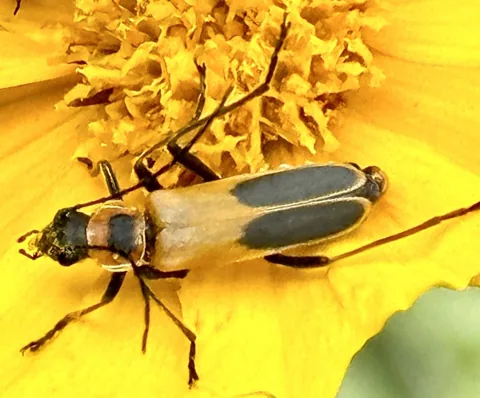 Soldier Beetles
Cantharidae (shown: Chauliognathus pensylvanicus)
Soldier beetles, also called leatherwings, are common flower visitors that resemble lightning bugs. They're beneficial: many pollinate flowers, adults of some species eat aphids and other soft insects, and the larvae hunt insect eggs and larvae in the soil and leaf litter.
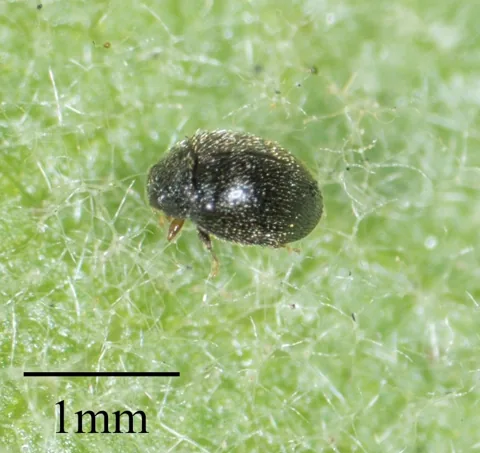 Spider Mite Destroyer
Stethorus species (S. punctum in the East, S. picipes in California per UC IPM)
Barely 1/16 inch long, the spider mite destroyer is a lady beetle that specializes in plant-feeding mites and flies in to find mite outbreaks.
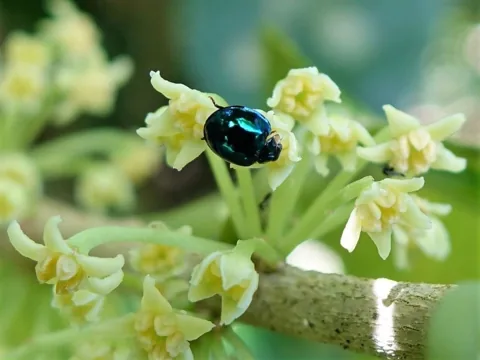 Steelblue Lady Beetle
Halmus chalybeus
Brought from Australia to Southern California in 1892, the steelblue lady beetle still helps control scale insects along the coast.
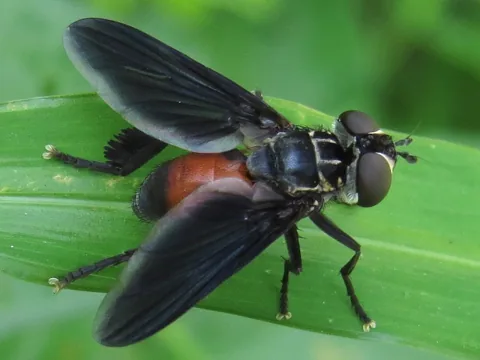 Tachinid Flies
Tachinidae (shown: Trichopoda pennipes)
Tachinids are the most important parasitic flies in biological control and one of the most diverse fly families. Their larvae develop inside caterpillars, beetles, true bugs and other insects, and kill them.
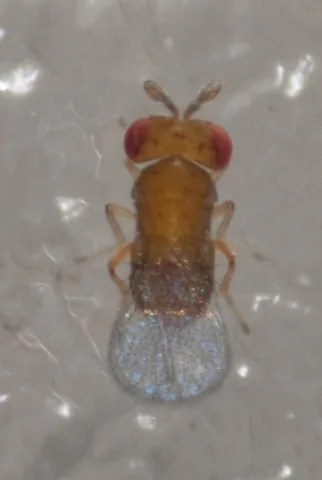 Trichogramma Wasps
Trichogramma species
Trichogramma are minute wasps that develop inside the eggs of moths and other insects, killing the pest before a caterpillar ever hatches. NC State calls them probably the most widely released insect for pest management.
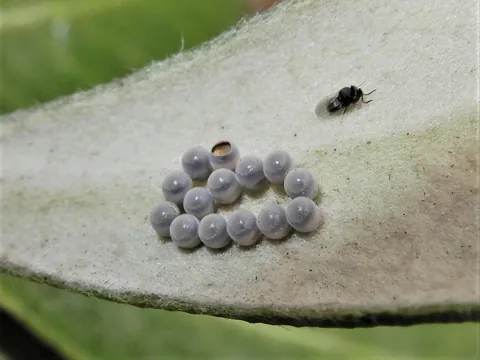 Trissolcus Wasps
Trissolcus species (e.g., T. basalis, T. japonicus)
Trissolcus wasps lay their eggs inside stink bug eggs, so a wasp emerges instead of a stink bug. The samurai wasp targets the brown marmorated stink bug.
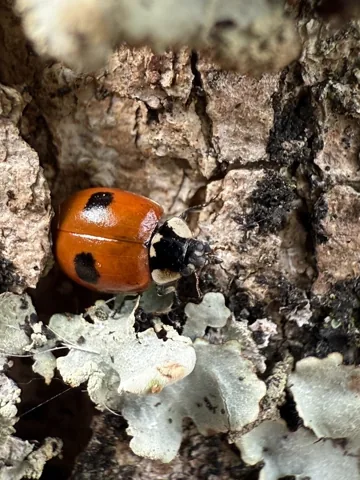 Twospotted Lady Beetle
Adalia bipunctata
The twospotted lady beetle is a beneficial insect: adults and larvae hunt aphids, mostly on trees and shrubs. It was once among the most common lady beetles in North America but has grown scarce in many areas.
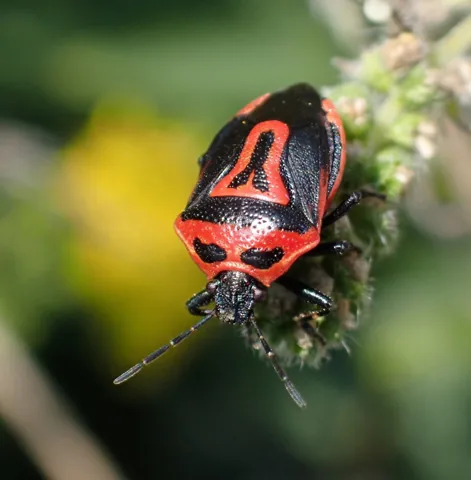 Twospotted Stink Bug
Perillus bioculatus
The twospotted stink bug is a native North American predator, not a plant pest. It hunts caterpillars and beetle larvae, and Oregon State University lists it as a predator of the Colorado potato beetle throughout the Northwest.
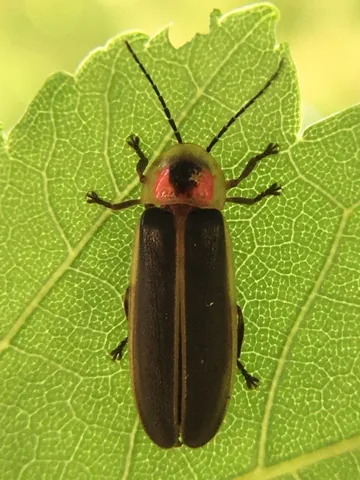 Fireflies
Lampyridae (e.g., Photinus pyralis, the big dipper firefly)
Fireflies, also called lightning bugs, are neither flies nor bugs but soft-bodied beetles. Many flash light to find mates, and their larvae prey on snails, slugs and other soft-bodied animals.
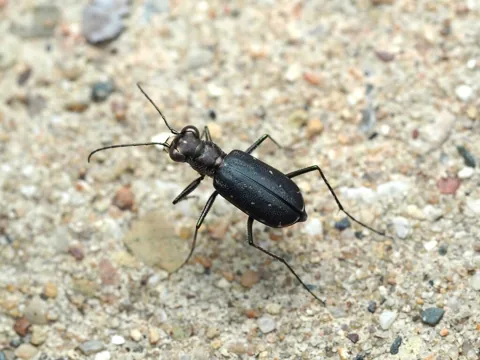 Punctured Tiger Beetle
Cicindelidia punctulata (formerly Cicindela punctulata)
The punctured tiger beetle (Cicindelidia punctulata), often called the sidewalk tiger beetle, is a fast-running, long-legged beetle most often seen on pathways and sidewalks in summer. Adults run down other insects, and the larvae ambush them from burrows in dry, hard-packed soil.
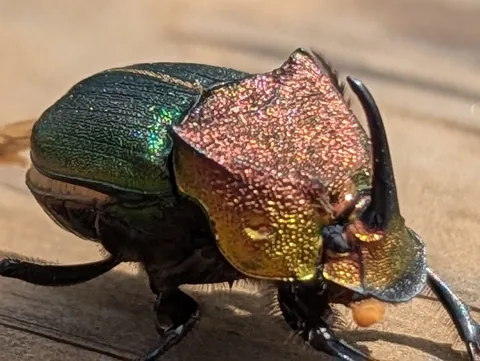 Rainbow Scarab
Phanaeus vindex
The rainbow scarab is a native dung beetle with metallic green or blue-green wing covers and an iridescent red and gold thorax. It buries animal dung under the pat to feed its young, which helps return nutrients to the soil.
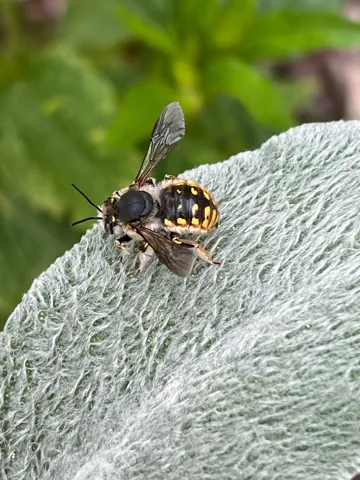 European Wool Carder Bee
Anthidium manicatum
The European wool carder bee is a stout, solitary, yellow-and-black bee about the size of a honey bee; females scrape the fuzz off plants such as lamb's ear to line their nests, and males aggressively guard flower patches.
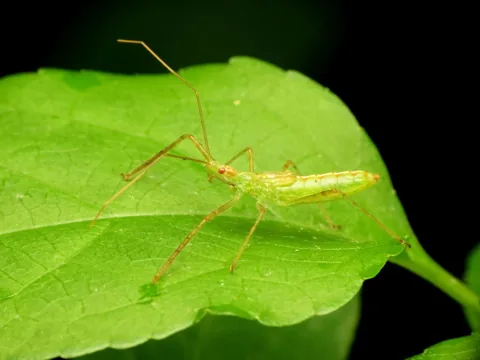 Pale Green Assassin Bug
Zelus luridus
The pale green assassin bug is a slender, long-legged green bug that hunts other insects on the leaves of trees and shrubs. It is a beneficial predator, but like other assassin bugs it can bite if handled carelessly.
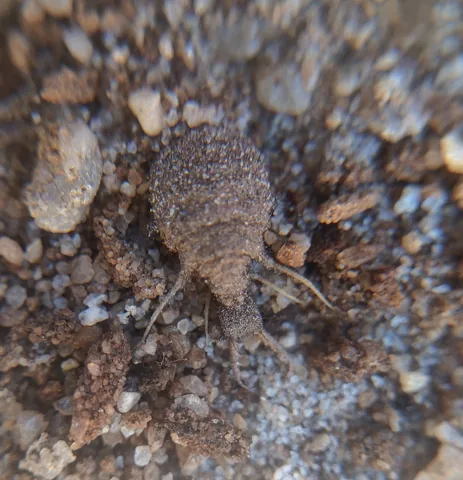 Antlions
Myrmeleontidae (e.g., Myrmeleon species)
Antlions are predatory insects that eat ants and other small insects. Their larvae, called doodlebugs, leave winding trails in loose sand and many dig cone-shaped pits to trap prey, while the adults look like drab damselflies with clubbed antennae.
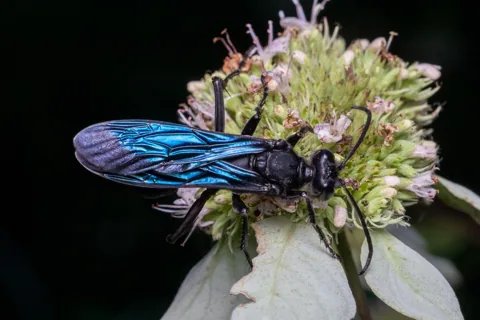 Great Black Wasp
Sphex pensylvanicus
The great black wasp is a large, solitary, satiny black wasp with smoky black wings that shine blue. Missouri gives its length as about 1 to nearly 1 1/2 inches. It visits flowers for nectar and pollen in summer and is not aggressive.
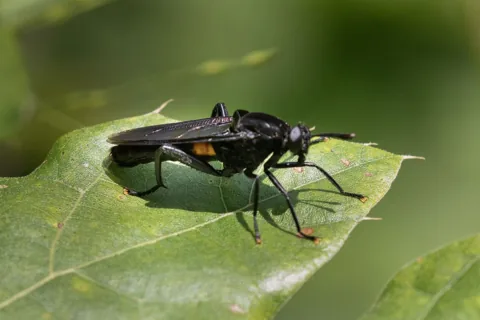 Mydas Flies
Mydidae
Mydas flies are large, harmless flies that mimic wasps. The eastern Mydas clavatus is velvety black with a bright orange or reddish mark on the second abdominal segment.
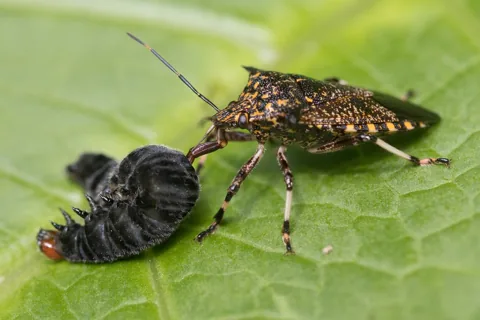 Giant Strong-Nosed Stink Bug
Alcaeorrhynchus grandis
The giant strong-nosed stink bug is a large, speckled brown predatory stink bug. It hunts other insects, especially moth caterpillars, and is generally considered beneficial.
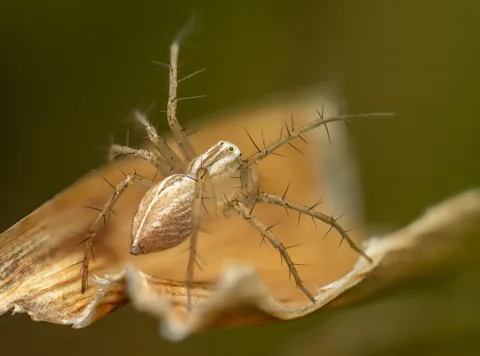 Striped Lynx Spider
Oxyopes salticus
The striped lynx spider is a small, spiny-legged hunting spider of fields, prairies, grasses and gardens. It builds no web; it runs down and jumps on insects. The University of Florida calls it one of the most abundant beneficial spiders in North American gardens, yards and farm fields.
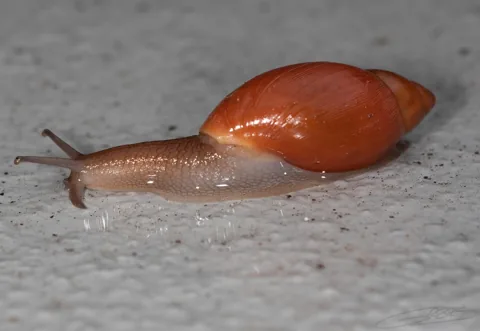 Rosy Wolf Snail
Euglandina rosea
The rosy wolf snail is a large land snail that hunts and eats other snails, and sometimes slugs. In southeastern gardens it needs no control; on islands where people released it, it has wiped out native snails.
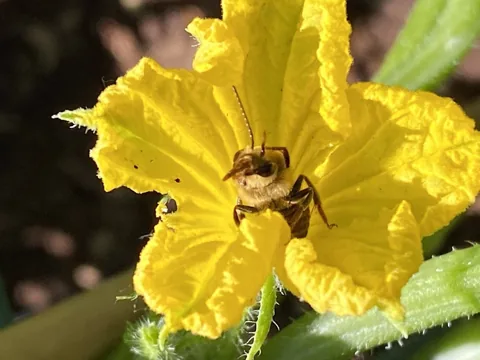 Squash Bees
Xenoglossa pruinosa (formerly Peponapis pruinosa)
Squash bees are native, solitary bees that collect pollen only from squash, pumpkin and gourd flowers, and they are usually the first bees in the blossoms at sunrise.
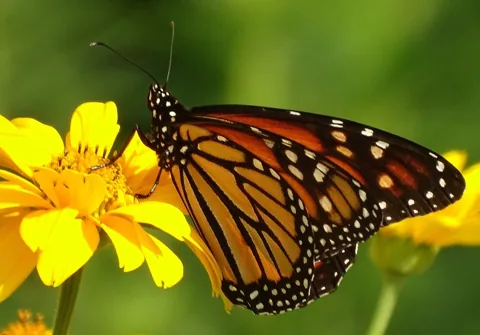 Monarch Butterfly
Danaus plexippus
The monarch is a large orange-and-black butterfly whose caterpillars feed only on milkweeds. North America has two migratory populations: eastern monarchs overwinter in mountain forests of central Mexico and western ones in groves on the California coast.
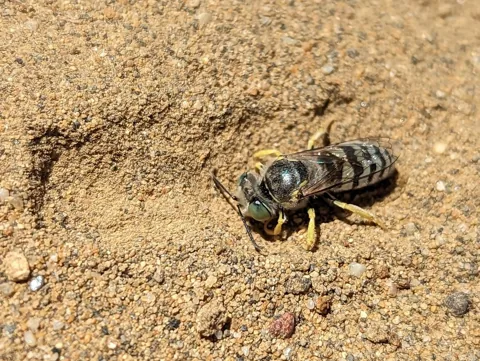 American Sand Wasp
Bembix americana
The American sand wasp is a solitary wasp that digs its nest burrows in sandy ground, often beside many others of its kind, and catches flies to feed its young.
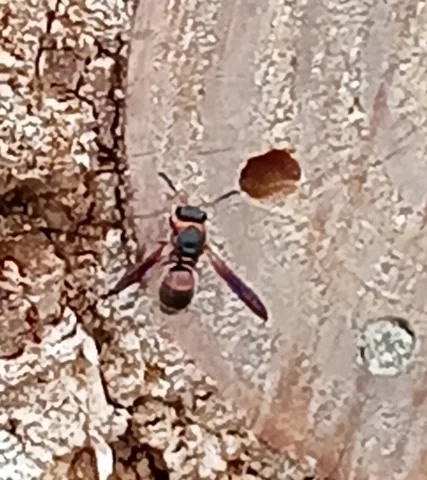 Red and Black Mason Wasp
Pachodynerus erynnis
The red and black mason wasp is a solitary wasp in the potter and mason wasp group. Females nest in existing holes and hollow stems and stock them with caterpillars for their young. UF/IFAS calls it a specialist predator of caterpillars and highly beneficial, since its prey include armyworms, cutworms and loopers.
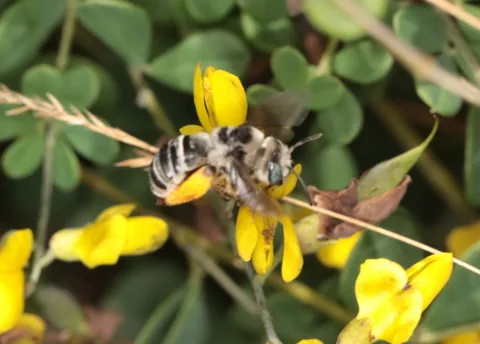 Common Long-Horned Bee
Melissodes communis
The common long-horned bee is one of the longhorn bees, fuzzy, medium-sized native bees named for their long antennae. Missouri's conservation department calls longhorn bees valuable native pollinators that are not aggressive. UF/IFAS describes it as a solitary, ground-nesting bee, the most widely distributed species of its genus and a frequent pollinator of wildflowers across the United States.
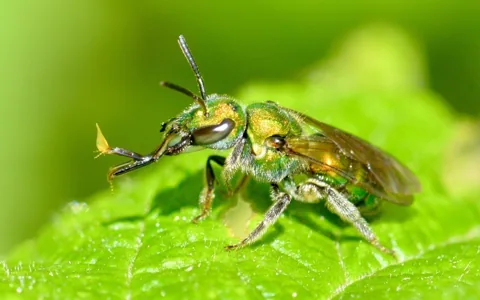 Pure Gold-Green Sweat Bee
Augochlora pura
The pure gold-green sweat bee is one of the most common bees in eastern North America and one of the most tied to woodlands. It nests in rotting wood, lives alone rather than in a colony, and pollinates many flowers.
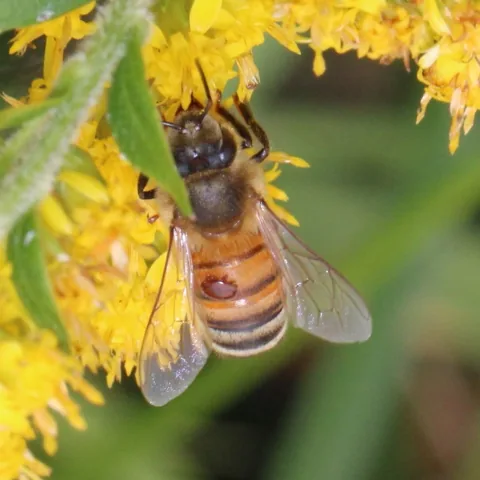 Varroa Mite
Varroa destructor
The Varroa mite is the most damaging pest of honey bees: it feeds on adult bees and developing brood, weakens the colony and spreads viruses, and an unmonitored infestation can kill the hive.
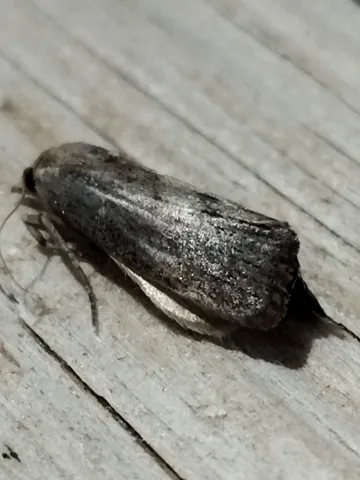 Wax Moths
Galleria mellonella (greater wax moth) and Achroia grisella (lesser wax moth)
Two moths, the greater wax moth (Galleria mellonella) and the lesser wax moth (Achroia grisella), live with honey bee colonies. Their caterpillars tunnel through beeswax comb, leaving silk webbing and droppings, and do most harm in weak or dead colonies and in stored comb.
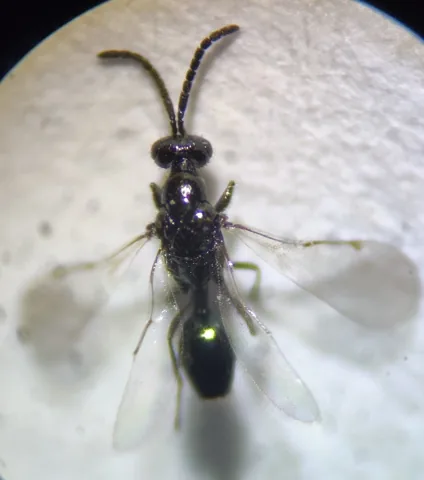 Filth fly parasitoids
Pupal parasitoid wasps, chiefly Muscidifurax raptor, M. raptorellus and Spalangia species
Filth fly parasitoids are tiny wasps that lay their eggs in the pupae of house flies and stable flies, killing the developing fly. They occur naturally on most farms where flies breed, and several species are sold for release around barns, dairies, horse farms, feedlots and poultry houses as part of a fly control program.
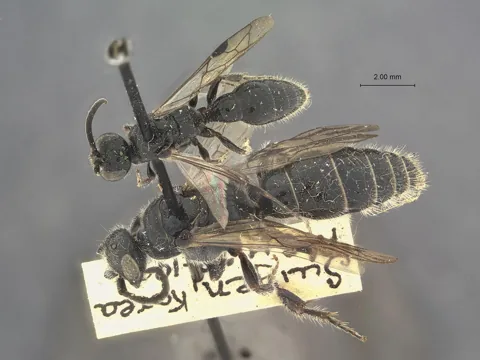 Spring tiphia
Tiphia vernalis
Spring tiphia is a small black wasp brought from Korea in the 1920s and early 1930s to fight Japanese beetles. Each spring the females dig into the soil, paralyze a Japanese or oriental beetle grub and lay an egg on it, and the wasp larva eats the grub. It now occurs on its own wherever Japanese beetles are present across much of the central and eastern United States.
No photo yet
Diadegma insulare
Diadegma insulare
Diadegma insulare is a small, slender black wasp that lays its eggs in diamondback moth caterpillars on cabbage and other crucifers. UF/IFAS calls it the most important naturally occurring enemy of the diamondback moth, able to parasitize up to 90 percent of the larvae, and parasitism above 90 percent has been recorded in South Carolina. Adults are very susceptible to most insecticides.
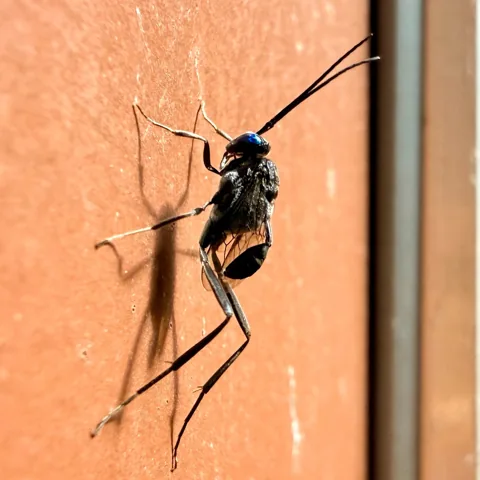 Ensign wasp
Evania appendigaster
The ensign wasp is a small black wasp that turns up now and then in homes and other buildings. It does not sting or bite. It is a parasite of cockroach egg cases, so seeing one usually means one of the larger cockroaches, such as the American cockroach, is breeding somewhere in the building.
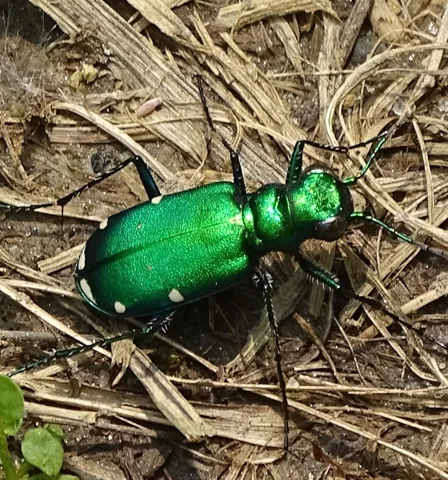 Six-spotted tiger beetle
Cicindela sexguttata
The six-spotted tiger beetle is a shiny, metallic green beetle that runs and flies in quick bursts along sunny trails in spring. Adults and larvae both hunt other insects, and the University of Minnesota counts it among the predators that help keep insects in check.
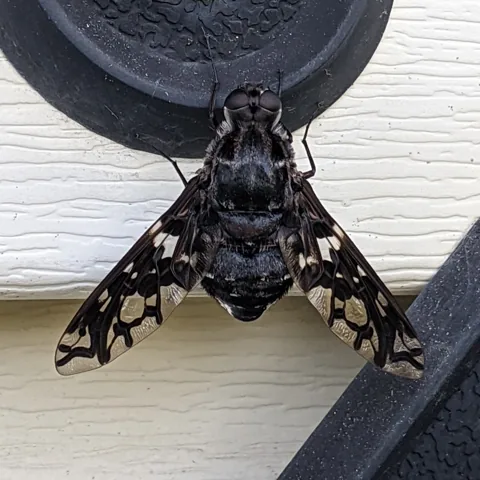 Tiger Bee Fly
Xenox tigrinus
The tiger bee fly is a large, fuzzy black fly with boldly patterned wings that hovers around decks, fences and other wood around homes. It can't sting or bite, and its larvae feed on carpenter bee larvae, which makes it a natural enemy of the carpenter bees that bore into wood.
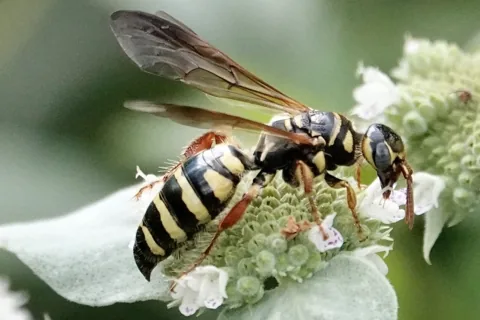 Five-banded thynnid wasp
Myzinum quinquecinctum
The five-banded thynnid wasp is a black-and-yellow solitary wasp of late-summer flowers. Its larvae feed on the white grubs of scarab beetles in the soil, and the clusters of males that gather on plants look alarming but cannot sting.
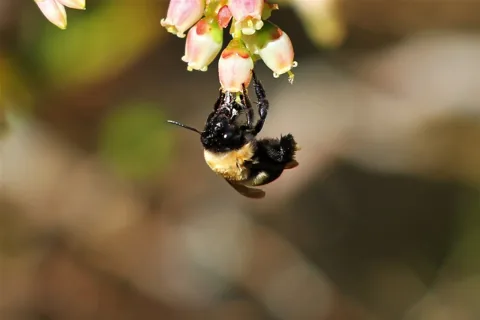 Southeastern blueberry bee
Habropoda laboriosa
The southeastern blueberry bee is a native, solitary bee closely tied to blueberry flowers. It looks like a small bumble bee, flies mainly around blueberry bloom, and shakes pollen loose by buzz pollination; UF/IFAS calls it a more effective pollinator of cultivated blueberries than honey bees.
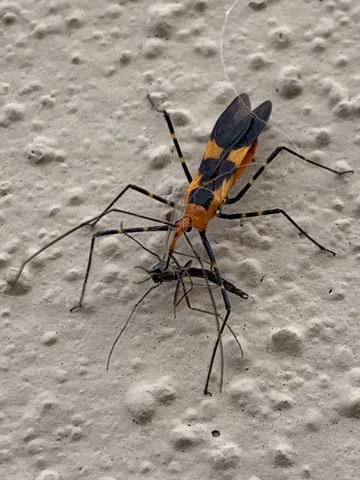 Milkweed assassin bug
Zelus longipes
The milkweed assassin bug is a long-legged, orange and black predator of gardens and fields. Some color forms may mimic the milkweed bug. It is a beneficial insect, but like other assassin bugs it can give a painful bite if handled carelessly. UF/IFAS says it is also called the longlegged assassin bug or Zelus assassin bug, and that it hunts by day.
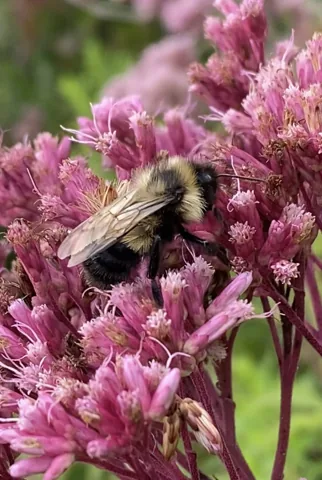 Rusty-patched bumble bee
Bombus affinis
The rusty patched bumble bee was once common across the northern part of eastern North America. The U.S. Fish and Wildlife Service listed it as endangered in 2017, making it the first federally protected bumble bee and the first bee on the endangered species list, and it now survives in low numbers in a small part of its former range.
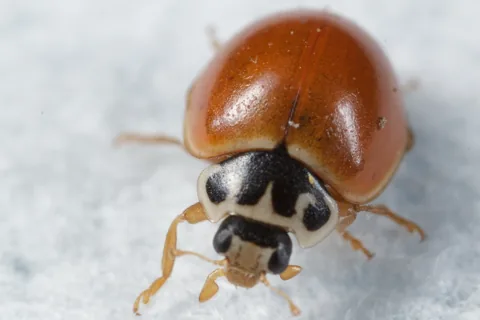 Polished lady beetle
Cycloneda munda
The polished lady beetle, also called the red lady beetle or immaculate lady beetle, is a native lady beetle whose orange to red wing covers have no spots. Is it harmful? No. It is a helpful predator: adults and larvae both feed mainly on aphids in gardens, landscapes, crops and wild areas. There is nothing to get rid of; to keep it working, avoid broad-spectrum insecticides and grow flowers that feed adults with nectar and pollen.
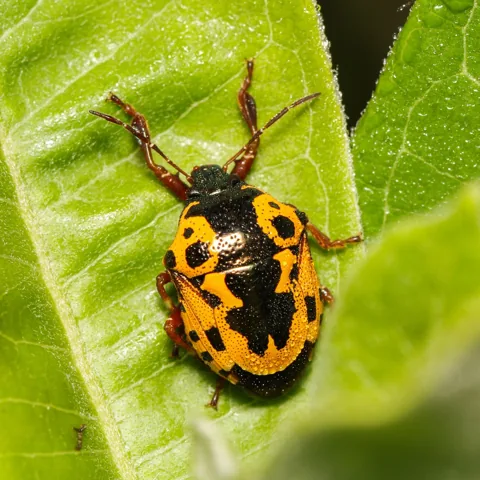 Anchor stink bug
Stiretrus anchorago
The anchor stink bug is a native predatory stink bug of eastern North America that hunts plant-feeding insects, including beetle larvae and caterpillars such as Mexican bean beetle and alfalfa weevil larvae. Its colors vary, combining black with yellow, orange, red or white, or solid metallic blue, green or purple, often with an anchor-shaped mark on top of the abdomen, and it is easily mistaken for the harlequin bug, a pest.
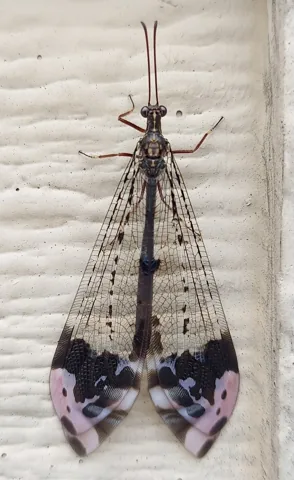 Pleasing antlion
Glenurus gratus
The pleasing antlion, Glenurus gratus, is an antlion with very large, strikingly attractive wings richly marked with dark patches; UF/IFAS calls it one of the most striking antlions in Florida. Unlike the familiar doodlebugs that wait under pits in sand, its larvae live in the dry debris that collects in the hollows of trees.
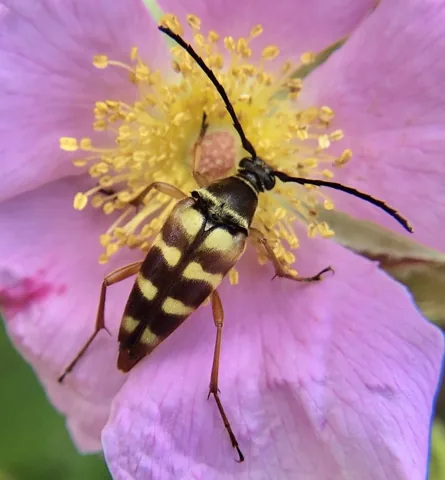 Banded longhorn beetle
Typocerus velutinus
The banded longhorn (Typocerus velutinus) is a harmless, rusty-colored beetle with wide yellow bands and black antennae that you'll see on summer flowers, where adults feed on nectar and help pollinate. Its larvae grow in dead and decaying wood, not in healthy trees, so it needs no control. It is common across much of eastern North America, and in Kentucky it is the most abundant member of its genus.
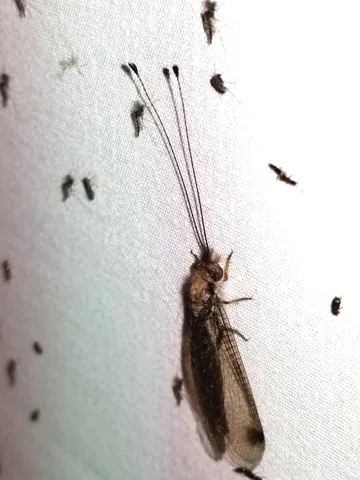 Owlflies
Ascalaphidae (owlflies, e.g., Ululodes and Ascaloptynx; iNaturalist places them as subfamily Ascalaphinae of Myrmeleontidae)
Owlflies are lacewing relatives that look like dragonflies with long, clubbed antennae and large, bulging eyes. They are harmless predators: adults snatch insects in flight at dusk and dawn, and the larvae wait in leaf litter with their jaws held open.
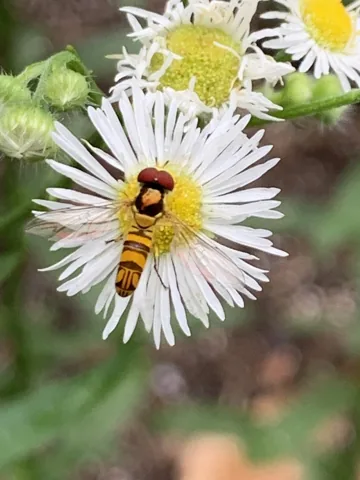 Oblique Streaktail
Allograpta obliqua
The oblique streaktail (Allograpta obliqua) is a small yellow-and-black hover fly, also called a flower fly, whose larvae eat aphids. In California it is consistently the syrphid most often found in cole crops such as broccoli, and it is among the main aphid-eating flies in Michigan soybean fields and California organic lettuce. In Florida it is one of the little flies most often mistaken for a harmful fruit fly.
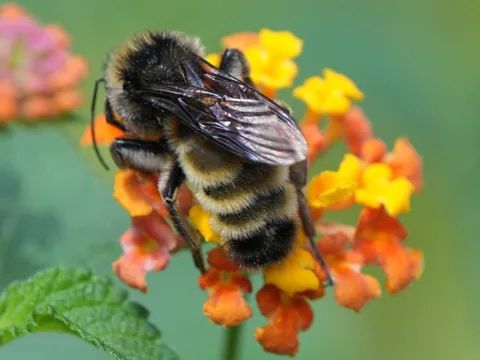 American bumble bee
Bombus pensylvanicus
The American bumble bee was once one of the most common and widespread bumble bees in the eastern and southeastern United States. MDC puts its North American decline at nearly 90 percent between 2000 and 2020, and the U.S. Fish and Wildlife Service cites a 2014 assessment that found an 89 percent drop in abundance relative to other bees sharing its habitat. Losses are worst in the northern part of its range.
 Brown-belted bumble bee
Bombus griseocollis
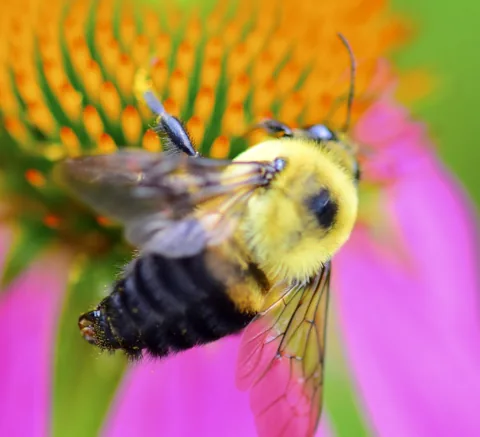
The brown-belted bumble bee takes its name from a thin belt of rusty or reddish-brown hair across the second segment of its abdomen. It has one of the largest ranges of any U.S. bumble bee, from coast to coast, and UW-Madison describes its populations as stable, even in highly urbanized landscapes; an Indiana study of museum records going back to the early 1900s found the share of counties where it occurs has risen over time.
 Two-spotted bumble bee
Bombus bimaculatus
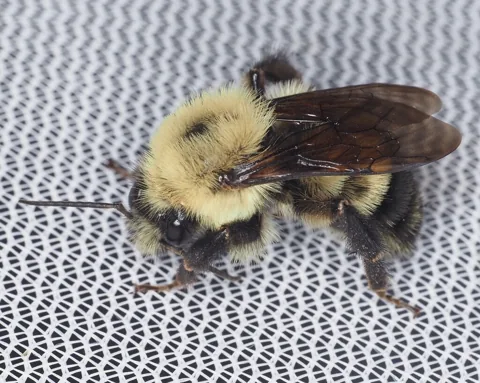
The two-spotted bumble bee is a common bumble bee of the eastern United States, with a yellow W on its second abdominal segment that looks like a pair of spots. Its queens are the first bumble bees out in spring, and while several bumble bees have declined, this one has held steady or increased in Wisconsin and Indiana and has spread into new parts of Canada.
 Black-and-gold bumble bee
Bombus auricomus
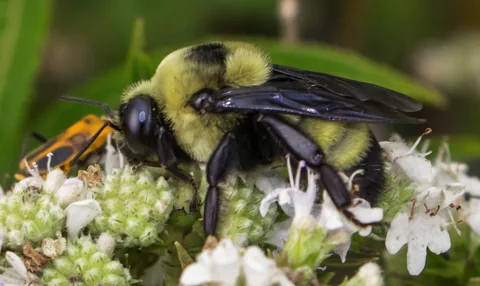
The black-and-gold bumble bee is one of the largest bumble bees in Wisconsin, and UW-Madison says one flying past your head sounds like a helicopter. It is a bee of prairies, pastures and other open, flower-rich ground, and it is relatively common in Missouri. It closely resembles the American bumble bee, a species of conservation concern.
 Orange assassin bug
Pselliopus barberi
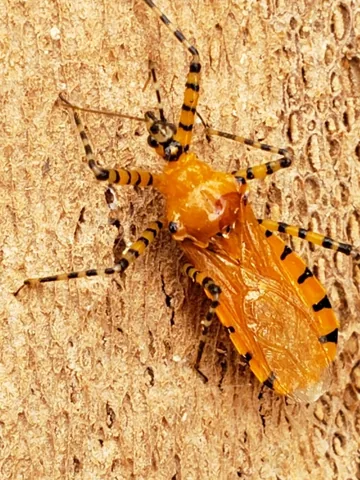
The orange assassin bug (Pselliopus barberi), also called the sycamore assassin bug, is a half-inch, golden-orange predator with black-banded legs and antennae. It hunts other insects on plants and is a garden helper, but it can give a painful bite if handled carelessly, so leave it alone. In winter, adults pack together under loose bark, sometimes more than 100 in one group.
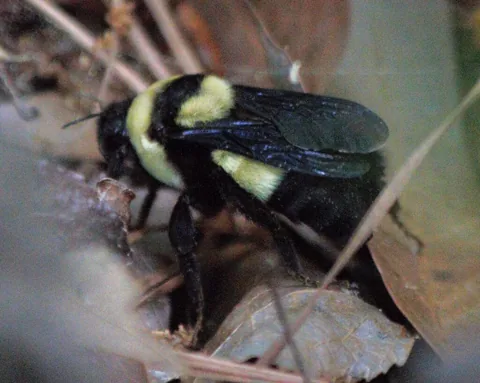 Southern plains bumble bee
Bombus fraternus
The southern plains bumble bee is a prairie specialist: in Missouri it is usually found only in native prairie. Once widespread across the eastern United States and into northeastern Mexico, it has been declining since the early 20th century, partly because nearly all native prairie has been converted to farmland, and it has been proposed for listing as federally endangered.
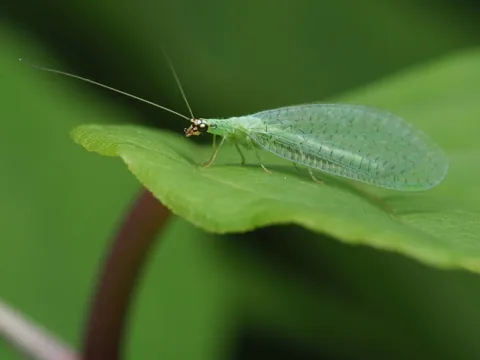 Goldeneyed lacewing
Chrysopa oculata
The goldeneyed lacewing, Chrysopa oculata, is a green lacewing that is a natural enemy of crop pests. Unlike the common Chrysoperla lacewings, whose adults eat nectar and pollen, both its larvae and its adults are predators.
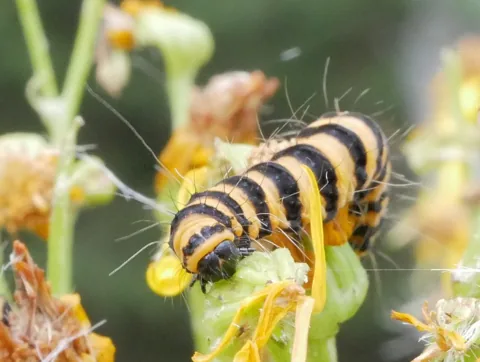 Cinnabar Moth
Tyria jacobaeae
The cinnabar moth is a biological control agent: it was released in California, starting in 1959, to help control tansy ragwort, a pasture and wildland weed. Its orange-and-black-banded caterpillars strip ragwort leaves in spring and summer and store the plant's toxic alkaloids for their own protection. Together with the ragwort flea beetle it has cut tansy ragwort by up to 99% in ungrazed areas of California and Oregon.
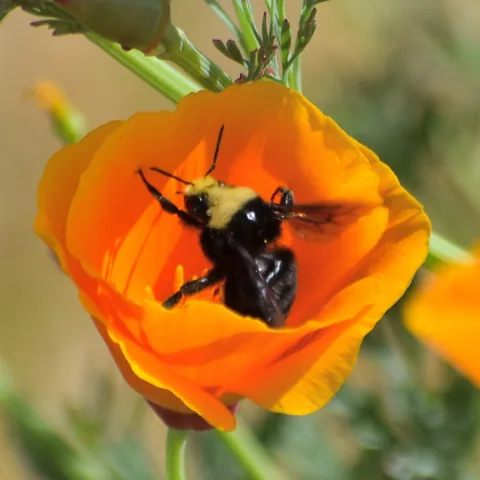 Yellow-faced bumble bee
Bombus vosnesenskii
The yellow-faced bumble bee, also called the Vosnesensky bumble bee, is a very common bumble bee of coastal California, Oregon and Washington, and the Forest Service guide suggests it may even be increasing. It is also one of three bumble bee species sold commercially in North America for pollination.
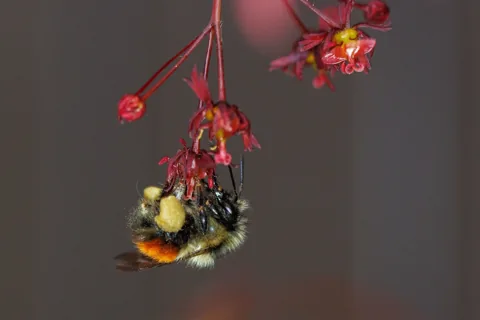 Black-tailed bumble bee
Bombus melanopygus
The black-tailed bumble bee is a common bumble bee from the Pacific coast east to the Colorado Rocky Mountains. It comes in two color forms: in most of California the middle of the abdomen is black, while farther north and east the same segments are orange-red, and the two forms meet in southern Oregon and northern California.
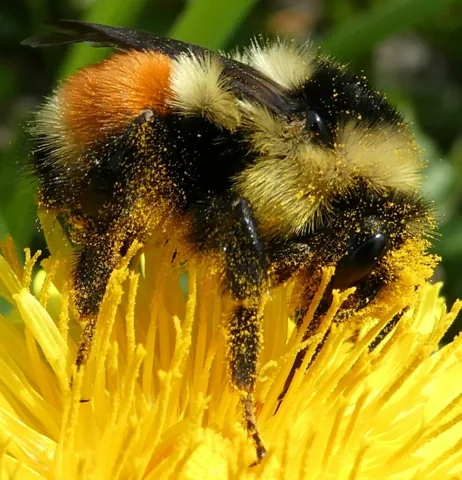 Tri-colored bumble bee
Bombus ternarius
The tri-colored bumble bee wears yellow, orange and black: a yellow thorax and first abdominal segment, two orange segments behind them, then a yellow band and a black tip. The Forest Service guides call it common in the eastern United States but rare in the West, and Wisconsin's bumble bee guide rates it generally stable.
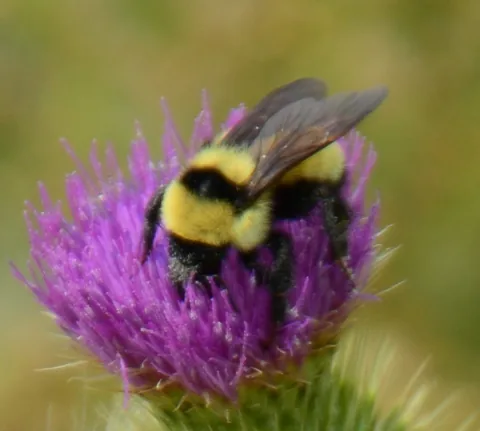 Golden northern bumble bee
Bombus fervidus
The golden northern bumble bee, called the yellow bumble bee in the Forest Service and University of Wisconsin guides, is almost entirely yellow except for the end of its abdomen. It is found across most of the continental United States except west of the Sierra-Cascade crest; the western guide calls it common, but in the East it may be declining.
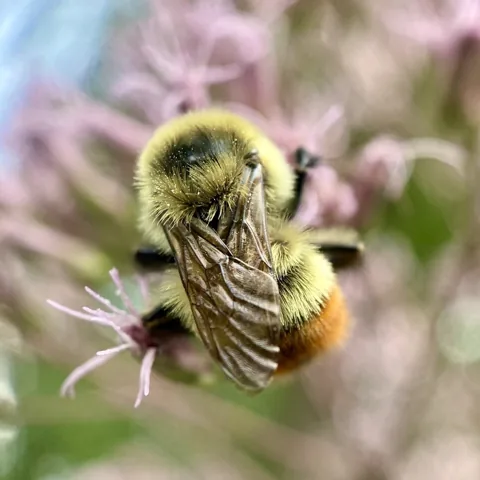 Red-belted bumble bee
Bombus rufocinctus
The red-belted bumble bee is a small bumble bee with unusually variable colors: the University of Wisconsin guide counts more than 30 color forms. The Forest Service guides list it as common across the northern half of the United States and in the southern Rocky Mountains and the Sierra Nevada.
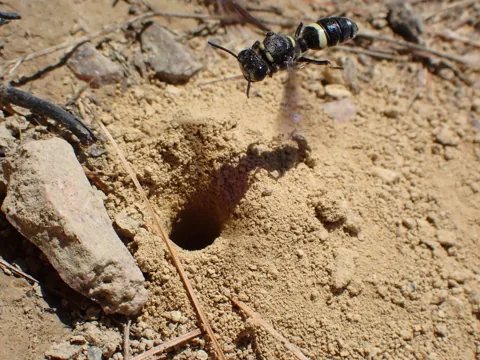 Smoky-winged beetle bandit
Cerceris fumipennis
The smoky-winged beetle bandit is a native solitary wasp of eastern North America that hunts metallic wood-boring beetles, including the invasive emerald ash borer, and carries them home to nests in packed sandy ground. Because it finds these beetles far better than people can, extension programs use its nests to detect emerald ash borer.
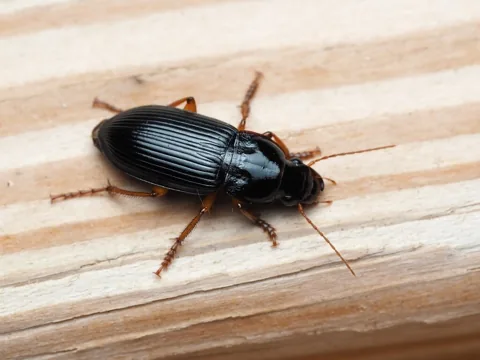 Pennsylvania dingy ground beetle
Harpalus pensylvanicus
Harpalus pensylvanicus, the Pennsylvania dingy ground beetle, is a dark brown ground beetle that Penn State Extension counts among the dominant ground beetles of Central Pennsylvania crop fields. It is best known as a weed seed predator, though it also eats a variety of insects.
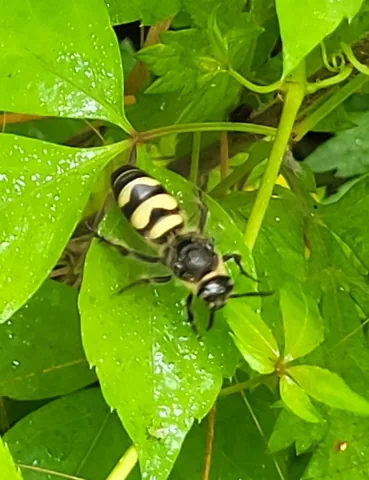 Scoliid wasps
Scoliidae (e.g., Scolia, Dielis and Pygodasis)
Scoliid wasps are large, stout, hairy solitary wasps whose larvae feed on the white grubs of scarab beetles in the soil. Most people see the adults drinking nectar at flowers or flying low over lawns in late summer. They are not aggressive toward people, and only the females can sting.
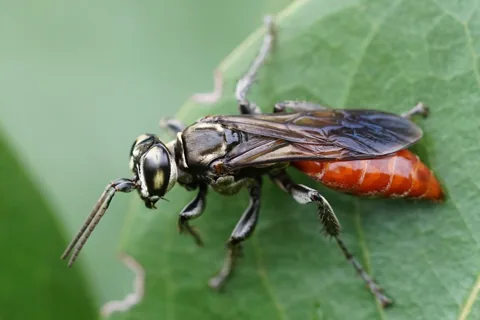 Mole cricket hunter
Larra bicolor
Larra bicolor is a black wasp with a solid red abdomen, native to South America, whose larvae develop only on Scapteriscus mole crickets. It was imported to Florida to control the invasive pest mole crickets that damage turf and pasture grasses, and it has since spread into Alabama and Mississippi and been introduced into Georgia.
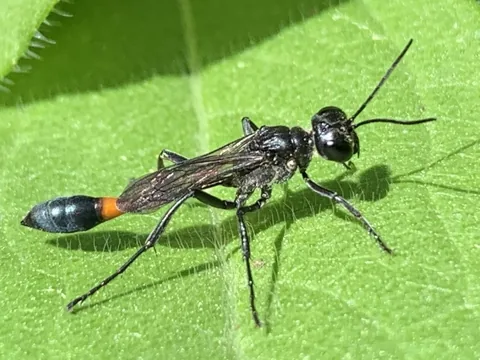 Thread-waisted sand wasps
Ammophila spp.
Ammophila wasps are slender, solitary thread-waisted wasps, usually black with some orange on the abdomen, that you may see dragging a caterpillar across bare ground. Each female digs her own burrow and stocks it with paralyzed caterpillars for her young. Are they harmful? Not really: they have no colony to defend, are not aggressive and sting only if mishandled. Do you need to get rid of them? No. MDC and WSU describe them as garden allies that reduce leaf-eating caterpillars, and WSU recommends no chemical control.
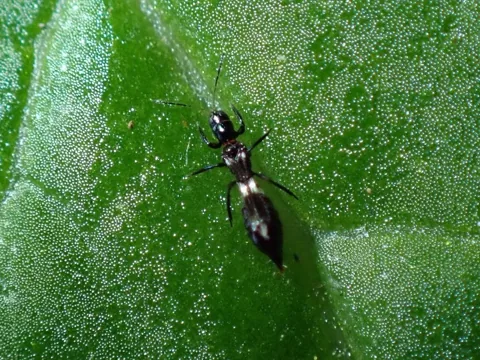 Vespiform thrips
Franklinothrips vespiformis
The vespiform thrips, Franklinothrips vespiformis, is a beneficial, ant-mimicking thrips that hunts other small insects. Its fast, ant-like adults and red-banded, humpbacked larvae eat pest thrips and mites, it is the most widespread of the predatory Franklinothrips, and it is sold in Europe and Israel for biological control in greenhouses.
No photo yet
Mite Midge
Feltiella acarisuga
Mite midges (Feltiella species) are tiny, delicate flies whose larvae live in spider mite colonies and feed almost entirely on the mites and their eggs. Feltiella acarisuga, found worldwide, is an important natural enemy that is sold for release against spider mites in greenhouses and nurseries.
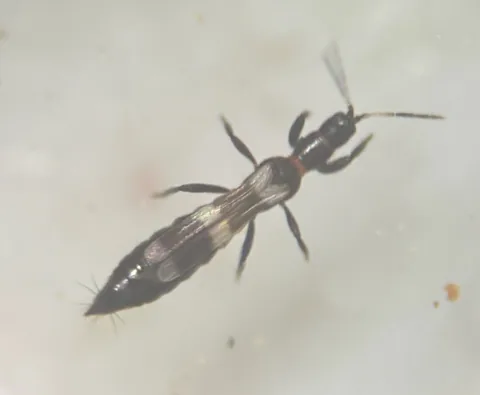 Banded thrips
Aeolothrips species (e.g., A. fasciatus, A. bicolor)
Banded thrips, the genus Aeolothrips, are predatory thrips. They eat plant-feeding thrips, spider mites and other tiny arthropods, and some also take pollen, aphids and whiteflies. At least 22 species live in California, and Aeolothrips bicolor is common in flowers across the southern United States.
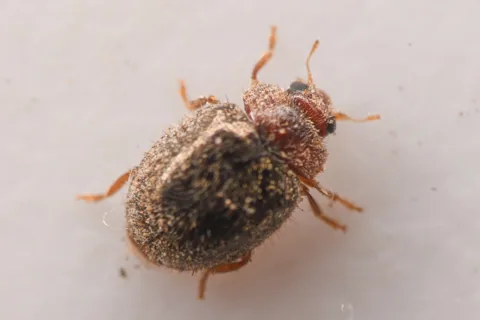 Purple scale predator
Rhyzobius lophanthae
Rhyzobius lophanthae, sometimes called the purple scale predator or black lady beetle, is a tiny lady beetle from Australia that eats scale insects. It was brought to California in 1892 to fight citrus scales, later reached Florida, has been introduced to other parts of the Americas, Europe and Africa against armored scales, and is sold commercially for biological control.
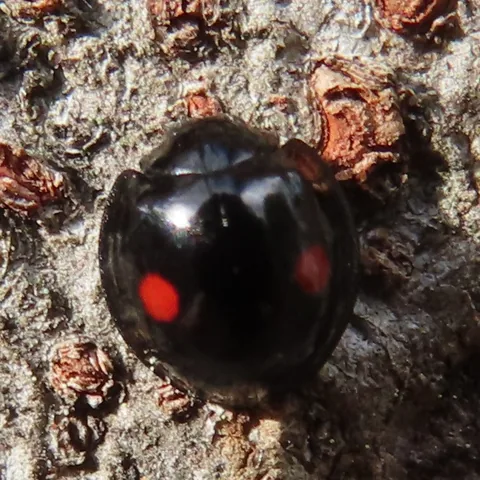 Kuwana's lady beetle
Chilocorus kuwanae
Kuwana's lady beetle, Chilocorus kuwanae, is a small black lady beetle with two red spots that feeds on scale insects, especially armored scales. The USDA imported it from China, Korea and Pakistan several times between 1895 and the 1980s and released it in many states against California red scale, euonymus scale and San Jose scale. It is now established in California and much of the United States.
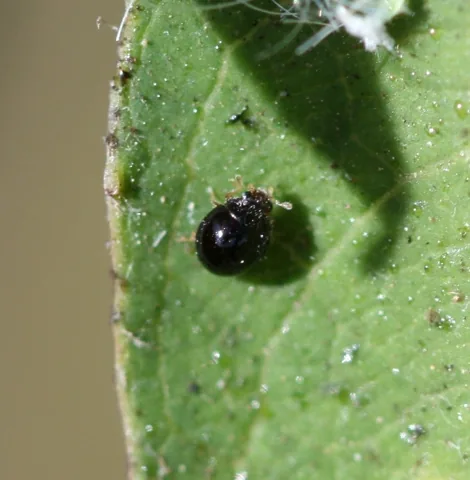 Whitefly predatory lady beetle
Delphastus catalinae
The whitefly predatory lady beetle, Delphastus catalinae, is a tiny black lady beetle, only about 1.5 mm long, that feeds on whiteflies. Native to Colombia, it is established in warm parts of the United States, including California and Florida, and is reared and sold for whitefly control, often under the name Delphastus pusillus.
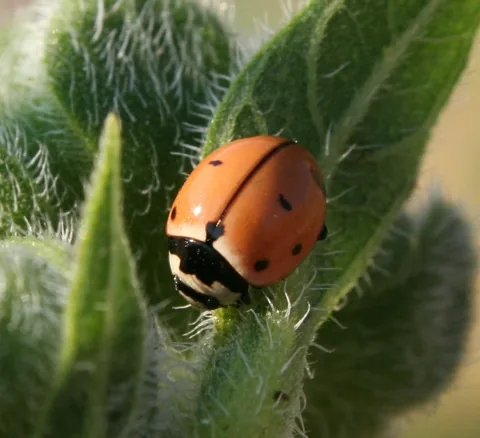 Nine-spotted lady beetle
Coccinella novemnotata
The nine-spotted lady beetle, Coccinella novemnotata, is a native North American lady beetle. Before the mid-1980s it was the most commonly encountered native lady beetle in the northeastern United States and among the most common nationally. It then declined so steeply that researchers could not find any to study until volunteers with the Lost Ladybug Project found several populations.
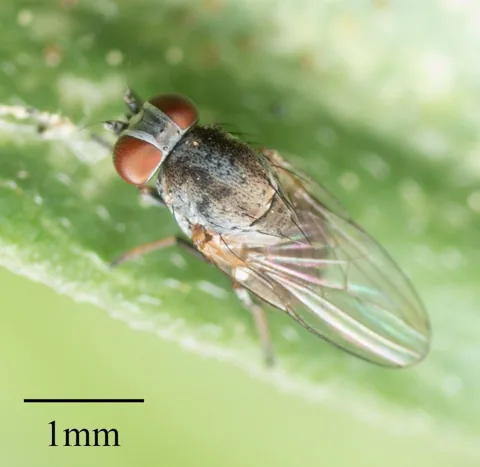 Aphid Flies (Silver Flies)
Chamaemyiidae (e.g., Leucopis, Leucotaraxis)
Aphid flies (family Chamaemyiidae) are tiny, often silvery-gray flies whose larvae eat aphids, adelgids, mealybugs and scale insects. They are beneficial predators in gardens and forests. Two western species, the silver flies Leucotaraxis argenticollis and L. piniperda, have been approved for release in the eastern United States to fight hemlock woolly adelgid.
No photo yet
Eastern cranberry bee
Melitta americana
The eastern cranberry bee (Melitta americana) is a native solitary bee that specializes on a few Vaccinium species, cranberry and blueberry, for its pollen and nectar. It nests in loose soil and sand and is a beneficial pollinator, not a pest; UF/IFAS notes researchers have found it is often the most frequent pollinator of these plants in North America.
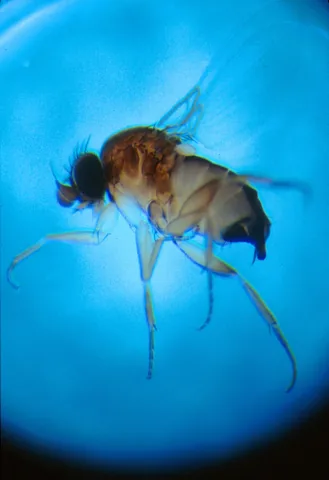 Fire Ant Decapitating Flies
Pseudacteon
Fire ant decapitating flies (Pseudacteon species) are tiny phorid flies that lay their eggs in fire ants. The maggot decapitates its host and uses the empty head as a pupal case. Since 1997, South American species have been released in the southern United States as biological control for imported fire ants; six have been released successfully, and eight native species attack native fire ants.
No photo yet
Brazilian Red-Eyed Fly
Ormia depleta
The Brazilian red-eyed fly (Ormia depleta) is a South American tachinid fly that kills pest mole crickets. Females find their hosts by homing on the calling songs of male mole crickets and deposit live larvae that enter and consume the crickets. Released in Florida beginning in 1988, it spread through most of peninsular Florida, and counties with the fly reported less mole cricket damage. It is a helpful insect: there is nothing to get rid of.
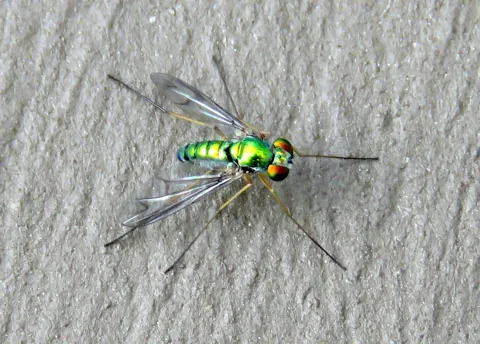 Longlegged Flies
Dolichopodidae (e.g., Condylostylus, Dolichopus)
Longlegged flies (family Dolichopodidae) are the small, shiny green, blue or bronze flies with long legs that run and hop between leaves in sunny spots. Both adults and larvae are predators of small, soft-bodied creatures, and the adults catch aphids, mites, thrips and gnats. They do not bite and pose no threat to people.
No photo yet
Leptomastix dactylopii (mealybug parasitoid)
Leptomastix dactylopii
Leptomastix dactylopii is a tiny parasitic wasp that develops inside mealybugs and kills them. It is sold commercially for release in greenhouses, citrus groves and interiorscapes, and released together with the mealybug destroyer lady beetle it has controlled citrus mealybug in greenhouses and interiorscapes. UF/IFAS credits it with significant reductions in mealybug populations in Florida and other locations.
No photo yet
Coccophagus lycimnia (soft scale parasitoid)
Coccophagus lycimnia
Coccophagus lycimnia is a tiny parasitic wasp, about 1 mm long, whose larvae develop inside scale insects and kill them. It parasitizes more than 100 kinds of scales, mostly soft scales, and was the most abundant parasite of lecanium scales in urban landscapes of South Carolina, North Carolina and Virginia.
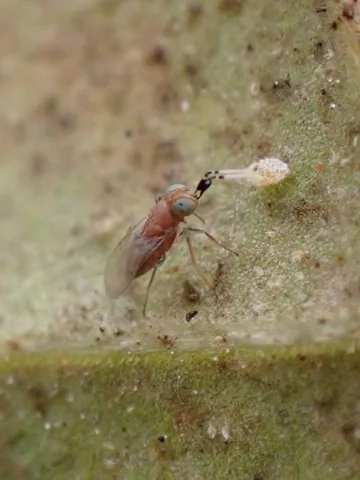 Anagyrus pseudococci (mealybug parasitoid)
Anagyrus pseudococci
Anagyrus pseudococci is a tiny parasitic wasp whose larvae develop inside mealybugs and kill them. It is reared commercially and sold for mealybug control, and in California it has been the most successful of the parasites released against vine mealybug.
No photo yet
Lonchaeid Fly
Lonchaea corticis
The lonchaeid fly Lonchaea corticis is a fly in the family Lonchaeidae whose larvae live under the bark of conifer leaders attacked by the white pine weevil. The young maggots scavenge dead weevil larvae and frass, then turn predator and eat healthy weevil prepupae and pupae. Natural Resources Canada calls it a beneficial insect and, at high larval densities, one of the most effective natural enemies of the white pine weevil.
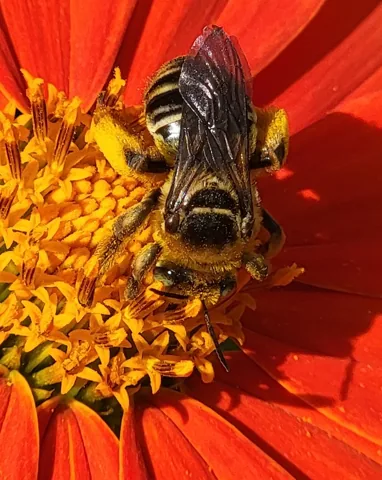 Sandhills longhorn bee
Epimelissodes aegis
The sandhills longhorn bee is a large, strong-bodied solitary bee with thick yellowish hair, found in sandy grasslands and wildflower-rich habitats across the Gulf and Atlantic coastal plains of the Southeast. It was formerly placed in the genus Svastra. Females dig nests in sandy or loose soil, often many close together, and forage heavily on sunflowers and other members of the aster family. Its biology is poorly documented; the first detailed nesting note came from a Florida cotton plot in 2023.
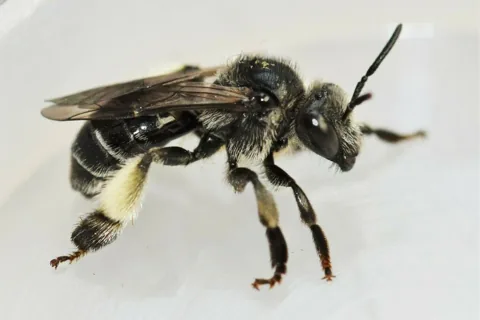 Oil-collecting bees (loosestrife bees)
Macropis species (e.g., M. nuda and M. patellata)
Oil-collecting bees of the genus Macropis are small black bees, about 7 to 8 mm long, that specialize completely on native loosestrifes (Lysimachia). Those flowers produce floral oil, and the female bees gather it along with pollen to provision their young in nests in the ground. They occur across the eastern and central United States and southern Canada, fly from about June to August, and are uncommon enough that Minnesota gives both of its species state rarity ranks (S1 and S2). They are harmless specialists worth leaving alone.
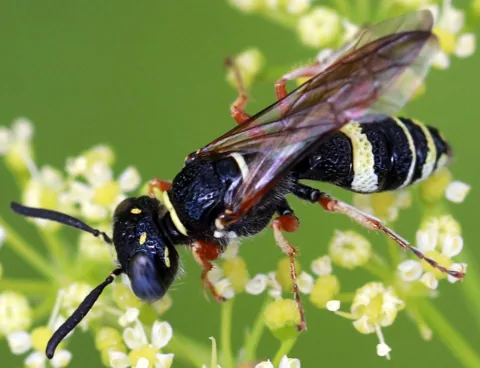 Beewolf
Philanthus gibbosus
The beewolf is a black-and-yellow digger wasp, half to three quarters of an inch long, that is one of the most widely distributed wasps in North America. Adults drink nectar and pollinate flowers, but the females hunt: they stalk and sting other bees, carry the paralyzed victims into cells in a burrow in the ground, and lay an egg beside each one. Like other solitary wasps it is not aggressive and rarely stings people, only if handled, so the best approach is to leave it alone; nests are active for just a few weeks in summer.
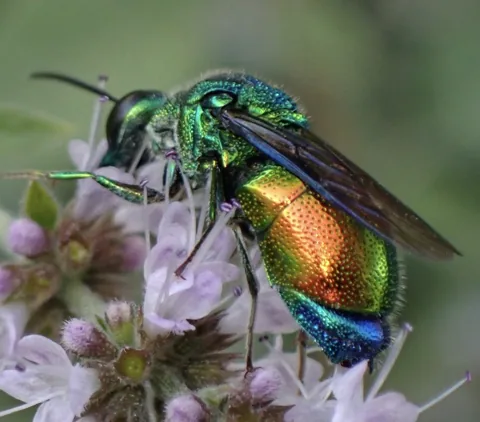 Cuckoo wasps
Chrysididae (e.g., Chrysis and Hedychrum species)
Cuckoo wasps are compact wasps with a hard exoskeleton, about the size of a rice grain, that glitter metallic green, blue-green, purple or coppery red. They are parasitoids: a female slips into the nest of a ground- or wood-nesting wasp or bee and lays an egg, and her larva eats the host and the food stored in the nest. North America has more than 200 species, most of them in the West. Adults crawl over the ground and dead wood hunting for nests, sometimes visit flowers, and often roll into a ball when disturbed, which green sweat bees do not do.
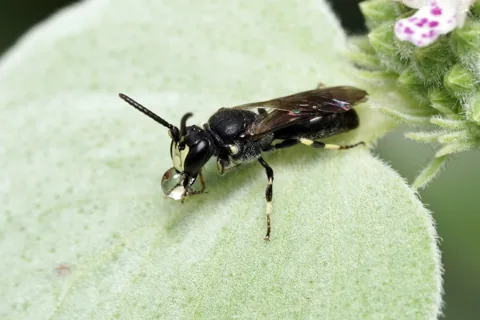 Yellow-faced bees
Hylaeus (yellow-faced or masked bees)
Yellow-faced bees are small native bees, 0.2 to 0.3 inch long, that most people take for wasps: they are slender, nearly hairless and black, with small bright yellow marks on the face, thorax and legs. They have no pollen-carrying hairs; a female swallows nectar and pollen, carries it home in her crop and regurgitates it for her young. They are solitary pollinators that need no control.
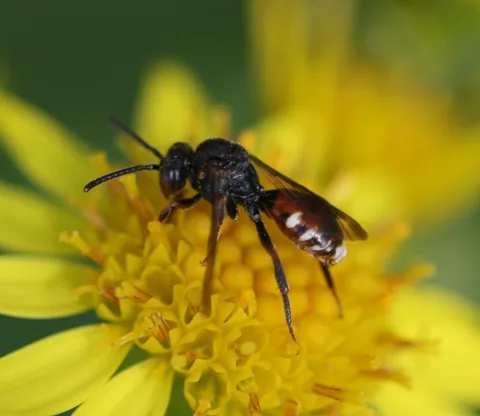 Nomad bees
Nomada (nomad or cuckoo bees)
Nomad bees (genus Nomada) are cuckoo bees: a quarter to half an inch long, slender, red or yellow, sometimes with whitish markings, and so hairless that they are often mistaken for wasps. They never collect pollen. A female looks for the nests of other solitary bees, especially mining bees, waits until the owner leaves, slips in and lays an egg, and her young eats the food stored for the host's offspring. They show up in spring, a few weeks after their hosts, often flying low over bare ground. They do no harm to people or plants and need no control.
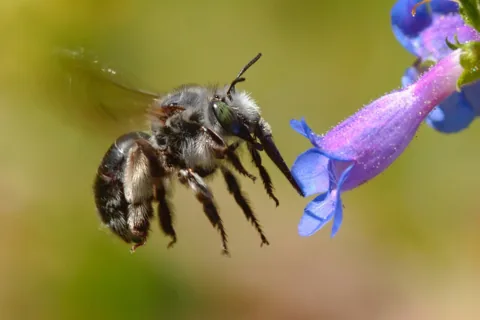 Digger bees
Anthophora (e.g., Anthophora abrupta, the chimney bee)
Digger bees are robust, hairy native bees, half an inch to an inch long, that many people take for small, fast, grayish bumble bees. They dig nest tunnels in dry ground with their jaws and legs, often in large groupings, and many species top each burrow with a little mud chimney. Although hundreds may nest side by side, each female works alone. They hover low, fly very fast, and are not aggressive toward people or pets. North America has about 100 Anthophora species, active from early spring into fall, and they need no control.
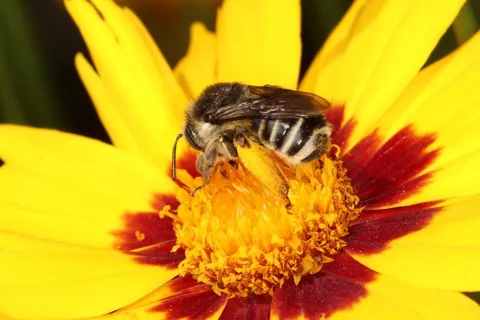 Long-horned bees
Eucerini (e.g., Melissodes and Eucera species)
Long-horned bees are medium to large native bees, half to three-quarters of an inch long, fuzzy and usually brown or gray with pale stripes, pale gray or blue eyes and, in the males, antennae long enough to give the group its name. More than 200 species occur in North America north of Mexico, most of them in the genera Melissodes and Eucera, and many visit particular flowers: sunflowers, squashes and pumpkins, pickerel weed. Females dig deep tunnels in the ground and are solitary, though they sometimes share an entrance. They are valuable pollinators, not aggressive, and need no control.
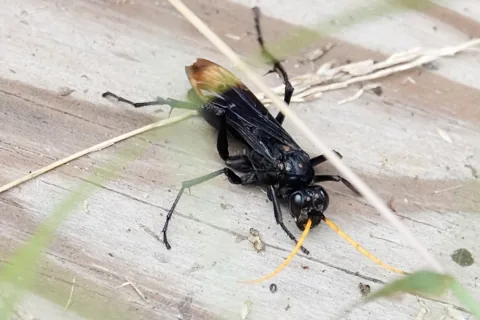 Entypus spider wasps
Entypus (e.g., Entypus unifasciatus, E. aratus, E. fulvicornis)
Entypus spider wasps are among the largest spider wasps, sometimes nearly an inch and a quarter long, black with a bluish sheen, smoky wings washed with amber and very long, spined legs. Seven species occur north of Mexico and none has a common name. They are seen mostly in late summer and early fall, drinking nectar at flowers or dragging a paralyzed wolf spider to a cavity another animal dug, where a single egg is laid on the spider and the larva eats it. Like other spider wasps they are solitary and hunt spiders, not people; no control is needed.
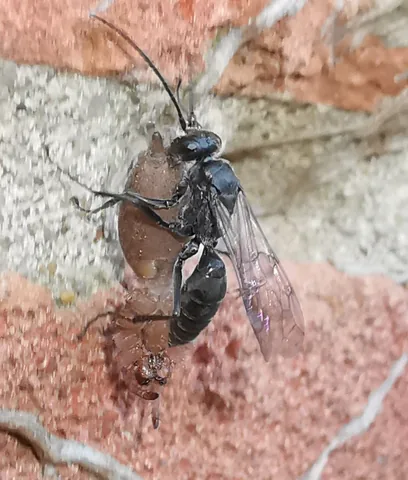 Auplopus spider wasps
Auplopus (about 10 North American species)
Auplopus spider wasps are small, solitary spider wasps, up to about half an inch long, black with a bluish or turquoise sheen. After stinging a spider, the female snips off its legs so the body is easier for a wasp her size to carry, then seals it in a small mud cell with one egg. Females sometimes build these cells in cracks on house foundations, and field studies have found them on a basement window edge and under a screen-door hinge. They are beneficial, the sources report no stings to people, and no control is needed; an empty mud cell can simply be scraped off.
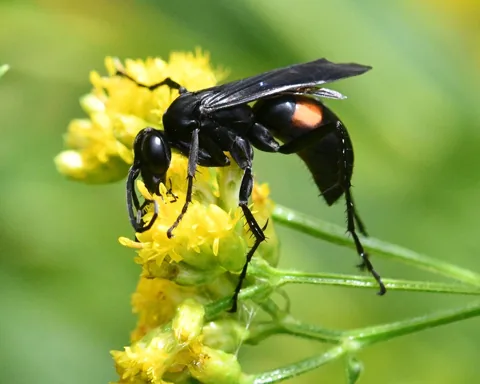 Blue-black spider wasps
Anoplius (nearly 50 North American species, e.g., Anoplius depressipes)
Blue-black spider wasps are the Anoplius wasps, nearly 50 North American species of long-legged, nervously wing-flicking wasps that are either entirely black with a bluish sheen or black with an orange patch on the abdomen. Females hunt wolf spiders, grass spiders and similar ground spiders, sting them, drag them into a burrow and lay a single egg on each; the larva eats the paralyzed spider alive. One species even walks on water to catch fishing spiders. The adults are common at flowers, can sting if handled, but are solitary hunters that need no control.
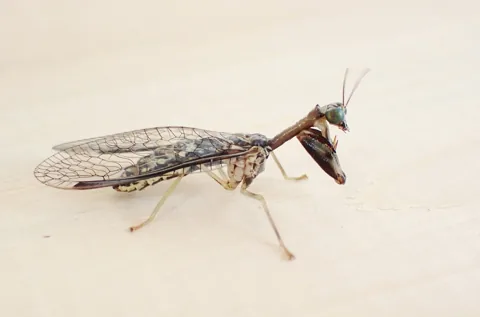 Mantidflies
Mantispidae (Dicromantispa, Zeugomantispa, Climaciella, Leptomantispa)
A mantidfly looks like a cross between a lacewing and a praying mantis: a triangular mantis-like head, a long neck-like prothorax and spiny grabbing forelegs on an inch-long body with four net-veined wings. It is a lacewing relative, not a mantis. The Missouri Department of Conservation says most people would consider mantidflies friendly, since they serve as a control on spiders, insects and other small arthropods; about 11 species live in North America north of Mexico, most commonly in the southern United States, and many come to lights at night from late April until heavy frosts in October.
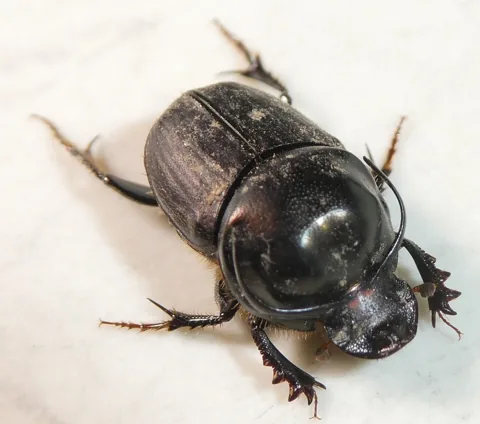 Dung beetles
Scarabaeinae and Aphodiinae (Onthophagus, Canthon, Phanaeus, Aphodius and others), plus Geotrupidae
A cow pat is a small ecosystem, and the beetles that arrive within hours are the ones that decide whether it breeds horn flies and parasites or disappears into the soil. Dung beetles come in three working styles: rollers that carve off a ball and trundle it away to bury, tunnelers that dig chambers beneath the pat and drag dung down to stock them, and dwellers that simply live and breed inside the manure. All three can share one pat, competing with the horn and face flies that lay eggs in fresh dung, and Cornell credits them with reducing those flies by as much as 95 percent on New York pastures.
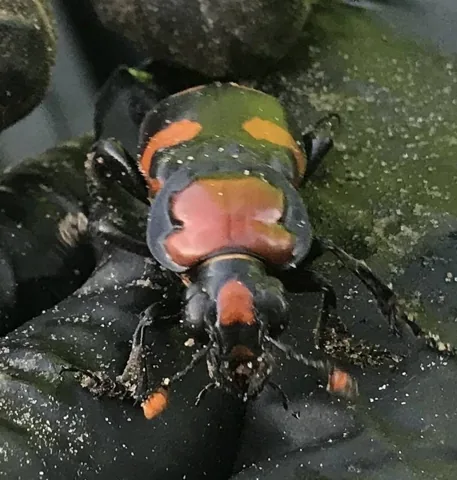 American burying beetle
Nicrophorus americanus
A hundred years ago this beetle buried mice and quail across 35 states and southern Ontario. Today wild populations survive in only a handful of states, it has not been seen in Ontario since 1972 or in Missouri since the mid-1970s, and it holds the distinction of being the first insect the U.S. Fish and Wildlife Service ever listed as endangered. Anyone who finds a shiny black, inch-long beetle with bright orange-red bands on its wing covers and an orange patch behind the head is looking at something worth reporting, not controlling.
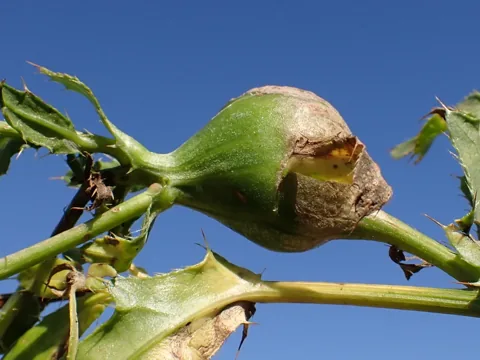 Thistle Stem Gall Fly
Urophora cardui
The Canada thistle stem gall fly (Urophora cardui) is a beneficial fruit fly, not a pest. Native to Europe, it was first released in Canada in 1974 and in the United States in California in 1977 as a classical biological control agent for Canada thistle, and it is now widely distributed across the U.S. and southern Canada. Its larvae induce hard, woody galls on thistle stems that divert nutrients from growth, stunt young stems by half or more and reduce seed production; the fly lays its eggs only in Canada thistle and a few close relatives.
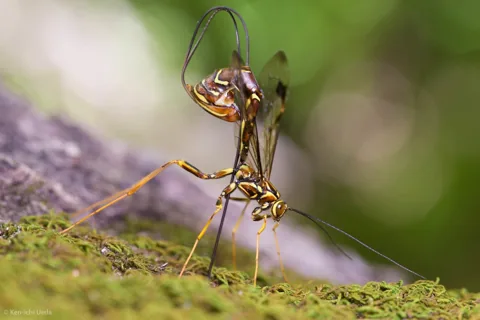 Ichneumon wasps
Ichneumonidae (more than 5,000 North American species)
Ichneumon wasps are the largest family of wasps, with more than 5,000 species in North America alone. They look like stinging wasps drawn out thin: slender, long-legged, with antennae at least half the body length and, on most females, an ovipositor that is often longer than the whole insect. That filament is for laying eggs inside caterpillars, grubs and wood-boring larvae, which the wasp's young eat from the inside. Missouri's conservation department says most ichneumons are harmless, although the female's long ovipositor is intimidating, and that they help control pests such as tomato hornworms, boll weevils and wood borers; WSU recommends no chemical management for them.
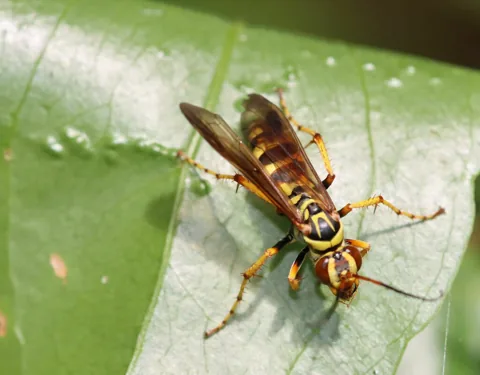 Poecilopompilus spider wasps
Poecilopompilus (Poecilopompilus algidus and P. interruptus)
Poecilopompilus spider wasps are the spider wasps that specialize in orbweavers, while most of their relatives take jumping, wolf or crab spiders. Two species, Poecilopompilus algidus and P. interruptus, are widespread in North America. Depending on the region they may be banded yellow and orange or mostly black with an orange patch on the side of the abdomen, a pattern that tends to copy whatever stinging wasp is most common locally. Females dig burrows in sandy ground, stock each with one paralyzed spider and an egg, and are otherwise seen at flowers in open country. They are solitary and need no control.
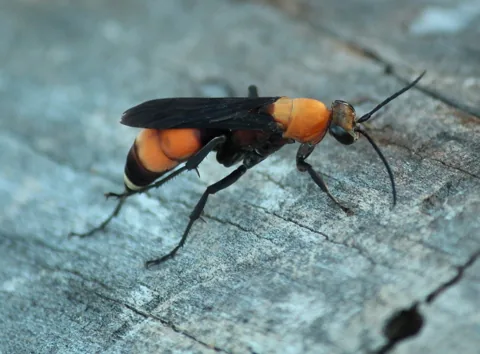 Psorthaspis spider wasps
Psorthaspis (about 13 North American species, e.g., Psorthaspis sanguinea)
Psorthaspis spider wasps look so much like velvet ants that Missouri's field guide calls them 'velvet ant mimics'. About 13 species occur north of Mexico; in the central states they are usually velvety red and black, and elsewhere the same yellow, orange or striped patterns as the velvet ants of that region. Females hunt on the ground in woods, apparently favoring trapdoor spiders, and nest like other spider wasps, stocking a burrow with one paralyzed spider. They are said to have a very painful sting but are not aggressive, and they need no control.
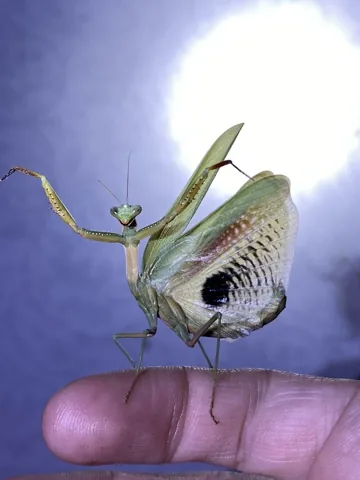 Mediterranean mantis
Iris oratoria
The Mediterranean mantis (Iris oratoria) is one of the introduced mantids of California, along with the Chinese, European and South African mantids. UC IPM says it is sold by mail order and in some garden stores, but that mantids are of no benefit for biological pest control. Field studies at Davis, California, have watched it alongside the native bordered mantis.
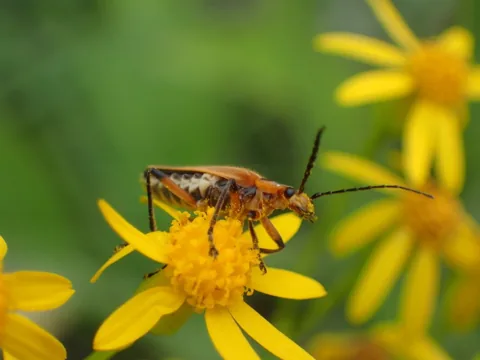 Margined leatherwing
Chauliognathus marginatus
The margined leatherwing is the soldier beetle you see on flowers in late spring and early summer. Adults visit flowers for nectar and pollen, and the larvae hunt insects in the soil. It does not damage plants and does not bite or sting.
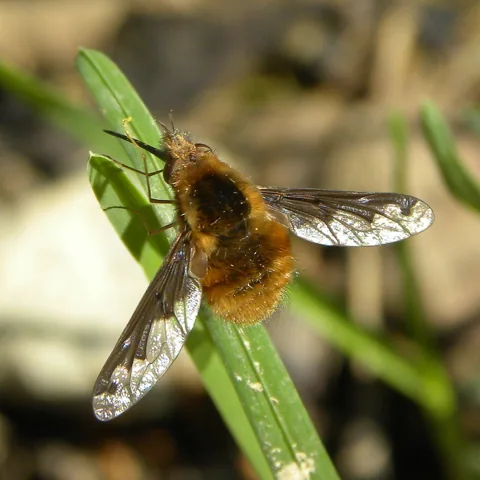 Bee Flies
Bombyliidae (e.g., Bombylius major)
Bee flies are fuzzy, round-bodied flies that hover in front of flowers and look a lot like small bees. They are true flies, not bees, and they can't sting or bite; the long beak on some species is only for sipping nectar. North America has about 800 species. The adults feed at flowers, while the larvae grow on the eggs, larvae or pupae of other insects, including cutworms, grasshoppers and carpenter bees.
Common garden predators
- Green lacewings: larvae up to about 1/2 inch, cream to tan with dark or reddish markings and large curved jaws; they feed on mites and soft-bodied insects. Some species are sold as adults, eggs or larvae and released in greenhouses.[5]
- Predaceous ground beetles: shiny, long-legged, usually blackish or dark reddish beetles, 1/8 to 1 inch long, mostly active at night on the ground, eating caterpillars, root-feeding insects, millipedes, slugs and snails.[4]
- Soldier beetles (leatherwings): elongate, dark with orange, red or yellow, with soft, flexible wing covers; they eat aphids, insect eggs and other soft-bodied insects.[6]
- Minute pirate bugs and bigeyed bugs: small true bugs that prey on aphids, mites, thrips, whiteflies, insect eggs and small caterpillars.[7][8]
- Lady beetles and syrphid fly larvae are major aphid predators; round, discolored aphid 'mummies' mean parasitic wasps are at work.[9]
Predators with a downside
- Assassin bugs have long, narrow heads, beady eyes and needlelike mouthparts; they're general predators that also eat bees, lacewings and lady beetles.[2]
- Mantids, 2 to 5 inches long and brown, green or yellowish, prey indiscriminately on beneficial and harmless insects, including bees, butterflies and syrphid flies. Chinese and Mediterranean mantids are sold by mail order, but they don't provide pest control.[3]
Pests of honey bees
- Varroa mites feed on the fat body and blood of adult bees and developing brood and spread viruses; colonies with uncontrolled infestations are likely to die in fall or over winter.[13][14][15]
- Wax moth caterpillars tunnel through comb, leaving a trail of silk webbing and droppings. They're opportunistic, far more common in weak or dead colonies, and especially drawn to brood comb.[16]
Keeping natural enemies around
- Tolerate low pest numbers so predators have food, and check for natural enemies before treating.[9][10]
- If you need a pesticide, insecticidal soaps and horticultural oils are less harmful to natural enemies than broad-spectrum products.[9][12]
- Control ants on plants; they protect aphids, scales and whiteflies from their natural enemies.[9][10][11]
Photo credits
- Ambush Bugs: Alex Heyman, public domain (CC0), via iNaturalist
- Aphid Midge: (c) Martin Scheuch, some rights reserved (CC BY) — via iNaturalist, CC BY 4.0
- Ashy Gray Lady Beetle: (c) Gabriel O. Keller, some rights reserved (CC BY) — via iNaturalist, CC BY 4.0
- Dragonflies: (c) Lauren McLaurin, some rights reserved (CC BY) — via iNaturalist, CC BY 4.0
- Drone Fly and Rat-Tailed Maggot: (c) Wendy Bailey, some rights reserved (CC BY) — via iNaturalist, CC BY 4.0
- Dustywings: (c) thomas_oswald, some rights reserved (CC BY) — via iNaturalist, CC BY 4.0
- Encarsia Wasps: Jesse Rorabaugh, public domain (CC0), via iNaturalist
- Florida Predatory Stink Bug: (c) Katja Schulz, some rights reserved (CC BY) — via iNaturalist, CC BY 4.0
- Mildew-Eating Lady Beetles: (c) Will Linnard, some rights reserved (CC BY) — via iNaturalist, CC BY 4.0
- Mealybug Destroyer: Jesse Rorabaugh, public domain (CC0), via iNaturalist
- Pink Spotted Lady Beetle: Zygy, public domain (CC0), via iNaturalist
- Sevenspotted Lady Beetle: (c) Atalay Karakuş, some rights reserved (CC BY) — via iNaturalist, CC BY 4.0
- Sixspotted Thrips: 余世文, public domain (CC0), via iNaturalist
- Soldier Beetles: Anne P, public domain (CC0), via iNaturalist
- Spider Mite Destroyer: Jesse Rorabaugh, public domain (CC0), via iNaturalist
- Steelblue Lady Beetle: (c) Jacqui Geux, some rights reserved (CC BY) — via iNaturalist, CC BY 4.0
- Tachinid Flies: (c) Theo Rickert, some rights reserved (CC BY) — via iNaturalist, CC BY 4.0
- Trichogramma Wasps: (c) Kerri-Lee Harris, some rights reserved (CC BY) — via iNaturalist, CC BY 4.0
- Trissolcus Wasps: (c) Grey Smith, some rights reserved (CC BY) — via iNaturalist, CC BY 4.0
- Twospotted Lady Beetle: (c) Halema J, some rights reserved (CC BY) — via iNaturalist, CC BY 4.0
- Twospotted Stink Bug: (c) Jan Ebr & Ivana Ebrová, some rights reserved (CC BY) — via iNaturalist, CC BY 4.0
- Fireflies: (c) Albert Cardona, some rights reserved (CC BY) — via iNaturalist, CC BY 4.0
- Punctured Tiger Beetle: Brighton Lee, public domain (CC0), via iNaturalist
- Rainbow Scarab: (c) P.G.Th❤️mas, some rights reserved (CC BY) — via iNaturalist, CC BY 4.0
- European Wool Carder Bee: (c) Michael Ellis, some rights reserved (CC BY) — via iNaturalist, CC BY 4.0
- Pale Green Assassin Bug: (c) Katja Schulz, some rights reserved (CC BY) — via iNaturalist, CC BY 4.0
- Antlions: (c) Bartosz Czołczyński, some rights reserved (CC BY) — via iNaturalist, CC BY 4.0
- Great Black Wasp: (c) DiegoH, some rights reserved (CC BY) — via iNaturalist, CC BY 4.0
- Mydas Flies: (c) Kristof Zyskowski, some rights reserved (CC BY) — via iNaturalist, CC BY 4.0
- Giant Strong-Nosed Stink Bug: Frank Thomas Sautter, public domain (CC0), via iNaturalist
- Striped Lynx Spider: (c) cesar stastny, some rights reserved (CC BY) — via iNaturalist, CC BY 4.0
- Rosy Wolf Snail: (c) Tedd Greenwald, some rights reserved (CC BY) — via iNaturalist, CC BY 4.0
- Squash Bees: (c) Frances Oliver, some rights reserved (CC BY) — via iNaturalist, CC BY 4.0
- Monarch Butterfly: (c) Shirley Zundell, some rights reserved (CC BY) — via iNaturalist, CC BY 4.0
- American Sand Wasp: (c) Karen Kincy, some rights reserved (CC BY) — via iNaturalist, CC BY 4.0
- Red and Black Mason Wasp: (c) Mary G, some rights reserved (CC BY) — via iNaturalist, CC BY 4.0
- Common Long-Horned Bee: (c) Jake McCumber, some rights reserved (CC BY) — via iNaturalist, CC BY 4.0
- Pure Gold-Green Sweat Bee: (c) Bernie Paquette, some rights reserved (CC BY) — via iNaturalist, CC BY 4.0
- Varroa Mite: (c) Adrienne van den Beemt, some rights reserved (CC BY) — via iNaturalist, CC BY 4.0
- Wax Moths: (c) SteveM4560, some rights reserved (CC BY) — via iNaturalist, CC BY 4.0
- Filth fly parasitoids: (c) Svavar Martin Andreasen, some rights reserved (CC BY) — via iNaturalist, CC BY 4.0
- Spring tiphia: Smithsonian National Museum of Natural History, public domain (CC0), via Smithsonian Open Access
- Ensign wasp: (c) Heatherelle, some rights reserved (CC BY) — via iNaturalist, CC BY 4.0
- Six-spotted tiger beetle: (c) Shirley Zundell, some rights reserved (CC BY) — via iNaturalist, CC BY 4.0
- Tiger Bee Fly: cgmayers, public domain (CC0), via iNaturalist
- Five-banded thynnid wasp: (c) Louise Woodrich, some rights reserved (CC BY) — via iNaturalist, CC BY 4.0
- Southeastern blueberry bee: (c) Joshua Liverman, some rights reserved (CC BY) — via iNaturalist, CC BY 4.0
- Milkweed assassin bug: (c) Sandra H Statner, some rights reserved (CC BY) — via iNaturalist, CC BY 4.0
- Rusty-patched bumble bee: Milwaukee County Parks - Natural Areas Program, public domain (CC0), via iNaturalist
- Polished lady beetle: (c) Victor Engel, some rights reserved (CC BY) — via iNaturalist, CC BY 4.0
- Anchor stink bug: (c) Adrienne van den Beemt, some rights reserved (CC BY) — via iNaturalist, CC BY 4.0
- Pleasing antlion: (c) florawhite, some rights reserved (CC BY) — via iNaturalist, CC BY 4.0
- Banded longhorn beetle: Ken Kneidel, public domain (CC0), via iNaturalist
- Owlflies: TheMongrelKoi, public domain (CC0), via iNaturalist
- Oblique Streaktail: (c) David George, some rights reserved (CC BY) — via iNaturalist, CC BY 4.0
- American bumble bee: (c) Linda Watson, some rights reserved (CC BY) — via iNaturalist, CC BY 4.0
- Brown-belted bumble bee: (c) Bernie Paquette, some rights reserved (CC BY) — via iNaturalist, CC BY 4.0
- Two-spotted bumble bee: (c) Rosario Douglas, some rights reserved (CC BY) — via iNaturalist, CC BY 4.0
- Black-and-gold bumble bee: (c) aarongunnar, some rights reserved (CC BY) — via iNaturalist, CC BY 4.0
- Orange assassin bug: (c) Mark Richman, some rights reserved (CC BY) — via iNaturalist, CC BY 4.0
- Southern plains bumble bee: Raven Dandridge, public domain (CC0), via iNaturalist
- Goldeneyed lacewing: Brighton Lee, public domain (CC0), via iNaturalist
- Cinnabar Moth: Christian Kahle, public domain (CC0), via iNaturalist
- Yellow-faced bumble bee: Anne Parsons, public domain (CC0), via iNaturalist
- Black-tailed bumble bee: (c) Jeff Bartlett, some rights reserved (CC BY) — via iNaturalist, CC BY 4.0
- Tri-colored bumble bee: Bruce Cook, public domain (CC0), via iNaturalist
- Golden northern bumble bee: (c) earl woolsey, some rights reserved (CC BY) — via iNaturalist, CC BY 4.0
- Red-belted bumble bee: (c) Michelle Orcutt, some rights reserved (CC BY) — via iNaturalist, CC BY 4.0
- Smoky-winged beetle bandit: (c) John Abrams, some rights reserved (CC BY) — via iNaturalist, CC BY 4.0
- Pennsylvania dingy ground beetle: Brighton Lee, public domain (CC0), via iNaturalist
- Scoliid wasps: (c) Zihao Wang, some rights reserved (CC BY) — via iNaturalist, CC BY 4.0
- Mole cricket hunter: (c) Eridan Xharahi, some rights reserved (CC BY) — via iNaturalist, CC BY 4.0
- Thread-waisted sand wasps: (c) Healthy Yards, some rights reserved (CC BY) — via iNaturalist, CC BY 4.0
- Vespiform thrips: (c) Ben Jobson, some rights reserved (CC BY) — via iNaturalist, CC BY 4.0
- Banded thrips: James Hussey, public domain (CC0), via iNaturalist
- Purple scale predator: (c) Trevor Van Loon, some rights reserved (CC BY) — via iNaturalist, CC BY 4.0
- Kuwana's lady beetle: (c) Timur Kalininsky, some rights reserved (CC BY) — via iNaturalist, CC BY 4.0
- Whitefly predatory lady beetle: (c) Sandy Rae, some rights reserved (CC BY) — via iNaturalist, CC BY 4.0
- Nine-spotted lady beetle: (c) Rebecca Ray, some rights reserved (CC BY) — via iNaturalist, CC BY 4.0
- Aphid Flies (Silver Flies): Jesse Rorabaugh, public domain (CC0), via iNaturalist
- Fire Ant Decapitating Flies: Photo by Sanford Porter, USDA Agricultural Research Service (public domain; ARS Image Number K8575-22)
- Longlegged Flies: (c) Jason Hill, some rights reserved (CC BY) — via iNaturalist, CC BY 4.0
- Anagyrus pseudococci (mealybug parasitoid): (c) Ben Jobson, some rights reserved (CC BY) — via iNaturalist, CC BY 4.0
- Sandhills longhorn bee: (c) Rebecca Gimenez Husted, some rights reserved (CC BY) — via iNaturalist, CC BY 4.0
- Oil-collecting bees (loosestrife bees): (c) Owen Strickland, some rights reserved (CC BY) — via iNaturalist, CC BY 4.0
- Beewolf: (c) Catherine C. Galley, some rights reserved (CC BY) — via iNaturalist, CC BY 4.0
- Cuckoo wasps: (c) Albert Cardona, some rights reserved (CC BY) — via iNaturalist, CC BY 4.0
- Yellow-faced bees: (c) Amy Schnebelin, some rights reserved (CC BY) — via iNaturalist, CC BY 4.0
- Nomad bees: (c) Sandy Rae, some rights reserved (CC BY) — via iNaturalist, CC BY 4.0
- Digger bees: (c) Joel Gardner, some rights reserved (CC BY) — via iNaturalist, CC BY 4.0
- Long-horned bees: (c) Jake McCumber, some rights reserved (CC BY) — via iNaturalist, CC BY 4.0
- Entypus spider wasps: (c) Louise Woodrich, some rights reserved (CC BY) — via iNaturalist, CC BY 4.0
- Auplopus spider wasps: Matthew Wilkinson, public domain (CC0), via iNaturalist
- Blue-black spider wasps: (c) Roger Rittmaster, some rights reserved (CC BY) — via iNaturalist, CC BY 4.0
- Mantidflies: (c) Susan Blayney, some rights reserved (CC BY) — via iNaturalist, CC BY 4.0
- Dung beetles: (c) Wendy Jegla, some rights reserved (CC BY) — via iNaturalist, CC BY 4.0
- American burying beetle: (c) Mark Pollock, some rights reserved (CC BY) — via iNaturalist, CC BY 4.0
- Thistle Stem Gall Fly: (c) Patrick Hacker, some rights reserved (CC BY) — via iNaturalist, CC BY 4.0
- Ichneumon wasps: (c) Ken-ichi Ueda, some rights reserved (CC BY) — via iNaturalist, CC BY 4.0
- Poecilopompilus spider wasps: (c) hr_dragonfly, some rights reserved (CC BY) — via iNaturalist, CC BY 4.0
- Psorthaspis spider wasps: (c) mayfly1963, some rights reserved (CC BY) — via iNaturalist, CC BY 4.0
- Mediterranean mantis: (c) David Rankin, some rights reserved (CC BY) — via iNaturalist, CC BY 4.0
- Margined leatherwing: (c) George Williams, some rights reserved (CC BY) — via iNaturalist, CC BY 4.0
- Bee Flies: (c) M. Whitson, some rights reserved (CC BY) — via iNaturalist, CC BY 4.0
Sources
- University of California Statewide IPM Program, “Natural Enemies Gallery.” ipm.ucanr.edu/natural-enemies/ (accessed 2026-10-06)
- University of California Statewide IPM Program, “Assassin Bugs (Natural Enemies Gallery).” ipm.ucanr.edu/natural-enemies/assassin-bugs/ (accessed 2026-10-06)
- University of California Statewide IPM Program, “Mantids (Natural Enemies Gallery).” ipm.ucanr.edu/natural-enemies/mantids/ (accessed 2026-10-06)
- University of California Statewide IPM Program, “Predaceous Ground Beetles (Natural Enemies Gallery).” ipm.ucanr.edu/natural-enemies/predaceous-ground-beetles/ (accessed 2026-10-06)
- University of California Statewide IPM Program, “Green Lacewings (Natural Enemies Gallery).” ipm.ucanr.edu/natural-enemies/green-lacewings/ (accessed 2026-10-06)
- University of California Statewide IPM Program, “Soldier Beetles (Natural Enemies Gallery).” ipm.ucanr.edu/natural-enemies/soldier-beetles/ (accessed 2026-10-06)
- University of California Statewide IPM Program, “Minute Pirate Bugs (Natural Enemies Gallery).” ipm.ucanr.edu/natural-enemies/minute-pirate-bugs/ (accessed 2026-10-06)
- University of California Statewide IPM Program, “Bigeyed Bugs (Natural Enemies Gallery).” ipm.ucanr.edu/natural-enemies/bigeyed-bugs/ (accessed 2026-10-06)
- University of California Statewide IPM Program, “Aphids (Pest Notes, Home and Landscape).” ipm.ucanr.edu/home-and-landscape/aphids/ (accessed 2026-10-06)
- University of California Statewide IPM Program, “Scales (Pest Notes, Home and Landscape).” ipm.ucanr.edu/home-and-landscape/scales/ (accessed 2026-10-06)
- University of California Statewide IPM Program, “Whiteflies (Pest Notes, Home and Landscape).” ipm.ucanr.edu/home-and-landscape/whiteflies/ (accessed 2026-10-06)
- University of California Statewide IPM Program, “Spider Mites (Pest Notes, Home and Landscape).” ipm.ucanr.edu/home-and-landscape/spider-mites/ (accessed 2026-10-06)
- Delaware Department of Agriculture, “Varroa Mites (June 2023).” agriculture.delaware.gov/wp-content/uploads/sites/108/2023/06/Varroa-Mites_Final_6.12.23.pdf (accessed 2026-11-12)
- Penn State Extension, “Methods to Control Varroa Mites: An Integrated Pest Management Approach.” extension.psu.edu/methods-to-control-varroa-mites-an-integrated-pest-management-approach (accessed 2026-11-12)
- University of Minnesota Bee Lab, “Varroa Mite Testing & Management.” beelab.umn.edu/varroa-mite-testing (accessed 2026-11-12)
- Mississippi State University Extension Service, “Wax Moths, Greater and Lesser (Publication 3195).” extension.msstate.edu/sites/default/files/publications/P3195_web.pdf (accessed 2026-11-12)