On this page
How to identify it
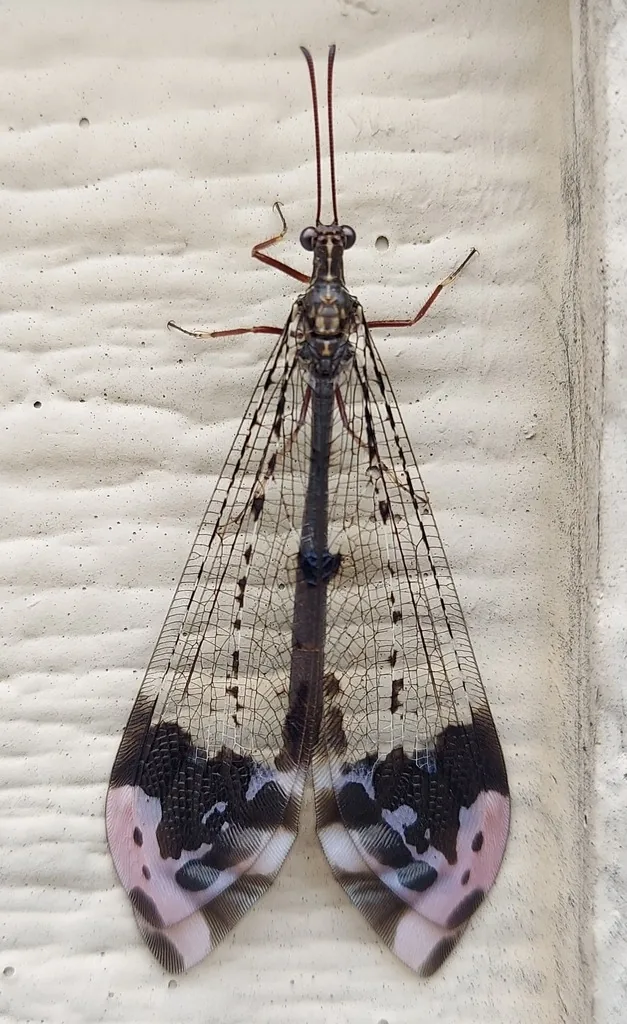
- MDC gives the adult a body length of up to about 1 1/2 inches and a wingspan of about 3 1/2 to 4 inches.[1]
- The four wings are very large and richly marked with dark patches, a pattern UF/IFAS calls distinctive among Florida antlions.[1][2]
- Like other antlions it has clubbed or curved antennae about as long as the head and thorax combined; damselflies have small antennae.[3]
- The larva's curved mandibles each carry two teeth, a trait of its genus. Most other Florida antlion genera have three teeth, and Paranthaclisis has one.[2]
Look-alikes
| Look-alike | How to tell them apart |
|---|---|
| Pit-building antlions (doodlebugs) | Most antlions people know have larvae that sit under cone-shaped pits in sandy or loose soil, and their adults are drab, with wings mottled brown and black. Pleasing antlion larvae live in debris inside tree hollows, and the adults' wings are very large and distinctive.[3][1] |
| Damselflies | Damselflies have small antennae, are often colorful and usually rest with their wings held together above the body. Antlions have clubbed or curved antennae about as long as the head and thorax combined.[3] |
Where it lives
UF/IFAS, citing a 2000 checklist, lists it in the United States from Florida (throughout the peninsula), Indiana, Kentucky, Mississippi, Missouri, New Jersey, Ohio and Tennessee, and the Missouri Department of Conservation includes it in its Missouri field guide. Florida has the richest antlion fauna in the eastern United States, with 22 species in nine genera.[2][1]
Biology and life cycle
Adults fly in forested areas during the summer and are sometimes drawn to lights; adult antlions fly mostly on calm late-summer evenings. They prey on aphids and caterpillars.[2][1][3]
All three larval stages live at the bottom of dry tree hollows, among fine wood particles, squirrel droppings and other debris. The hollows are roomy enough for a larva to move about under the surface of the debris and sheltered enough that rain does not fully soak the contents.[1][2]
The larvae dig or run after prey, though not quickly, and sometimes simply lie in wait. They eat the insects of the hollow: termites, beetle larvae and ants.[1][2]
Florida researchers found as many as three larvae in one hollow, and once a larva of another antlion, Dendroleon obsoletus, sharing it.[2]
Development takes one or two years, depending on how much food there is and how long the warm nights last. Two larvae reared by the UF/IFAS authors each spun a cocoon 13 mm (1/2 in) across, shallowly buried in the debris, and the adults emerged 28 days after the cocoons were made.[2]
Its egg laying and eggs are not known, and no natural enemies or parasites have been recorded.[2]
Damage and signs
Health risk
It is a predatory insect, and neither UF/IFAS, MDC nor USU Extension describes any risk to people.[1][3][4][2]
Control
Prevention
No control is needed. Adults eat aphids and caterpillars and larvae eat termites and ants, and extension and wildlife agencies count antlions as beneficial insect predators.[1][3][4]
Common questions
- Does the pleasing antlion dig sand pits?
- No. Its larvae live in the debris inside hollow trees, where they eat termites, ants and beetle grubs, rather than under cone-shaped pits in sand.[1][3]
- Where can I find one?
- Look for larvae in the debris at the bottom of hollow tree trunks; UF/IFAS found them by sifting dry organic material in tree holes, especially in live oaks (Quercus virginiana). Adults come to lights at night and can be found in forests by beating plants.[1][2]
- Is it a kind of damselfly?
- No. It is an antlion, in the order Neuroptera with the lacewings. Adult antlions are commonly mistaken for damselflies, but antlions have clubbed or curved antennae and damselflies have small ones.[1][3][4][2]
Sources
- Missouri Department of Conservation, “Pleasing Antlion (Field Guide).” mdc.mo.gov/discover-nature/field-guide/pleasing-antlion (accessed 2026-11-12)
- University of Florida IFAS Extension (EDIS), “An Antlion, Glenurus gratus (Say), EENY-393/IN708 (R. Miller and L. Stange; Featured Creatures).” ask.ifas.ufl.edu/publication/IN708 (accessed 2026-11-14)
- Missouri Department of Conservation, “Antlion Adults (Field Guide).” mdc.mo.gov/discover-nature/field-guide/antlion-adults (accessed 2026-11-12)
- Utah State University Extension, “Beneficial Insects: Lacewings and Antlions.” extension.usu.edu/planthealth/research/beneficial-insects-lacewings-antlions (accessed 2026-11-12)
- iNaturalist, “Glenurus gratus taxon page (order and family).” www.inaturalist.org/taxa/52885 (accessed 2026-11-09)