On this page
How to identify it
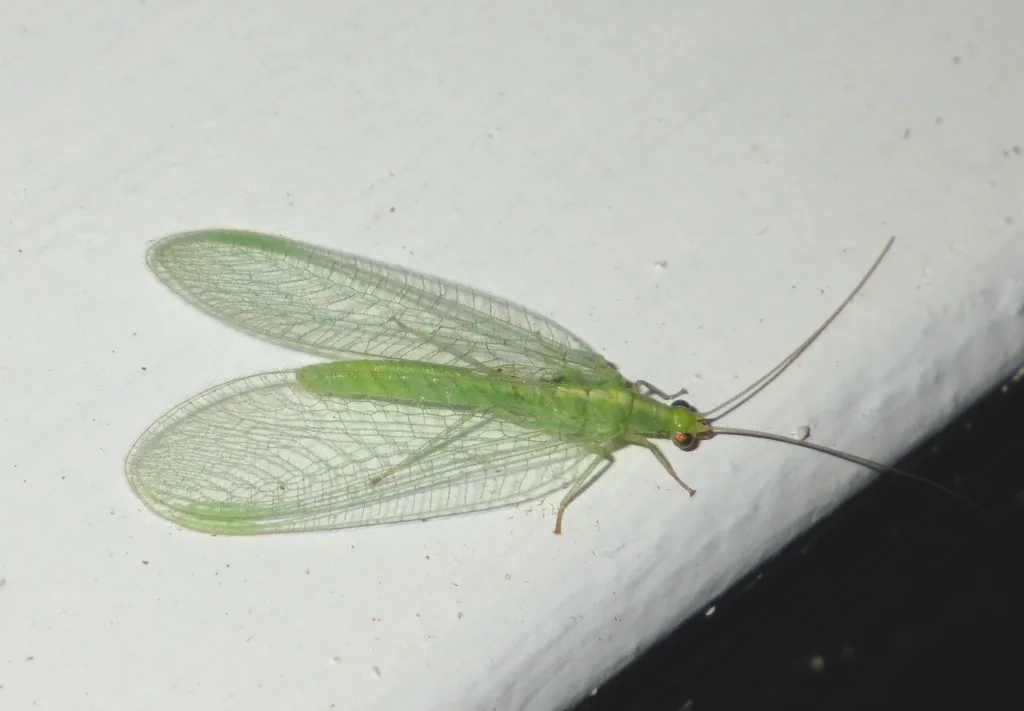
- Adults are soft-bodied and usually light green, with long antennae and lacy, finely veined wings held rooflike over the body. UC IPM and Kentucky give them as about 3/4 inch long; some species are tan or brown.[2][1][3]
- Their eyes look like two shiny golden hemispheres.[1][2]
- Each egg sits on the tip of a slender, hairlike stalk about 1/2 inch long attached to a leaf or stem, which keeps hatching larvae from eating their siblings.[2][1][5][3]
- Larvae grow to about 1/2 inch, are flattened and spindle-shaped like tiny alligators, and have large, curved, sickle-shaped jaws. They are usually camouflaged in gray, tan and brown.[2][1][3]
- Pupae form inside round, loosely woven white silk cocoons about 1/8 to 1/4 inch across, often attached beneath leaves.[2][3]
- UF/IFAS notes they are usually green in life but often turn yellowish after death, and some groups are brownish. The wing membrane is clear.[6]
- Fun fact: nearly all green lacewings have a tympanic organ on the underside of the base of a wing vein (the radial vein), which UF/IFAS calls unique among insects.[6]
- Some larvae are trash-carriers: UF/IFAS describes larvae of genera such as Leucochrysa, Nodita and Ceraeochrysa with short, broad bodies bearing many hooked bristles that hold debris on their backs; Chrysoperla larvae have long, slender abdomens and two black spots on the head.[6]
Look-alikes
| Look-alike | How to tell them apart |
|---|---|
| Brown lacewings | Adults and larvae look similar, but green lacewings are about twice as long in California species; color alone isn't reliable, because some green lacewings turn brown or reddish in winter.[2] |
| Lady beetles | Lady beetles are a separate group of predators; released lady beetle adults fly away from the release area, while newly hatched lacewing larvae are wingless and stay to hunt.[1] |
Where it lives
Common in field and tree crops, gardens, landscapes and wildlands throughout much of North America. About 85 green lacewing species occur north of Mexico and at least 37 in California; NC State calls them native throughout eastern North America. Worldwide there are about 1,300 species in about 87 genera, and UF/IFAS counts 22 species in nine genera in Florida.[2][3][7][4][6]
Biology and life cycle
Females lay about 100 to 300 eggs during a lifespan of several weeks, usually near food for the larvae.[2][1]
Larvae go through three instars, then spin a cocoon on a plant or under loose bark. The Missouri Department of Conservation says larvae cut a tiny lid from the egg, start eating immediately, and form a cocoon after 1-2 months. Cornell and Utah State put the larval stage at two to three weeks.[2][3][7][5]
Egg to adult takes about 4 to 6 weeks in warm weather, and there are commonly several generations a year.[2]
In cold climates they overwinter mostly as last-stage larvae or pupae in cocoons, and some adults turn reddish brown in fall; in the Southeast adults come to porch lights year-round, looking faded in winter.[2][4]
Adults feed mainly on nectar, pollen and honeydew; adults of Chrysoperla species aren't predators, but some other lacewings are.[2][1]
Fun fact: some lacewing larvae wear disguises. Certain species cover their backs with plant debris or prey remains, and at least one glues deflated aphid skins onto its back.[2][3]
Two common species are used in gardens: the common green lacewing (Chrysoperla carnea) suits drier areas of the northeastern, midwestern and western U.S., while the red-lipped green lacewing (C. rufilabris) does better where humidity is high, such as greenhouses and the southeastern and midwestern U.S.[7]
They are generalists but not equally good on every aphid. In a lab test, C. rufilabris larvae ate all 16 aphid species offered but completed development on only seven of them.[8]
UF/IFAS adds that the larvae take aphids, scale insects, whiteflies, thrips, insect eggs and other small, soft-bodied prey, which is why they are used so widely in biological control. Florida's four Chrysoperla species are probably widespread there because they are used for biological control.[6]
In Florida the larvae of two genera, Abachrysa and Nacarina, are associated with ants; Abachrysa eureka, the only species in its genus, is found in the southeastern United States.[6]
Damage and signs
Health risk
Lacewing larvae rarely bite people; when they do, it usually causes nothing more than a small skin irritation. Adults can give off a foul odor when handled.[1][3]
Control
Prevention
No control is needed; lacewings are beneficial natural enemies that help regulate aphids and other small soft-bodied insects.[1][4]
Bug zappers and other indiscriminate pest-control measures kill many lacewings, so avoid them where you want lacewings to work.[3]
Biological control
Protect resident lacewings by avoiding broad-spectrum, persistent insecticides and miticides, and by controlling ants and dust.[2]
Grow flowering plants that supply nectar and pollen for the adults, to make resident and released lacewings more effective.[2]
Lacewing eggs, larvae or adults are sold by biological control suppliers; eggs have been used with some success against aphids in greenhouses and plant beds.[2][1]
Lacewings are shipped as eggs, young larvae, pupae and adults; Planet Natural and Arbico Organics sell pre-hatched C. rufilabris larvae. Released larvae stay near the release site if aphids or other prey are present, but newly emerged adults often fly great distances before laying eggs, which is why commercial strains work best in greenhouses. Young larvae may need a moisture source, and tolerating a low level of aphids helps them stay.[7]
Where sources disagree
Size: UC IPM and Kentucky give adults as about 3/4 inch (19 mm) long, while Cornell and Utah State give 12-20 mm. UC IPM, Kentucky and the Missouri Department of Conservation give larvae as up to about 1/2 inch; Cornell says larvae grow from under 1 mm to 6-8 mm.[2][1][7][5][3]
Larval period: Cornell and Utah State give two to three weeks; the Missouri Department of Conservation says larvae form a cocoon after 1-2 months.[7][5][3]
Do adults hunt? UF/IFAS says green lacewing adults are usually predatory, with a few species feeding only on pollen; UC IPM says adults of the common Chrysoperla species are not predators and feed on nectar, pollen and honeydew.[6][2]
Common questions
- What are the tiny eggs on hairlike stalks on my plants?
- They are almost certainly green lacewing eggs, each perched on a slender stalk. Leave them alone, because the larvae that hatch will hunt aphids.[1][2]
- Do lacewings bite?
- Larvae can occasionally nip people, but it is rare and usually causes only a small skin irritation.[1]
- How many aphids can a lacewing larva eat?
- A lot. Cornell reports that each larva has been recorded eating 100 to 600 aphids, and the Missouri Department of Conservation says a larva can eat an aphid a minute, for hours, without slowing down.[7][3]
- Why are green lacewings at my porch light?
- Adults rest in vegetation by day, come out around sunset, and like many flying insects are attracted to lights at night.[3][4]
- Why did the green lacewing turn yellow?
- UF/IFAS notes that green lacewings are usually green in life but often turn yellowish after they die; some living species are brownish.[6]
Sources
- University of Kentucky Entomology Extension, “Green Lacewing, ENTFACT-708 (revised November 2019).” entomology.mgcafe.uky.edu/files/ef708.pdf (accessed 2026-11-14)
- University of California Statewide IPM Program, “Green Lacewings (Natural Enemies Gallery).” ipm.ucanr.edu/natural-enemies/green-lacewings/ (accessed 2026-11-14)
- Missouri Department of Conservation, “Green Lacewings (Field Guide).” mdc.mo.gov/discover-nature/field-guide/green-lacewings (accessed 2026-11-14)
- NC State Extension, Department of Entomology, “Green Lacewing (Biological Control Information Center).” entomology.ces.ncsu.edu/biological-control-information-center/beneficial-predators/green-lacewing/ (accessed 2026-11-14)
- Utah State University Extension, “Beneficial Insects: Lacewings and Antlions.” extension.usu.edu/planthealth/research/beneficial-insects-lacewings-antlions (accessed 2026-11-14)
- University of Florida/IFAS Extension (EDIS, Featured Creatures), “Green lacewings (of Florida) (Insecta: Neuroptera: Chrysopidae), EENY-534/IN965 (L. A. Stange).” ask.ifas.ufl.edu/publication/IN965 (accessed 2026-11-14)
- Cornell University, New York State Integrated Pest Management, “Common Green Lacewing Biocontrol Agent Factsheet.” cals.cornell.edu/integrated-pest-management/outreach-education/fact-sheets/common-green-lacewing-biocontrol-agent-factsheet (accessed 2026-11-14)
- Bulletin of Entomological Research (2022), via PubMed, “Diet breadth of the aphid predator Chrysoperla rufilabris Burmeister (Neuroptera: Chrysopidae).” pubmed.ncbi.nlm.nih.gov/35256021/ (accessed 2026-11-14). Cited from the PubMed abstract.
- iNaturalist, “Chrysoperla carnea taxon page (order and family).” www.inaturalist.org/taxa/858297 (accessed 2026-11-14)