On this page
How to identify it
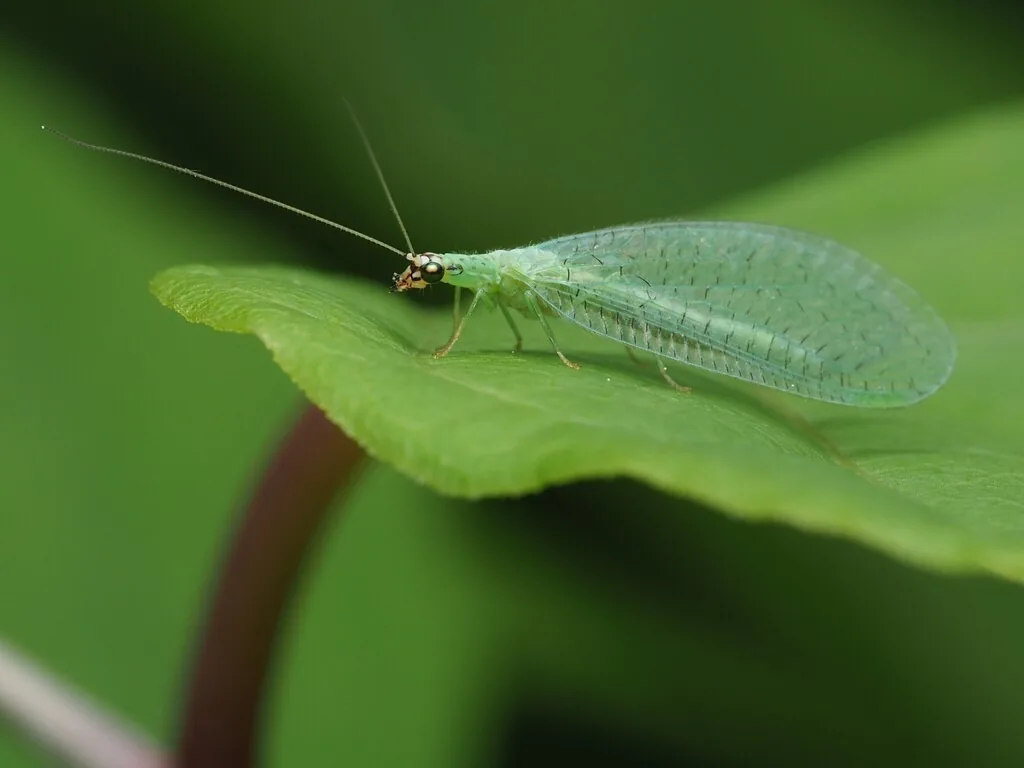
- Like other green lacewings, the adult has a soft, narrow body, long threadlike antennae, coppery or golden eyes, and lacy, finely veined wings that fold rooflike over the body. Most green lacewings are pale green.[4]
- Green lacewing larvae, sometimes called aphid lions, are long, flattened and lizard-like with six legs, usually patterned gray, tan and brown with small bristles. Some species carry debris on their backs as camouflage.[4]
- In the University of Florida key to Florida's green lacewing genera, Chrysopa adults have small eyes and broad wings. The pronotum (the plate behind the head) usually has red or orange bands along its edges, the gradate cross veins of the wings are often dark brown, and the antennae are sometimes dark brown.[5]
- Chrysopa larvae don't carry debris on their backs. They are long and slender, with the abdomen longer than the head and thorax together, and the head capsule has three or four black or reddish spots.[5]
- UF/IFAS notes that live green lacewings are usually greenish but often turn yellowish after death, and that nearly all have a tympanic organ at the base of a wing vein on the underside, a feature it calls unique among insects.[5]
Look-alikes
| Look-alike | How to tell them apart |
|---|---|
| Common green lacewings (Chrysoperla species) | These are the lacewings sold for biological control. Chrysoperla adults feed on nectar and pollen rather than prey, while goldeneyed lacewing adults hunt. In the University of Florida key, Chrysoperla adults lack red or orange bands on the pronotum (it often has a yellow stripe down the middle), their antennae are pale and their gradate cross veins usually green, and their larvae have two prominent, elongated black spots on the head instead of three or four. UF/IFAS lists four Chrysoperla species in Florida and says all are probably widespread there because they are used for biological control.[2][3][5] |
Where it lives
UF/IFAS lists the goldeneyed lacewing (Chrysopa oculata) among the Chrysopa species found in Florida, and USDA researchers studied wild adults in Maryland. Green lacewings as a group are common across Missouri.[5][3][4]
Biology and life cycle
Both larvae and adults are predators. Green lacewing larvae, often called aphid lions, seize aphids in their grooved, curved jaws, often lift them into the air, and drink the body fluids.[2][4]
As in other lacewings, the female lays each egg at the top of a threadlike stalk, which helps protect it from predators, including other lacewing larvae. Green lacewing larvae feed for 1 to 2 months before spinning round, white silk cocoons under leaves, and Missouri's green lacewings have several broods a year.[4]
Males release a compound called iridodial that strongly attracts both males and females. Around iridodial lures, adults gathered between dusk and dawn. Females lack the skin glands that make the compound and do not produce it.[1][3]
Males seem to need something from their food to make iridodial. Males reared in the laboratory made none unless they were fed nepetalactol, a component of the sex pheromone of aphids, and wild males collected in spring make less than males collected later in the season.[3]
Adult green lacewings have paired glands behind the head that are thought to produce defensive secretions, and skatole has been identified in Chrysopa secretions. Green lacewings can give off a foul odor when handled.[6][4]
Green lacewings rest in vegetation by day and become active around sunset. Like many flying insects, the adults come to lights at night.[4]
Chrysopa adults are harder to rear than Chrysoperla adults. Artificial diets exist for Chrysoperla adults, but suitable diets for Chrysopa adults are still being worked out, which limits their use in commercial biological control.[2][3]
UF/IFAS says Florida has 22 green lacewing species in nine genera. Their larvae are voracious predators of small, soft-bodied prey such as aphids, scale insects, whiteflies, thrips and insect eggs, which is why lacewings are widely used in biological control. Adults are usually predators too, though a few species feed only on pollen.[5]
Health risk
The Missouri Department of Conservation's field guide to green lacewings doesn't mention any risk to people or pets; it notes that they can give off a foul odor when handled.[4]
Control
Prevention
The Missouri Department of Conservation calls lacewing larvae insatiable predators of other insects, especially aphids, and says many lacewings are killed by bug zappers and other indiscriminate pest-control measures.[4]
Biological control
USDA researchers suggest that iridodial may be useful for inducing goldeneyed lacewings to lay eggs in targeted plant patches for biological pest control.[1]
Common questions
- How is the goldeneyed lacewing different from the lacewings sold for biological control?
- The lacewings sold for release are Chrysoperla species, whose adults feed on nectar and pollen; only their larvae hunt. In Chrysopa species such as the goldeneyed lacewing, the adults are predators too.[2][3]
- What are the tiny eggs on hair-like stalks on my plants?
- Stalked eggs are unique to lacewings. The stalk helps protect the egg from predators, and the larva that hatches starts eating aphids and other small insects right away.[4]
- Why do lacewings show up at my porch light?
- Green lacewings rest in vegetation by day, become active around sunset and, like many flying insects, are attracted to lights at night.[4]
- How can I tell a goldeneyed lacewing larva from the lacewing larvae sold for release?
- Look at the head. In the University of Florida key, Chrysopa larvae such as the goldeneyed lacewing have three or four black or reddish spots on the head capsule, while Chrysoperla larvae, the kind sold for biological control, have two prominent, elongated black spots. Neither carries debris on its back.[5]
Sources
- Journal of Economic Entomology, via PubMed, “Female Goldeneyed Lacewings (Neuroptera: Chrysopidae) Approach but Seldom Enter Traps Baited with the Male-Produced Compound Iridodial (Chauhan et al. 2007).” pubmed.ncbi.nlm.nih.gov/18232390/ (accessed 2026-11-13)
- Environmental Entomology, via PubMed, “Artificial Adult Diet for Chrysopa oculata (Neuroptera: Chrysopidae) to Overcome the Barriers to Rearing Predatory Adult Green Lacewings (Sigdel and Amarasekare 2026).” pubmed.ncbi.nlm.nih.gov/41736558/ (accessed 2026-11-13)
- PeerJ, full text via PubMed Central, “Pharmacophagy in Green Lacewings (Neuroptera: Chrysopidae: Chrysopa spp.)? (Aldrich, Chauhan and Zhang 2016).” pmc.ncbi.nlm.nih.gov/articles/PMC4727961/ (accessed 2026-11-13)
- Missouri Department of Conservation, “Green Lacewings (Field Guide).” mdc.mo.gov/discover-nature/field-guide/green-lacewings (accessed 2026-11-14)
- University of Florida IFAS Extension (EDIS), “Green Lacewings (of Florida), Neuroptera: Chrysopidae, EENY-534/IN965 (L. A. Stange; Featured Creatures).” ask.ifas.ufl.edu/publication/IN965 (accessed 2026-11-14)
- Journal of Chemical Ecology, via PubMed, “Prothoracic Gland Semiochemicals of Green Lacewings (Aldrich et al. 2009).” pubmed.ncbi.nlm.nih.gov/19844760/ (accessed 2026-11-13)
- Global Biodiversity Information Facility (GBIF), “Chrysopa oculata Say, 1839 (GBIF Backbone Taxonomy).” api.gbif.org/v1/species/2106129 (accessed 2026-11-13)
- iNaturalist, “Chrysopa oculata taxon page (order and family).” www.inaturalist.org/taxa/146945 (accessed 2026-11-09)