On this page
How to identify it
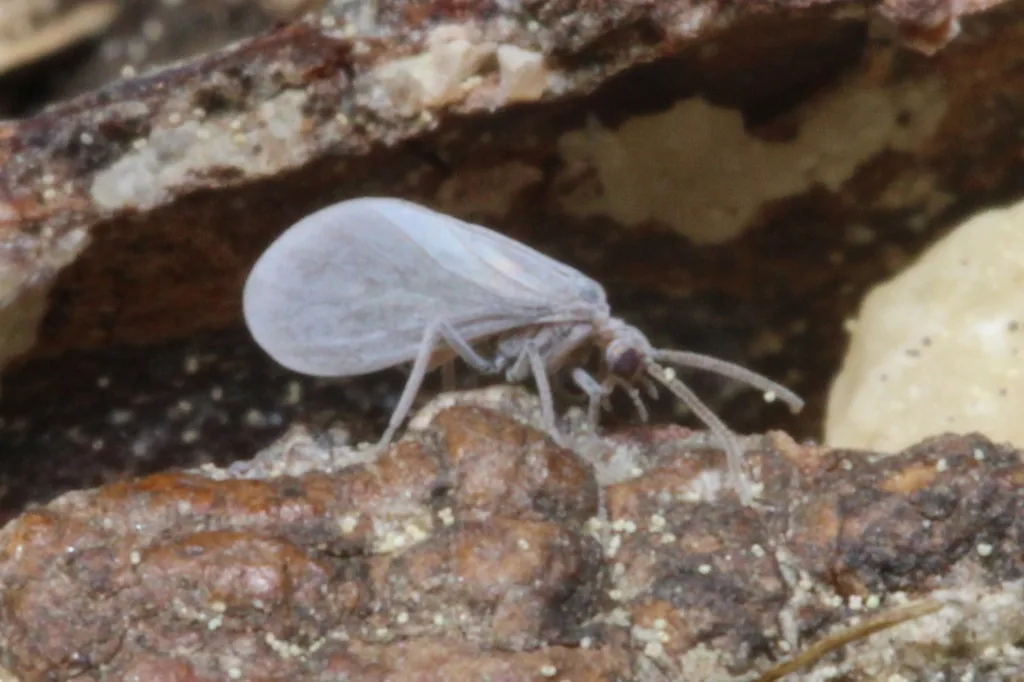
- Adults are about 1/8 to 5/16 inch (3 to 7 mm) long from head to wing tip, with long, thin antennae made of many beadlike segments, usually held out in front.[1]
- Gray to white powdery wax covers the wings and often the body, head and legs.[1]
- At rest the wings are held like a roof over the body, though UC IPM notes that females of Helicoconis species can be wingless.[1]
- Larvae are tapered, segmented and 1/5 inch or less, with mouthparts too short to see without magnification.[1]
- Eggs are oval, about 1 mm long or less, and whitish, pale orange, pink or yellowish with netlike markings; they are laid singly among the prey.[1]
Look-alikes
| Look-alike | How to tell them apart |
|---|---|
| Whiteflies | Dustywings have much longer antennae and legs than whiteflies. Whiteflies suck plant sap and are dustywing prey, so the two often turn up together.[1] |
| Brown and green lacewings | Dustywings have few wing veins and no more than two crossveins along the front edge; their larvae lack the obvious pointed jaws of lacewing larvae.[1] |
Where it lives
Dustywings live mostly on trees and shrubs. California alone has at least 28 species in 7 genera, and a survey of hemlock woolly adelgid predators on western hemlock in Oregon and Washington found dustywings among 14 predator families.[1][2][3]
Biology and life cycle
A female lays about 200 eggs singly on bark or leaves, and larvae pass through three stages before pupating.[1]
Egg to adult takes about six to eight weeks in warm weather, with two or more generations a year.[1][2]
They overwinter as adults in sheltered spots or as inactive mature larvae (prepupae) in flat, round silk cocoons on bark or under leaves, which pupate in spring. Penn State says that where spotted lanternflies occur, dustywings also tuck cocoons into spent lanternfly egg masses.[1][2]
Adults are active mostly at dawn and dusk, fluttering slowly between leaves, and they come to lights.[1]
Damage and signs
Health risk
Dustywings are predators of small arthropods, and no cited source describes any risk to people or pets.[1][2]
Control
Prevention
Check before you spray for whiteflies: UC IPM says a white, powdery insect with much longer antennae and legs may be a dustywing, and the two often occur together because whiteflies are its prey.[1]
Biological control
Protect them. UC IPM says many species stick to particular plants, such as junipers, and can be important biological control agents of the pests found there; Penn State says to leave spent spotted lanternfly egg masses holding white dustywing cocoons alone.[1][2]
More from Penn State Extension
Penn State Extension describes dustywings as tiny relatives of lacewings named for the waxy dust that coats them; both adults and larvae prey on mites, scale insects, mealybugs and arthropod eggs. They live mostly on trees and shrubs and have two or more generations a year. Where spotted lanternflies are present, dustywings tuck their cocoons into empty, already-hatched lanternfly egg masses as well as bark crevices and the undersides of leaves, so Penn State suggests leaving those spent egg masses alone.[2]
Common questions
- Are these tiny white flying insects whiteflies?
- Not necessarily. Dustywings look similar but have much longer legs and antennae, and they eat whiteflies.[1]
- Why haven't I noticed dustywings before?
- They're very small, look like whiteflies and fly mostly at dawn and dusk.[1]
- Should I get rid of dustywings?
- No. They are predators of plant pests: UC IPM calls them important biological control agents of certain plant feeders, and Penn State says to let them continue to do their job.[1][2]
Sources
- University of California Statewide IPM Program, “Dustywings (Natural Enemies Gallery).” ipm.ucanr.edu/natural-enemies/dustywings/ (accessed 2026-11-13)
- Penn State Extension, “There Is a Predator Hiding in Empty Spotted Lanternfly Eggs (Penn State Extension, updated July 12, 2023).” extension.psu.edu/there-is-a-predator-hiding-in-empty-spotted-lanternfly-eggs (accessed 2026-11-13)
- Environmental Entomology (via PubMed), “Predators associated with the hemlock woolly adelgid (Hemiptera: Adelgidae) in the Pacific Northwest (Kohler et al. 2008) (abstract).” pubmed.ncbi.nlm.nih.gov/18419922/ (accessed 2026-11-13)
- Global Biodiversity Information Facility (GBIF), “Coniopterygidae (family) (GBIF Backbone Taxonomy).” api.gbif.org/v1/species/5204 (accessed 2026-11-13)