On this page
How to identify it
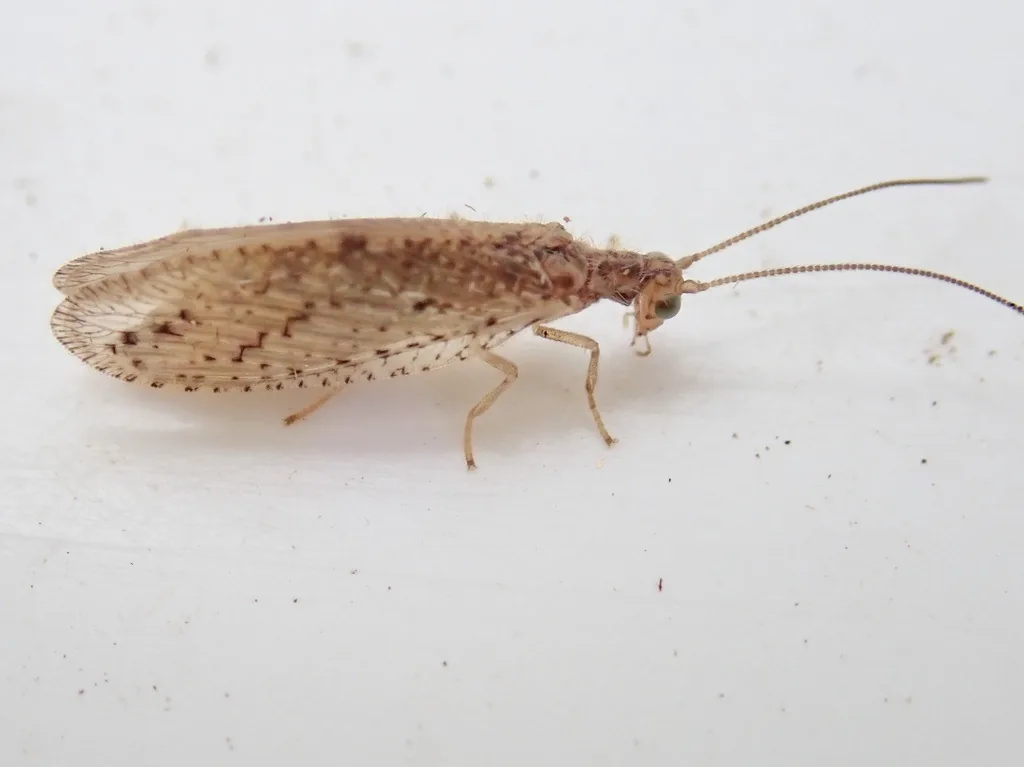
- Adults are soft-bodied with two pairs of hairy, see-through wings held like a roof over the body, mostly brown. UC IPM gives 1/5 to 2/5 inch (5 to 10 mm) for most species; Utah State gives 5 to 7.5 mm for the most common species, Hemerobius stigma.[1][2]
- They have long, slender antennae. Some species have a blackish or yellow body, or turn grayish brown or spotted over winter.[1]
- Larvae are flattened, tapered at the tail and alligator-like, 1/3 inch (8 mm) or less, cream to gray with two brown or reddish stripes, and have paired, tubelike mouthparts that curve inward.[1]
- Eggs are tiny, about 1 mm or less, gray, pink or whitish, laid singly near prey or tucked around buds and bark.[1]
Look-alikes
| Look-alike | How to tell them apart |
|---|---|
| Green lacewings | Color isn't reliable, since some green lacewings are tan or brown. Brown lacewings are about half as long in California, their larvae wag their heads side to side while hunting, and green lacewings lay each egg on a hairlike stalk.[1][8][2] |
| Syrphid fly eggs | Both eggs are similar, but a brown lacewing egg has a short projecting knob at one end that syrphid eggs lack.[1] |
Where it lives
Brown lacewings live on every continent except Antarctica, with about 560 described species. At least 31 species live in California, where they are common in coastal areas but not in interior areas with hot summers, and Utah State calls Hemerobius stigma the most common species. GBIF holds about 12,000 U.S. records of the family since 1990, most of them from California and Texas.[3][1][2][4]
Biology and life cycle
They grow through egg, three larval stages, pupa in a loose silk cocoon, and adult.[1]
Where winters are mild all stages can be found year-round; where winters are cold they mostly spend the winter as inactive last-stage larvae or pupae in cocoons in bark crevices. Utah State notes they help with early-season pest control.[1][2]
Some are built for cold: Hemerobius simulans in Alaska was the first lacewing found to make antifreeze proteins.[5]
California species have several generations a year. Hemerobius pacificus adults live about 10 weeks, females lay about 600 to 700 eggs, and one generation takes about 6 weeks at an average of 65 degrees F.[1]
They are active mostly from dusk to dawn and in overcast weather, so you see adults at porch lights or flying up when you disturb the plants they rest on.[1]
Damage and signs
- Larvae and adults both prey on small insects and mites. Aphids, mealybugs and mites are common prey; others include insect and mite eggs, lace bugs, leafhoppers, psyllids, scales, small caterpillars, thrips and whiteflies.[1][2]
- On hemlock woolly adelgid infestations in Oregon and Washington, brown lacewings were the third most abundant predator family collected.[6]
Health risk
UC IPM and Utah State describe them only as predators of small insects and mites; none of the sources reports any harm to people.[1][2]
Control
Biological control
Protect them: avoid broad-spectrum insecticides, which kill beneficial insects too, and plant native flowers that bloom through the season so adult natural enemies have pollen and nectar.[2]
Keep shrubs and trees: brown lacewings live mostly on woody plants, and Utah State notes they prefer wooded areas.[1][2]
Plant scents can draw them in: in a Washington vineyard, sticky cards in blocks baited with methyl salicylate, a compound plants release when insects feed on them, caught significantly more Hemerobius brown lacewings than unbaited blocks.[7]
Who eats brown lacewings
Night-flying adults are prey for bats. DNA from the winter diet of bats in southeastern Coastal Plain forests included Hemerobius stigma and two Micromus brown lacewings.[9]
Bug zappers kill them too; the Missouri Department of Conservation notes that many lacewings die in bug zappers and other indiscriminate pest control.[8]
Common questions
- What is the small brown lacewing at my porch light?
- Brown lacewings fly mostly from dusk to dawn and are often seen at lights at night.[1]
- Is it a green lacewing that turned brown?
- Possibly; some green lacewings are brown or turn brown in winter. Whether the crossveins along the wing's front edge are forked (Y-shaped) reliably separates the two groups.[1]
- When are brown lacewings active?
- Year-round where winters are mild; in cold-winter areas they spend the winter in cocoons, and Utah State notes they help with pest control early in the season.[1][2]
Sources
- University of California Statewide IPM Program, “Brown Lacewings (Natural Enemies Gallery).” ipm.ucanr.edu/natural-enemies/brown-lacewings/ (accessed 2026-11-11)
- Utah State University Extension (Integrated Pest Management), “Beneficial Insects: Lacewings and Antlions (July 2008).” extension.usu.edu/planthealth/research/beneficial-insects-lacewings-antlions.php (accessed 2026-11-11)
- BMC Evolutionary Biology, via PubMed Central, “The phylogeny of brown lacewings (Neuroptera: Hemerobiidae) reveals multiple reductions in wing venation (Garzon-Orduna et al. 2016).” pmc.ncbi.nlm.nih.gov/articles/PMC5029026/ (accessed 2026-11-11). PMID 27645380
- Global Biodiversity Information Facility (GBIF), “Hemerobiidae: U.S. occurrence records since 1990 by state (GBIF occurrence search).” api.gbif.org/v1/occurrence/search?taxonKey=3532&country=US&hasGeospatialIssue=false&occurrenceStatus=PRESENT&year=1990%2C2026&facet=stateProvince&facetLimit=400&limit=0 (accessed 2026-11-11)
- Journal of Insect Physiology, via PubMed, “Antifreeze proteins in Alaskan insects and spiders (Duman et al. 2004).” pubmed.ncbi.nlm.nih.gov/15081818/ (accessed 2026-11-11)
- Environmental Entomology, via PubMed, “Predators associated with the hemlock woolly adelgid in the Pacific Northwest (Kohler et al. 2008).” pubmed.ncbi.nlm.nih.gov/18419922/ (accessed 2026-11-11)
- Journal of Chemical Ecology, via PubMed, “Field-testing of methyl salicylate for recruitment and retention of beneficial insects in grapes and hops (James and Price 2004).” pubmed.ncbi.nlm.nih.gov/15537163/ (accessed 2026-11-11)
- Missouri Department of Conservation, “Green Lacewings (Field Guide).” mdc.mo.gov/discover-nature/field-guide/green-lacewings (accessed 2026-11-11)
- Scientific Reports, via PubMed Central, “Winter diet of bats in working forests of the southeastern U.S. Coastal Plain (Perea et al. 2024).” pmc.ncbi.nlm.nih.gov/articles/PMC11150266/ (accessed 2026-11-11). PMID 38834684
- iNaturalist, “Hemerobius taxon page (order and family).” www.inaturalist.org/taxa/118994 (accessed 2026-10-06)