On this page
How to identify it
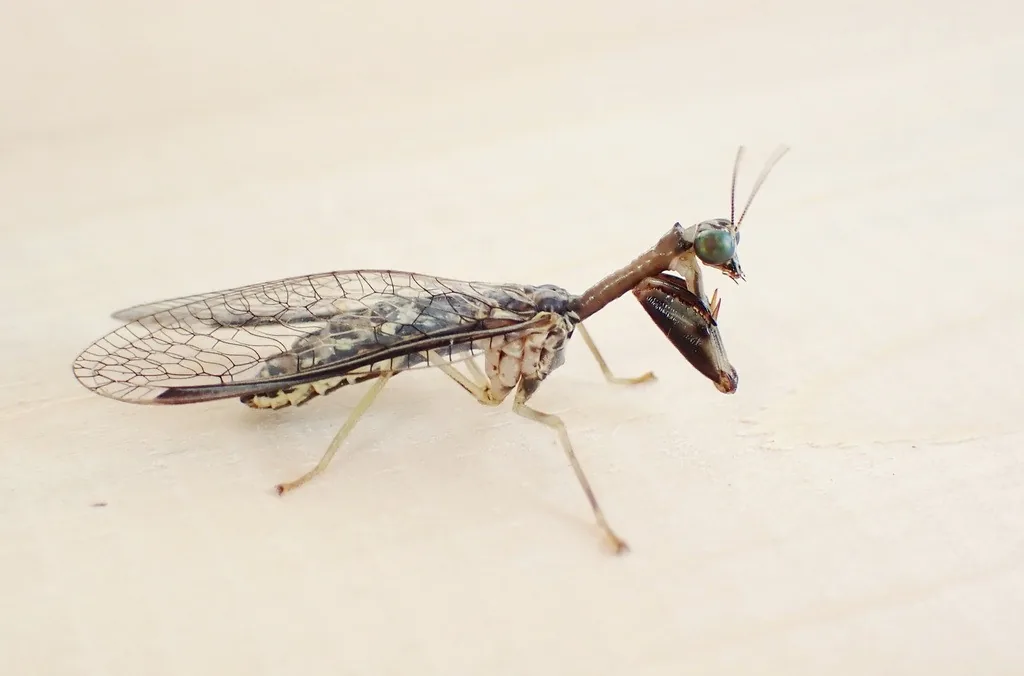
- Adults are 3/4 to 1 1/4 inches long with threadlike, toothed or feathery antennae that are never clubbed. The raptorial front legs are attached at the front of the elongated prothorax, just behind the head, and are held up rather than used for walking; a large claw at the tip closes against a wide, spiny tibia. Only the middle and hind legs walk.[1]
- All four wings are alike and lacewing-like, with an intricate net of veins. Most species are green, brown, tan, gray or yellowish: the green mantidfly (Zeugomantispa minuta) is pale lime green with iridescently patterned eyes, while Say's mantidfly (Dicromantispa sayi), D. interrupta and Leptomantispa pulchella are nondescript tan to brown and widespread in the eastern United States.[1]
- The brown wasp mantidfly (Climaciella brunnea) is banded in yellow, brown, rust or black, with wings colored and patterned to resemble a wasp's; across its broad North American range its coloration varies to match whichever wasps are locally abundant.[1]
- MDC says the adult size of a mantidfly varies with the amount of food it consumed as a larva. A University of Florida study of 255 museum specimens of Say's mantidfly found extreme size variation in both sexes: the largest 10% of females were 1.72 times larger than the smallest 10%, and the largest 10% of males 1.65 times; on average females were 7.94% larger than males. Larvae reared on small jumping spider egg sacs became smaller adults than those reared on large ones.[1][5]
Look-alikes
| Look-alike | How to tell them apart |
|---|---|
| Praying mantids | MDC says mantidflies look like a small mantid in front, with raptorial forelegs, but have four intricately net-veined wings like a lacewing's and are only about 3/4 to 1 1/4 inches long; they are much more closely related to lacewings than to true praying mantids.[1] |
| Green lacewings | The same delicate net-veined wings and often the same pale green color, but without the long prothorax and spiny raptorial forelegs.[1] |
| Dustywings | Tiny lacewing relatives no more than about 3 mm long, looking like miniature lacewings covered in dust; their larvae eat aphids, mites and scale insects.[1] |
| Snakeflies | Western insects with a long neck-like prothorax and a wide head held up and bobbing like a cobra's, but without raptorial forelegs; not found in Missouri.[1] |
Where it lives
Statewide in Missouri and most common in the southern parts of the United States; Say's mantidfly, D. interrupta and L. pulchella are widespread in the eastern United States, and the brown wasp mantidfly has a broad North American range in grasslands and open habitats. The University of Florida studies collected Say's mantidflies at a blacklight in Gainesville, Florida, from May through September.[1][6]
Biology and life cycle
Adults capture prey the way a mantis does, snatching a smaller insect, mite or other arthropod with the spiny forelegs and chewing it; the brown wasp mantidfly hunts insects visiting flowers. Many species come to lights at night, especially blacklights. Adults appear from late April through June and may persist until heavy frosts in October.[1]
The larvae are predators in spider egg sacs, draining the eggs through a piercing and sucking tube formed from the modified mandibles and maxillae. First-instar larvae reach the eggs in two ways: by burrowing straight through the silk of an egg sac they find, or by boarding a female spider and riding her, often near the pedicel and sometimes inside her book lungs, feeding on her blood until she builds a sac, which the larva enters as it is constructed. A larva that boards a male can transfer to a female during mating or cannibalism. Once a larva begins feeding it is limited to the eggs in that single sac, the University of Florida researchers note, and spider egg sacs range from a few eggs to several hundred.[2][1][5][6]
Boarding mantidflies attack all the major groups of hunting spiders, while egg-sac penetrators also enter the sacs of web builders. MDC says different mantidflies may focus on particular types of spiders; the brown wasp mantidfly specializes in wolf spiders. In University of Florida experiments, first-instar Say's mantidfly larvae spent more time on filter paper carrying silk and excreta from jumping spiders than on clean paper, slowed down to touch the silk, and spent more time on cues from adult spiders than from juveniles, without telling males from females. The authors note the adult spiders were also more active and may simply have left more silk. Field surveys of two species they cite found larvae on male and female spiders in about equal numbers.[2][1][6]
The life cycle is a hypermetamorphosis. Stalked eggs are laid in large clusters; the slender, agile first larva molts inside the sac into a chubby, grub-like feeder; the full-grown larva spins a cocoon and pupates; an active second-phase pupa crawls about on the cocoon and spent egg sac before the final molt to a winged adult. In some mantidfly groups the larvae are instead ordinary predators of other insects' larvae.[1]
Adults are highly visual, voracious predators with elaborate courtship displays, and both sexes can be aggressive or cannibalistic during courtship. The University of Florida team photographed a female Say's mantidfly eating a male before mating; because size varies so much in both sexes, either partner in a pair may be the larger one.[5]
Damage and signs
- MDC says mantidflies alone are probably not common or abundant enough to have a large effect on the small invertebrates they prey on, but combined with spiders, assassin bugs, robber flies, ants, lady beetles, mantises and other predatory arthropods they serve an important function in natural ecosystems.[1]
Health risk
Mantidflies prey on small arthropods and spider eggs. MDC and the Annual Review of Entomology review don't mention any risk to people or pets.[1][2]
Control
Prevention
MDC says most people would consider mantidflies friendly, since they serve as a control on spiders, insects and other small arthropods, and that many species are attracted to lights at night, especially blacklights.[1]
Where the sources disagree
What the larvae are: MDC calls larval mantidflies parasitoids in spider egg sacs; the Annual Review of Entomology review calls them predators in the egg sacs of spiders.[1][2]
Which spiders: MDC says larvae most commonly target running or hunting spiders as opposed to web builders; the review says egg-sac penetrators also enter the egg sacs of web-building spiders.[1][2]
Size: MDC ties adult size to the amount of food a larva ate; the University of Florida study supports that with rearing on small and large egg sacs but also found size differences among populations, so egg sac size may not be the only cause.[1][5]
Spider age: in the 2024 laboratory study larvae responded more to cues from adult spiders, but the field surveys it cites found Leptomantispa pulchella larvae on juvenile spiders more often than adults and Say's mantidfly larvae equally on adults and immatures.[6]
Common questions
- Is this a baby praying mantis with wings?
- No. MDC describes an inch-long insect with a mantis-like front half, raptorial forelegs attached at the front of a long prothorax, and four net-veined wings like a lacewing's as a mantidfly, a lacewing relative much more closely related to lacewings than to true praying mantids.[1]
- Does it bite or sting?
- MDC doesn't describe a bite or sting; it says the forelegs are for grabbing prey and that the brown wasp mantidfly's wasp mimicry no doubt helps protect it from predators.[1]
- Why would a mantidfly larva ride around on a spider?
- To reach the eggs. A first-instar larva that boards a female spider feeds on her blood until she spins an egg sac, then slips inside as the sac is built and eats the eggs through its piercing mouthparts; others simply burrow into sacs they find.[2]
- Why are some mantidflies so much bigger than others?
- Mostly because of what they ate as larvae. Each larva is limited to the eggs in the one spider egg sac it enters, and in a University of Florida study Say's mantidfly larvae reared on small egg sacs became smaller adults than those reared on large ones. The same study found extreme size variation in both sexes and some differences between populations.[5][6]
Sources
- Missouri Department of Conservation, “Mantidflies (Mantis Flies) field guide.” mdc.mo.gov/discover-nature/field-guide/mantidflies-mantis-flies (accessed 2026-11-13)
- Annual Review of Entomology (Annual Reviews), via PubMed, “Redborg KE (1998), Biology of the Mantispidae, Annual Review of Entomology 43.” pubmed.ncbi.nlm.nih.gov/15012388/ (accessed 2026-11-13)
- Global Biodiversity Information Facility (GBIF), “Mantispidae (family) (GBIF Backbone Taxonomy).” api.gbif.org/v1/species/5470 (accessed 2026-11-13)
- iNaturalist, “Mantispidae taxon page (order and family).” www.inaturalist.org/taxa/52955 (accessed 2026-11-10)
- Royal Society Open Science, via PubMed Central, “Lietzenmayer LB, Goldstein LM, Pasche JM, Taylor LA (2022), Extreme natural size variation in both sexes of a sexually cannibalistic mantidfly, Royal Society Open Science 9:220544 (University of Florida).” pmc.ncbi.nlm.nih.gov/articles/PMC9382211/ (accessed 2026-11-14)
- Scientific Reports, via PubMed Central, “Lietzenmayer LB, Taylor LA (2024), Mantidfly larvae use cues on substrate to locate and distinguish different sexes and life stages of potential spider hosts, Scientific Reports 14 (University of Florida).” pmc.ncbi.nlm.nih.gov/articles/PMC11551181/ (accessed 2026-11-14)