On this page
How to identify it
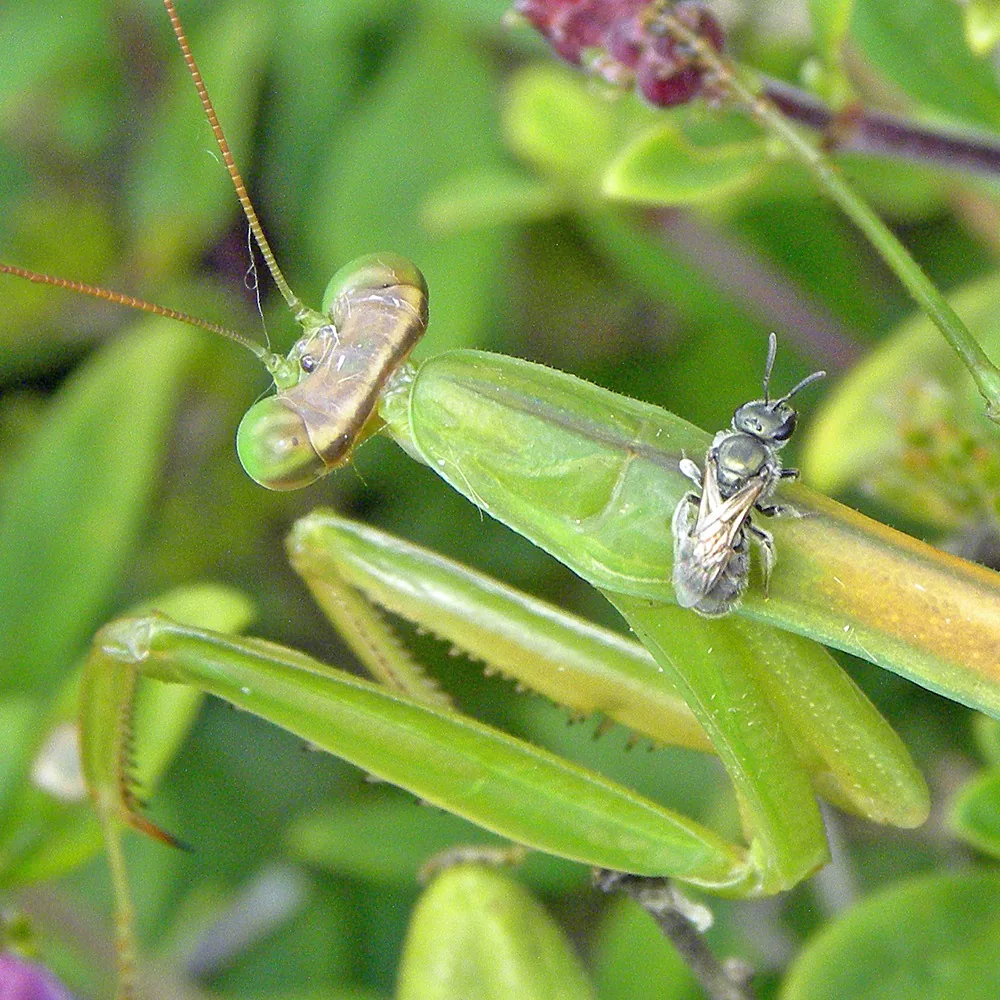
- Adults are elongate and brown, green or yellowish, and a single species can show all three colors. Sizes vary by source: UC IPM says 2 to 5 inches, Ohio State 2 to 4½ inches, and Kansas State 3 to 4 inches.[1][2][3]
- At rest the enlarged, spiny front legs are held up in front of the head, giving the praying look.[1][4]
- The triangular head has large, bulging eyes and can turn about 180 degrees.[1][4]
- The introduced Chinese mantid is the largest common species, 3 to 5 inches long by Kentucky's count or about 4½ inches by Ohio State's. The native Carolina mantid is about 2 inches (Kentucky) or 2 to 2½ inches (Ohio State).[4][2]
- Egg cases start as pale froth that hardens into a brown, papery mass up to 1½ inches long on branches, stems, fences, posts, walls, eaves or house siding. Kansas State says they can be found from November through April.[1][3]
- Ohio State warns that color is a poor way to tell species apart, since all three Ohio species come in green and brown forms. It points instead to a green stripe along the edge of the front wings on the Chinese mantid and a dark spot on the forewing of the Carolina mantid.[2]
Look-alikes
| Look-alike | How to tell them apart |
|---|---|
| European mantid | This introduced species is about 2¾ to 3 inches long, with a bull's-eye spot on the inside of each front leg. Kentucky describes it as pale green, though Ohio State says green and brown forms occur.[4][2] |
| Carolina mantid egg case | It's tan, 1/2 to 3/4 inch long and rectangular with a pale central band; a Chinese mantid case is light brown, 1 to 1 1/4 inches long and half-dome shaped.[3] |
Where it lives
The native Carolina mantid ranges from New York to Florida and west to Utah, Arizona and Texas. Sources differ on when the European and Chinese mantids arrived: Ohio State says the late 1800s, and Kentucky says about 75 years ago in the Northeast, as garden predators. Kansas State says the Chinese mantid is now naturalized in most regions, and California has at least nine species, five of them native.[2][4][3][1]
Biology and life cycle
After mating, a female lays eggs in a foam that hardens into an egg case. Egg counts differ: up to 400 (Ohio State), 12 to 400 (Kentucky) or 200 to 300 (Kansas State).[2][4][3]
Mantids overwinter as eggs, and nymphs hatch in spring (late winter to spring in California). Kansas State says 50 to 200 nymphs can emerge from one case; Kentucky says several dozen to hundreds.[3][1][4]
Nymphs look like small wingless adults and grow through about six or seven stages. There is one generation a year; in Ohio, look for nymphs in spring to early summer and adults from midsummer to fall.[1][2]
Hungry nymphs eat their siblings, which keeps mantid numbers in an area low.[4][3]
Sources differ on how often females eat males. UC IPM says it doesn't happen in most matings and isn't needed for egg production, and Ohio State says it is rarely seen in nature and may be exaggerated. Kansas State says the female may eat the male's head during mating and usually eats the rest of him afterward as protein for egg production.[1][2][3]
Adult males fly well and can cover long distances; females of the Ohio species have wings but fly little.[2]
Damage and signs
- Mantids don't feed on plants. They eat butterflies, caterpillars, crickets, flies, grasshoppers, moths, wasps and honey bees at hive entrances, and some large mantids catch small animals such as hummingbirds, lizards and frogs.[3]
Health risk
Ohio State Extension says that although mantids are large predatory insects, they do not bite humans.[2]
Control
Prevention
No control is needed. Mantids feed on pests and beneficials alike, and releasing them does no harm to the garden.[2]
Biological control
Buying egg cases for pest control isn't recommended: Kansas State says mantids don't kill enough pests to prevent plant damage, and UC IPM says they are of no benefit for biological pest control because each one eats relatively few insects.[3][1]
Adding many egg cases may not raise numbers either, because mantids move off to find cover and food.[4]
To keep resident mantids, limit pesticides and leave some vegetation for cover. Broad-spectrum insecticides harm them, while Bt and insecticidal soap affect them far less.[4][3]
Common questions
- What is the hard tan foam on my shrub?
- It's almost certainly a mantid egg case. The eggs overwinter inside and nymphs hatch in spring.[3][1]
- What happens if I bring an egg case indoors?
- Indoors at 70°F or warmer, Kansas State says nymphs hatch in four to six weeks, even in midwinter, and unfed nymphs start eating each other. Storing the case in a lidded jar in the refrigerator delays hatching.[3][4]
- Do praying mantids bite people?
- Ohio State Extension says mantids do not bite humans.[2]
Sources
- University of California Statewide IPM Program, “Mantids (Natural Enemies Gallery).” ipm.ucanr.edu/natural-enemies/mantids/ (accessed 2026-11-12)
- Ohio State University Extension, “Ohio's Natural Enemies: Mantids, ENT-67.” ohioline.osu.edu/factsheet/ent-67 (accessed 2026-11-12)
- Kansas State University Research and Extension, “Praying Mantids (MF3593).” bookstore.ksre.ksu.edu/pubs/praying-mantids_MF3593.pdf (accessed 2026-11-12)
- University of Kentucky Entomology Extension, “Praying Mantids, ENTFACT-418.” entomology.mgcafe.uky.edu/ef418 (accessed 2026-11-12)
- iNaturalist, “Tenodera sinensis taxon page (order and family).” www.inaturalist.org/taxa/71034 (accessed 2026-11-12)