On this page
How to identify it
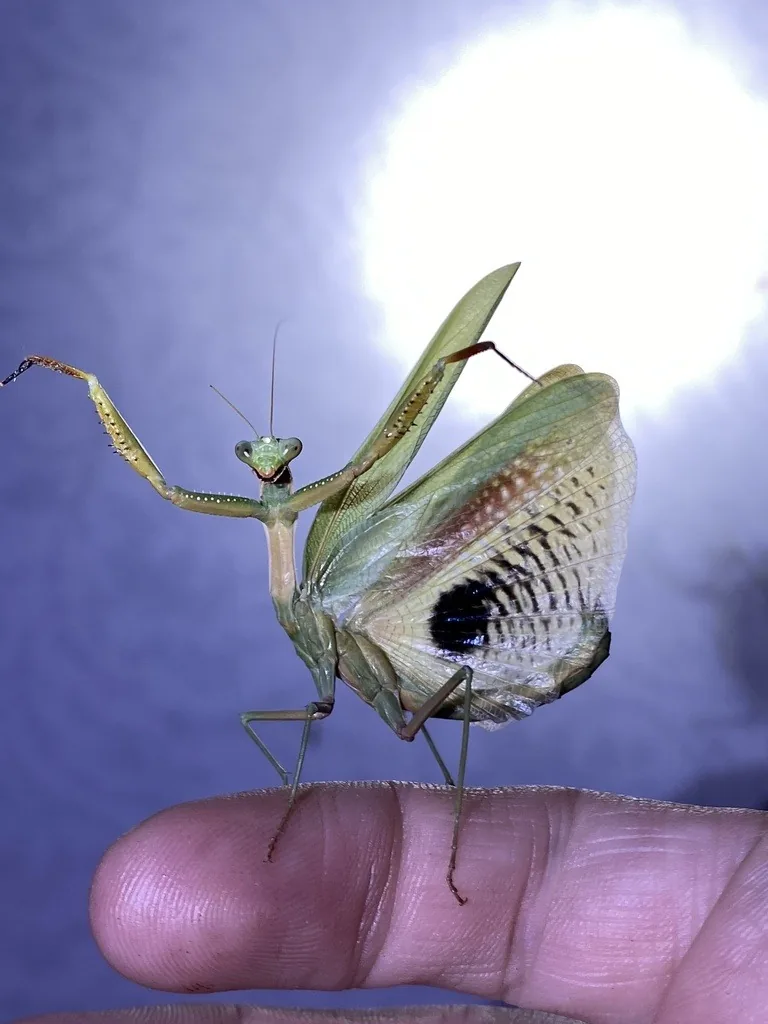
- Like other mantids it has leathery, narrow front wings, a triangular head that turns about 180 degrees and enlarged front legs held up in front of the head.[1]
- UC IPM says mantids are elongate and usually brown, green or yellowish, and that the hind wings, when unfolded, are wide and fan-shaped. The sources read today give no species-level features for telling the Mediterranean mantis from other mantids.[1]
Look-alikes
| Look-alike | How to tell them apart |
|---|---|
| Arizona mantis (Stagmomantis limbata) | UC IPM lists the Arizona or bordered mantid as a native California species, and field studies at Davis have found it living alongside the Mediterranean mantis. The sources read give no feature for telling the two apart.[1][2][3] |
| Chinese and European mantids | The other introduced mantids in California; the Chinese mantid is also sold to gardeners alongside this one.[1] |
Where it lives
UC IPM lists it among the introduced mantids of California, and a 2018 study notes that it persists in Davis, California, with the native bordered mantis and the European mantis. GBIF holds about 13,300 records, about 5,300 from the US and most of the rest from Spain, France, Greece, Portugal and Italy; its roughly 5,300 US records since 1990 come mostly from California and Arizona, with smaller numbers from Nevada, Texas and New Mexico.[1][3][5][6]
Biology and life cycle
California mantids follow one generation a year: nymphs hatch from late winter to spring, grow through six or seven stages, and adults lay eggs in fall. Nymphs and adults usually do not survive the winter.[1]
In a UC Davis field study, males of this species and the bordered (Arizona) mantis each encountered two or more females, but no male was seen in more than one copulation; a higher percentage of Mediterranean mantis males met two or more females. In captivity, Mediterranean mantis males preferentially mounted well-fed, fecund females.[2]
Mantids usually sit on flowers waiting for flying insects. Female mantids sometimes kill and eat males during courtship, but this does not happen in most matings.[1]
Damage and signs
- It does no damage to plants. Mantids catch any insect they can, including bees, butterflies and hover flies, and are relatively inactive, so each one eats relatively few insects.[1]
Health risk
UC IPM describes mantids only as predators of other insects; no cited source describes any risk to people or pets.[1]
Control
Prevention
No control is needed. If you were thinking of buying them for pest control, UC IPM says mantids, including the Mediterranean mantid sold by mail order and in some garden stores, are of no benefit for biological control of pests.[1]
Where the sources disagree
Classification: UC IPM's mantid page places mantids in the order Orthoptera with grasshoppers, while GBIF's backbone places Iris oratoria in the order Mantodea, family Eremiaphilidae; the 1998 field study listed it under Mantidae.[1][4][2]
Egg masses: UC IPM describes mantid egg masses in general as 2-row masses up to 1-1/2 inches (38 mm) long; the sources read today give no measurements for this species.[1]
Common questions
- Is it worth buying Mediterranean mantis egg cases for my garden?
- No. UC IPM notes that mantids eat beneficial insects such as bees and hover flies as readily as pests and each eats relatively few insects, so they are of no benefit for biological pest control.[1]
- Is the Mediterranean mantis native?
- No. UC IPM lists it among the introduced mantids of California, alongside the Chinese, European and South African mantids; the Arizona or bordered mantid and the California mantid are among the native species.[1]
- Where do the egg cases end up?
- Mantids attach their egg masses to twigs or other surfaces. Fresh egg masses are frothy and pale and dry to a brown, hard, paper-like case.[1]
Sources
- University of California Statewide IPM Program, “Natural Enemies Gallery: Mantids, or Praying Mantises.” ipm.ucanr.edu/natural-enemies/mantids/ (accessed 2026-11-13)
- Animal Behaviour (Elsevier), “Maxwell, M. R. (University of California, Davis). Lifetime mating opportunities and male mating behaviour in sexually cannibalistic praying mantids. Animal Behaviour 55 (1998) 1011-1028, PMID 9632486.” pubmed.ncbi.nlm.nih.gov/9632486/ (accessed 2026-11-13)
- PubMed Central (U.S. National Library of Medicine), “Jones C, DiRienzo N (2018), Behavioral variation post-invasion: resemblance in some, but not all, behavioral patterns among invasive and native praying mantids, Behav Processes (PMC5998679).” pmc.ncbi.nlm.nih.gov/articles/PMC5998679/ (accessed 2026-11-13)
- Global Biodiversity Information Facility (GBIF), “Iris oratoria Linne, 1758 (GBIF Backbone Taxonomy).” api.gbif.org/v1/species/1404300 (accessed 2026-11-13)
- Global Biodiversity Information Facility (GBIF), “Iris oratoria: occurrence records by country (GBIF occurrence search).” api.gbif.org/v1/occurrence/search?taxonKey=1404300&facet=country&facetLimit=20&limit=0 (accessed 2026-11-13)
- Global Biodiversity Information Facility (GBIF), “Iris oratoria: U.S. occurrence records since 1990 by state (GBIF occurrence search).” api.gbif.org/v1/occurrence/search?taxonKey=1404300&country=US&hasGeospatialIssue=false&occurrenceStatus=PRESENT&year=1990%2C2026&facet=stateProvince&facetLimit=400&limit=0 (accessed 2026-11-13)