On this page
How to identify it
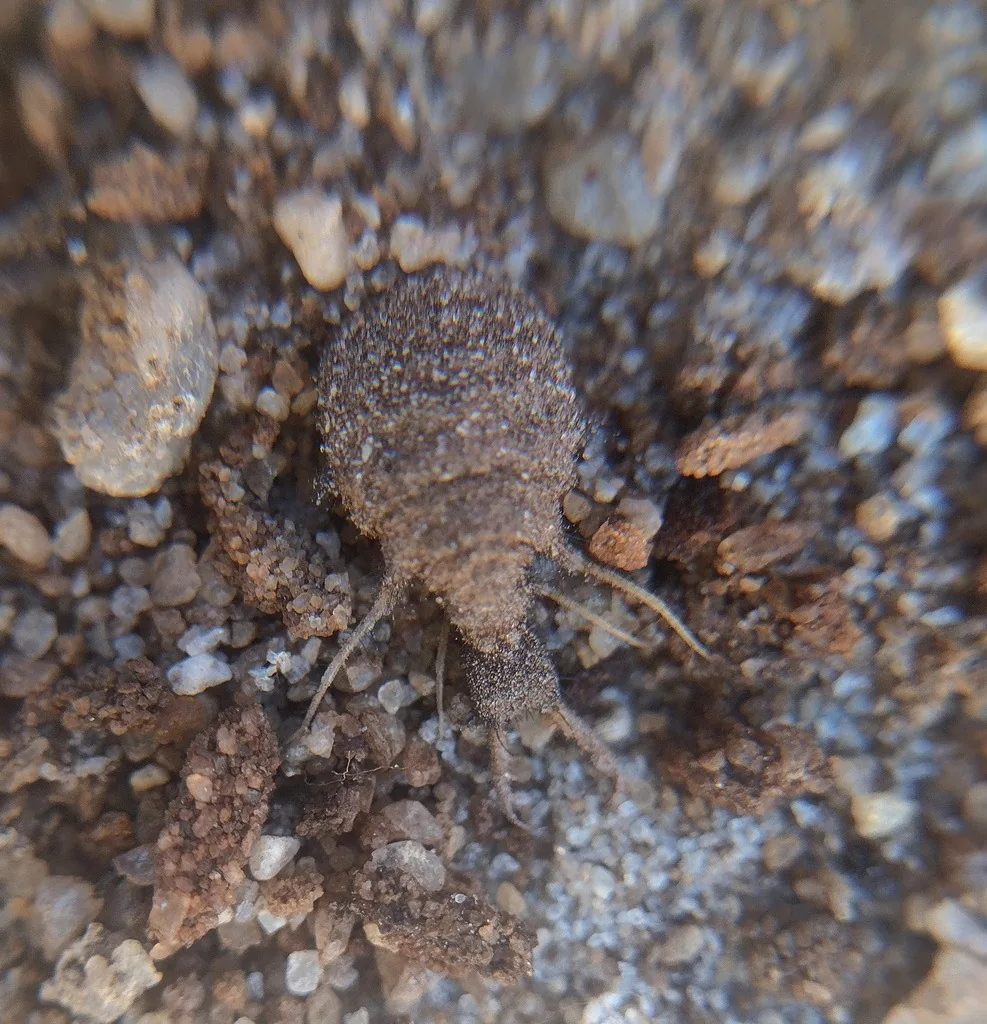
- Doodlebugs are oval, plump and flattened, mottled the color of dirt and often bristly, with three pairs of legs and a flat head bearing sickle-shaped jaws that inject venom into prey. Grown larvae reach only about 1/2 inch.[1][2]
- Adults are slender, with four oval, net-veined wings held roof-like over the body at rest, mottled brown and black, and large eyes; see where the sources disagree on size.[1][3]
- Adults are often mistaken for damselflies, but antlions have longer, clubbed or curved antennae, about as long as the head and thorax together.[1][3]
Look-alikes
| Look-alike | How to tell them apart |
|---|---|
| Damselflies | Damselflies usually rest with the wings held together above the body, have tiny antennae and are often brightly colored. Antlions are drab, with longer, clubbed antennae.[3][1] |
| Owlflies | Close relatives that also have clubbed antennae, but owlflies have remarkably large eyes.[3] |
| Lacewings | Close relatives in the same order, with similar net-veined wings held roof-like at rest. Green lacewings are pale green with golden eyes.[1] |
Where it lives
Antlions favor dry, sandy places. More than 100 species live in North America north of Mexico, and larvae of the genus Myrmeleon are the most familiar. In Missouri they occur statewide wherever there is sandy or dusty ground.[1][3][2]
Biology and life cycle
Depending on the species, larvae hide under leaves or pieces of wood or dig pits in sand. They feed mainly on ants and other small insects.[1][2]
A pit-builder digs by creeping backward and downward, flipping sand away with its head. It waits at the bottom with only its jaws showing, grabs insects that slide in, drains them and tosses the empty body out of the pit.[2][3]
Females lay eggs in sandy soil. Utah State says one generation may take 2 to 3 years, most of it as a larva. Grown larvae pupate deeper in the soil in a round cocoon of sand and silk, and the adult emerges about a month later.[1][3]
Adults live about a month or a little longer (see where the sources disagree on what they eat). They are weak fliers, active in the evening and at night, and come to lights.[3][1]
Damage and signs
Health risk
Utah State and the Missouri Department of Conservation describe antlions only as predators of ants and other small insects and don't mention any risk to people or pets.[1][2][3]
Control
Prevention
No control is needed. To support antlions and lacewings, plant a variety of flowers that bloom at different times so adults have nectar and pollen all season.[1]
What research shows about the pits
Most antlion pits are simple inverted cones, and fine sand lets the walls stand steeper. Larvae also flick sand at prey with the head and jaws, turning the shortest way around to get into throwing position.[4][5]
Pit-building larvae link vibrations in the sand with arriving prey, and in lab tests they could be trained to choose a direction in a maze.[6]
Where the sources disagree
Adult size: Utah State says adults can be up to 45 mm long with a 65 mm wingspan; the Missouri Department of Conservation gives an adult length of 1 1/2 to 3 inches, varying with species.[1][3]
Adult food: the Missouri Department of Conservation says adults nourish themselves with nectar and pollen; Utah State says antlion adults, like the larvae, are predators of other insects.[3][1]
Larval growth: Utah State says doodlebugs can feed for two years and molt three times before they are full grown; the Missouri Department of Conservation says only that they molt occasionally as they grow.[1][2]
Common questions
- What are the little cone-shaped pits in dry sand?
- Usually doodlebug traps made by antlion larvae, which wait buried at the bottom for ants to slide in.[1][2]
- Why are they called doodlebugs?
- For the winding, scrawl-like trails the larvae leave as they walk across sand.[1][3][2]
- Do antlions bite people?
- Utah State and the Missouri Department of Conservation describe antlions only as predators of ants and other small insects and don't mention any risk to people.[1][2]
- Is that a dragonfly at my porch light?
- It may be an antlion adult; they come to lights. Look for long, clubbed antennae and drab, mottled wings.[1][3]
Sources
- Utah State University Extension (Integrated Pest Management), “Beneficial Insects: Lacewings and Antlions (July 2008).” extension.usu.edu/planthealth/research/beneficial-insects-lacewings-antlions.php (accessed 2026-11-13)
- Missouri Department of Conservation, “Antlion Larvae (Doodlebug Larvae) (Field Guide).” mdc.mo.gov/discover-nature/field-guide/antlion-larvae-doodlebug-larvae (accessed 2026-11-13)
- Missouri Department of Conservation, “Antlion Adults (Field Guide).” mdc.mo.gov/discover-nature/field-guide/antlion-adults (accessed 2026-11-13)
- Journal of Experimental Biology, via PubMed, “Fine sand particles enable antlions to build pitfall traps with advanced three-dimensional geometry (Devetak, Podlesnik, Scharf and Klenovsek 2020).” pubmed.ncbi.nlm.nih.gov/32561631/ (accessed 2026-11-13)
- Journal of Experimental Biology, via PubMed, “Antlion larvae follow optimality rules in body orientation during sand tossing (Lo Bello, De Agro and Vallortigara 2026).” pubmed.ncbi.nlm.nih.gov/41877630/ (accessed 2026-11-13)
- Animal Cognition, via PubMed, “Operant conditioning in antlion larvae and its impairment following exposure to elevated temperatures (Miler and Scharf 2022).” pubmed.ncbi.nlm.nih.gov/34689302/ (accessed 2026-11-13)
- Global Biodiversity Information Facility (GBIF), “Myrmeleontidae (family) (GBIF Backbone Taxonomy).” api.gbif.org/v1/species/5471 (accessed 2026-11-13)
- iNaturalist, “Myrmeleontidae taxon page (order and family).” www.inaturalist.org/taxa/49358 (accessed 2026-10-06)