On this page
How to identify it
- They have long slender bodies, two pairs of clear, net-veined wings and heads made up mostly of large compound eyes that touch each other; the antennae are short.[1][3]
- At rest, dragonflies hold their wings out flat to the sides, and the hindwing is wider at the base than the forewing.[1][3]
- The largest U.S. dragonflies, such as the common green darner, are about 3 inches long, with wingspans up to 7 inches.[1][4]
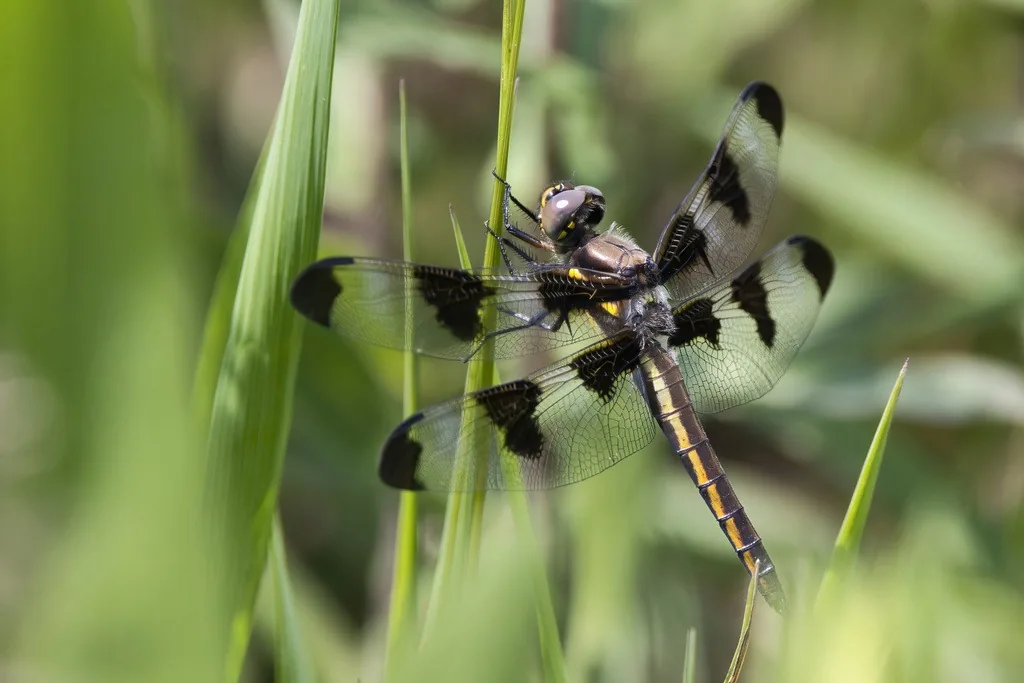
- Males and females often differ in color, and young adults have different markings again; the twelve-spotted skimmer shown has twelve brown wing spots, and mature males add white spots and a whitish coating.[3][5]
Look-alikes
Where it lives
Adults are most common near water because the young are aquatic, though their strong flight takes them many places. Texas lists 147 dragonfly species. GBIF holds about 1.4 million US records since 1990 of the three largest families (skimmers, darners and clubtails) from 49 states, counting the District of Columbia, most from Texas, Ohio and Florida.[3][2][8][9][10]
Biology and life cycle
Eggs are laid on or near water and hatch in three to five weeks into aquatic nymphs called naiads.[1]
Naiads live in mud or on submerged plants, breathing through gills inside the rectum and jetting forward by squirting water out; they catch prey with a hinged lower lip that shoots out.[1][3]
Grown naiads climb out on a plant stem, and the adult emerges and expands its wings; adults live up to about six weeks.[1][3]
Adults hunt by "hawking": they scoop mosquitoes, gnats, flying ants and other small insects from the air with spiny legs held like a basket. Perching skimmers fly straight to the point of interception, steering to keep the prey's image still on the eye.[1][3][7]
On hot, sunny days adults may rest in an "obelisk" posture, abdomen tip pointed at the sun, to limit heating.[3][2]
There are 8 North American families. Texas lists 147 dragonfly species, and Missouri counts nine as species of conservation concern; Hine's emerald is the only federally endangered dragonfly.[3][2]
Damage and signs
Health risk
Dragonflies can't sting and do no harm to people, pets, plants or houses. Large species can give a pinching bite if handled, but they cannot harm people.[1][3][4]
Control
Prevention
For mosquitoes themselves, Texas A&M points to draining standing water, treating water that can't be drained with Bti, and using repellents.[2]
No control of dragonflies is ever needed; Iowa State calls them entirely beneficial.[1]
Biological control
Don't buy or release dragonflies for mosquito control: none are sold, a released dragonfly goes wherever it wants, and without water nearby it is unlikely to stay.[2]
To attract them, add a water garden if there's no water nearby; it draws dragonflies, damselflies and other aquatic insects.[2][3]
Where sources disagree
Do they bite? Iowa State and Texas A&M say dragonflies can't sting or bite. The Missouri Department of Conservation agrees they can't sting but says larger species can deliver a pinching bite when handled, without harming people.[1][2][3][4]
How long do the nymphs live? Iowa State gives several months to as long as three years; the Missouri Department of Conservation says some species live 5 years underwater.[1][3]
Mosquito control: Texas A&M says dragonflies are unlikely to solve a mosquito problem because many fly by day, when mosquitoes are less active. A 2023 meta-analysis of 31 lab studies found a single dragonfly or damselfly naiad ate an average of 40 mosquito larvae a day in experimental containers, cutting larval numbers about 45 percent a day, and its authors argue that promoting them could lower mosquito-borne disease risk.[2][6]
Common questions
- Do dragonflies sting or bite?
- They can't sting, despite nicknames like horse stinger. Large ones may pinch if you hold them, but they cannot harm people.[1][3]
- Will dragonflies get rid of my mosquitoes?
- Not on their own. Adults and nymphs both eat mosquitoes, and lab studies show nymphs eat many larvae, but most adults fly by day, when mosquitoes are less active.[2][3][6]
- How do I tell a dragonfly from a damselfly?
- Watch it land: dragonflies rest with wings spread flat, damselflies with wings held together above the body.[1][3]
- Why do dragonflies hang around my yard?
- Adults hunt flying insects well away from water and often perch on walls, railings and fences, sometimes warming themselves on concrete or stone.[3][2]
Sources
- Iowa State University Extension and Outreach, “Dragonflies and Damselflies (Yard and Garden).” hortnews.extension.iastate.edu/dragonflies-and-damselflies (accessed 2026-11-11)
- Texas A&M AgriLife Research, “Questions from our Readers (Dragonflies of Texas).” agrilife.org/dragonfly/questions-from-our-readers/ (accessed 2026-11-11)
- Missouri Department of Conservation, “Dragonflies (field guide).” mdc.mo.gov/discover-nature/field-guide/dragonflies (accessed 2026-11-11)
- Missouri Department of Conservation, “Common Green Darner (field guide).” mdc.mo.gov/discover-nature/field-guide/common-green-darner (accessed 2026-11-11)
- Missouri Department of Conservation, “Twelve-Spotted Skimmer (field guide).” mdc.mo.gov/discover-nature/field-guide/twelve-spotted-skimmer (accessed 2026-11-11)
- Journal of Animal Ecology, via PubMed, “A meta-analysis reveals that dragonflies and damselflies can provide effective biological control of mosquitoes (Priyadarshana and Slade 2023).” pubmed.ncbi.nlm.nih.gov/37272224/ (accessed 2026-11-11). Cited from the PubMed abstract.
- Journal of Comparative Physiology A, via PubMed, “Prey pursuit and interception in dragonflies (Olberg et al. 2000).” pubmed.ncbi.nlm.nih.gov/10707313/ (accessed 2026-11-11). Cited from the PubMed abstract.
- Global Biodiversity Information Facility (GBIF), “Libellulidae (skimmers): US occurrence records since 1990 by state (GBIF occurrence search API).” api.gbif.org/v1/occurrence/search?taxonKey=5936&country=US&hasGeospatialIssue=false&occurrenceStatus=PRESENT&year=1990%2C2026&facet=stateProvince&facetLimit=400&limit=0 (accessed 2026-11-11). State counts are records reported (iNaturalist research-grade, museum specimens, surveys), not abundance.
- Global Biodiversity Information Facility (GBIF), “Aeshnidae (darners): US occurrence records since 1990 by state (GBIF occurrence search API).” api.gbif.org/v1/occurrence/search?taxonKey=4209&country=US&hasGeospatialIssue=false&occurrenceStatus=PRESENT&year=1990%2C2026&facet=stateProvince&facetLimit=400&limit=0 (accessed 2026-11-11). State counts are records reported (iNaturalist research-grade, museum specimens, surveys), not abundance.
- Global Biodiversity Information Facility (GBIF), “Gomphidae (clubtails): US occurrence records since 1990 by state (GBIF occurrence search API).” api.gbif.org/v1/occurrence/search?taxonKey=4486&country=US&hasGeospatialIssue=false&occurrenceStatus=PRESENT&year=1990%2C2026&facet=stateProvince&facetLimit=400&limit=0 (accessed 2026-11-11). State counts are records reported (iNaturalist research-grade, museum specimens, surveys), not abundance.
- iNaturalist, “Libellula pulchella taxon page (order and family).” www.inaturalist.org/taxa/81495 (accessed 2026-11-11)