On this page
How to identify it
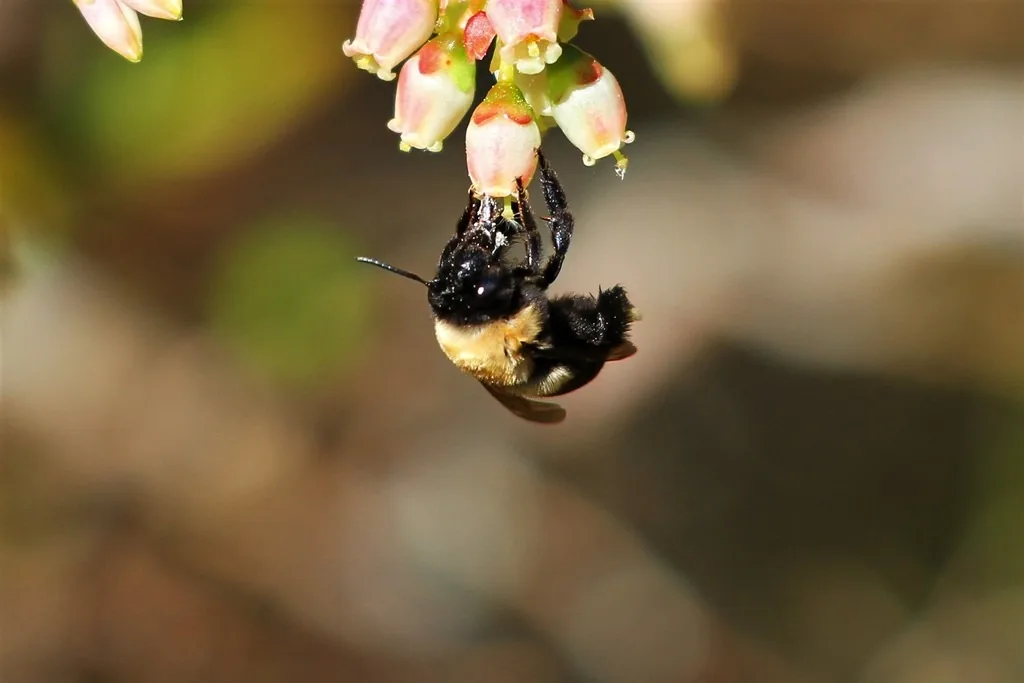
- It resembles a small, fuzzy bumble bee, with a stocky body covered in dense hair.[1]
- Males have a pale-colored face, which UF/IFAS describes as yellow hairs on the clypeus; females' faces are black.[1][3]
- At a blueberry flower it grips the bloom and vibrates the muscles of its thorax at high frequency, which shakes the pollen out.[1]
- It is active only around blueberry flowering; in Florida, UF/IFAS gives its foraging season as February to April.[1][4]
- Adults are 13 to 16 mm long; females, at 15 to 16 mm, are typically longer than males, at 13 to 14 mm. Both sexes have yellow hairs on the thorax, while the head and abdomen are completely black.[3]
- Two spurs at the tip of each hind shin help separate it and other digger bees from honey bees.[3]
- Eggs are white, slightly curved cylinders about 2.6 mm long and 0.7 mm wide, and larvae are white, legless grubs.[3]
Look-alikes
| Look-alike | How to tell them apart |
|---|---|
| Bumble bees | Bumble bees are social bees with annual colonies and generalists that need a variety of flowers; in Florida they are active from February to November. The blueberry bee lives alone, nests in the ground, and in Florida forages only from February to April.[1][2][4] |
| Large carpenter bees | Florida's two large carpenter bees, Xylocopa virginica and X. micans, also resemble bumble bees and visit blueberry blossoms, but they have shiny, relatively hairless abdomens, nest in tunnels they dig in wood, and slit the petals to rob nectar. In a USDA-ARS study on rabbiteye blueberry, a single robbing visit by a male X. virginica left less pollen on the stigma than one visit by a female blueberry bee, though about three robbing visits matched one, and the slitting had no appreciable effect on fruit set.[4][5] |
| Honey bee | Honey bees can't buzz pollinate, and UF/IFAS notes that two spurs at the tip of the hind shin separate the blueberry bee and other digger bees from honey bees.[3][1] |
Where it lives
UF/IFAS says it occurs throughout the southeastern United States and, despite its name, from New Jersey south into Florida and west into Illinois and Mississippi; museum records show scattered sightings farther afield that may not all be accurate. NC State lists it among the blueberry specialist bees of North Carolina, and a USDA-ARS study tracked it for 12 years at blueberries near Auburn, Alabama.[3][1][2]
Biology and life cycle
It is strongly tied to blueberries: wild and cultivated blueberries are its primary pollen hosts, and UF/IFAS's pollination guide says it often forages on nothing else. NC State notes that blueberry specialists may use other plants before and after bloom, and UF/IFAS's species profile reports a broader pollen diet that includes Carolina jessamine.[1][2][4][3]
Females nest underground in sandy soil near blueberry plants, often in large groups of nests close together.[1][2][4][3]
NC State says these ground-nesting blueberry specialists nest within about a city block of their host plants and avoid mulch and dense turf, preferring bare or sparsely vegetated soil or a thin layer of pine straw.[1]
A single female may visit as many as 50,000 blueberry flowers in her lifetime; NC State says that is enough for more than 6,000 ripe berries, and UF/IFAS puts it at about 6,000.[1][3]
In 12 years of records near Auburn, Alabama, males always appeared before females. Wild blueberry bloom, often starting in January, always came before the first males, while the first males often appeared before cultivated rabbiteye blueberries bloomed.[2]
Buzz pollination matters because blueberry flowers are cup-shaped and their pollen is heavy and sticky, and honey bees can't buzz pollinate. In humid weather, when flowers shed pollen less readily, buzz pollinators like this bee may be especially needed.[1][4]
Adults overwinter in underground nests and emerge in spring as blueberries bloom. Males come out first and patrol nesting sites until females emerge and mate. Each nest holds on average two brood cells lined with a waxy secretion, each with a single egg and a store of pollen, and the larvae do not spin cocoons.[3]
Adults emerge close to wild blueberry bloom, toward the end of southern highbush bloom, so in Florida there may be too few of them to pollinate early-blooming cultivars without managed pollinators. UF/IFAS adds that because males emerge first and don't collect pollen for nests, their value as blueberry pollinators is uncertain.[4][3]
Health risk
UF/IFAS, NC State and the USDA-ARS studies discuss it only as a pollinator and mention no stings or other risk to people.[1][2][5][4][3]
Control
Prevention
No control is needed; it is a beneficial pollinator. To keep it around, NC State suggests leaving patches of bare, undisturbed soil near blueberries, limiting mulch, and choosing pollinator-friendly pest control that keeps pesticide use low.[1]
UF/IFAS suggests planting flowers along field edges that bloom in late winter and early spring but not at the same time as the blueberries, and notes that late-blooming blueberry cultivars suit this bee especially well. NC State suggests native plants such as willow to feed bees once blueberry flowering ends.[1][4]
Keep changes around nest sites to a minimum: UF/IFAS reports that females become disoriented and can't find their nests if the landscape is disturbed. Argentine ant infestations made females abandon nests, so ant control that doesn't disturb the bees may help.[3]
Protect natural habitat and blueberry fields; UF/IFAS cites research linking losses of both to less pollen collection and smaller bees.[3]
Where the sources disagree
How specialized it is: UF/IFAS's blueberry pollination guide and NC State describe it as a blueberry specialist that often forages on nothing else, while UF/IFAS's newer species profile says it was once thought to specialize on blueberries but has a broader pollen diet, including Carolina jessamine.[4][1][3]
Common questions
- Is the fuzzy bee on my blueberry flowers a bumble bee?
- It may be a southeastern blueberry bee, which looks like a small bumble bee and appears during blueberry bloom; males have pale faces. Unlike bumble bees, it lives alone rather than in a colony.[1][4]
- Do blueberries need these bees if honey bees are around?
- They help. Honey bees can't buzz pollinate, while this bee and bumble bees can. UF/IFAS notes that wild pollinators like it can be more efficient than honey bees, so farms with many of them may need fewer honey bee colonies; NC State adds that honey bees generally contribute to higher overall yields.[1][4]
- When are southeastern blueberry bees active?
- Only around blueberry bloom. In Florida they forage from February to April, and near Auburn, Alabama, the first males appeared after wild blueberries had begun to bloom.[1][2][4]
- Does the southeastern blueberry bee visit only blueberries?
- Mostly, but not only. Blueberries are its main pollen source, but UF/IFAS's species profile reports a broader diet that includes Carolina jessamine, and NC State notes that blueberry specialists may use other plants before and after bloom.[3][1]
Sources
- NC State Extension, “Blueberry Pollination: The Role of Specialist Bees (E. Payne, guest post on E. Youngsteadt's Pollinators blog, April 18, 2025).” pollinators.ces.ncsu.edu/2025/04/blueberry-pollination-the-role-of-specialist-bees (accessed 2026-11-12)
- Insects (via PubMed Central), “Cane 2021, Global Warming, Advancing Bloom and Evidence for Pollinator Plasticity from Long-Term Bee Emergence Monitoring (full text).” pmc.ncbi.nlm.nih.gov/articles/PMC8155920/ (accessed 2026-11-12)
- University of Florida IFAS Extension (EDIS), “Southeastern Blueberry Bee, Habropoda laboriosa, EENY-827/IN1474 (A. Ryan, C. Prouty and C. Jack; Featured Creatures).” ask.ifas.ufl.edu/publication/IN1474 (accessed 2026-11-14)
- University of Florida IFAS Extension (EDIS), “Pollination Best Practices in Southern Highbush Blueberry in Florida, ENY-172/IN1237 (R. E. Mallinger and D. A. Phillips).” ask.ifas.ufl.edu/publication/IN1237 (accessed 2026-11-14)
- Journal of Economic Entomology (via PubMed), “Sampson, Danka and Stringer 2004, Nectar robbery by bees Xylocopa virginica and Apis mellifera contributes to the pollination of rabbiteye blueberry (abstract).” pubmed.ncbi.nlm.nih.gov/15279245/ (accessed 2026-11-12)
- iNaturalist, “Habropoda laboriosa taxon page (order and family).” www.inaturalist.org/taxa/121510 (accessed 2026-11-08)