On this page
How to identify it
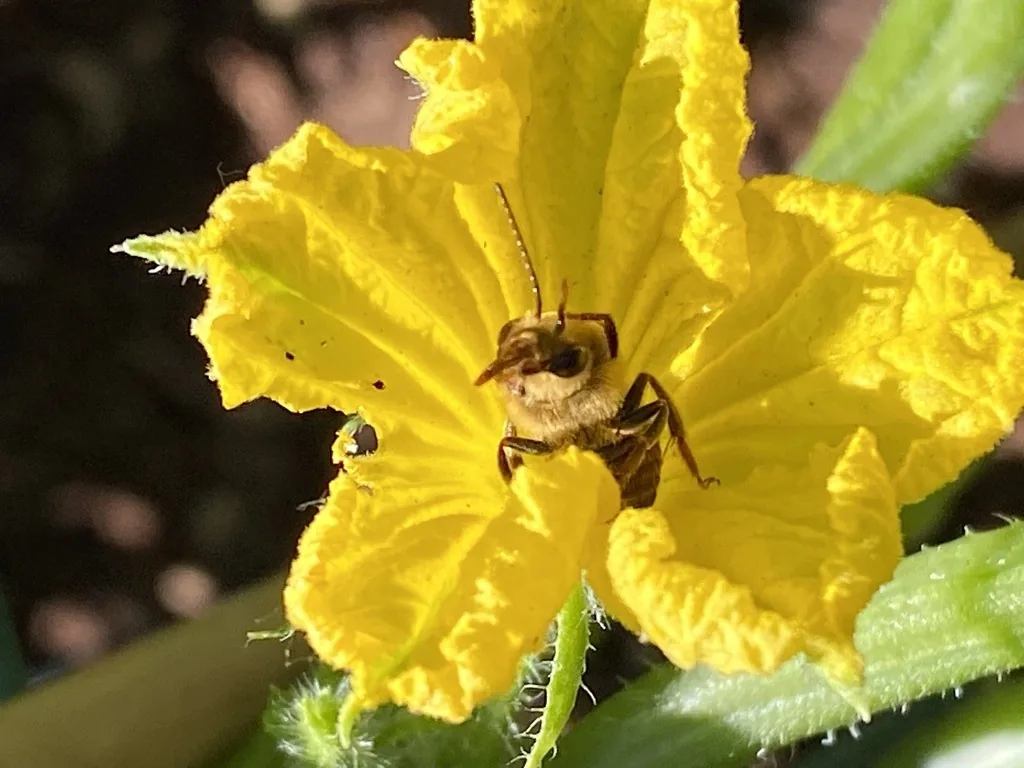
- They resemble hairy honey bees but are larger and bulkier, with longer antennae, rounder faces and well-defined white bands on the abdomen.[1][2]
- Females carry pollen dry and loose in a brush of hairs on very fuzzy hind legs, often covered all over in pollen. Males carry no pollen and have a yellow spot on the face; females' faces are entirely dark.[1][4]
- They are easiest to recognize by behavior: visiting squash-family flowers starting around sunrise, before other bees are active.[1][4]
Look-alikes
Where it lives
Native to North America; first collected in southern Oregon in 2016, and active in North Carolina from June to August.[1][2]
Biology and life cycle
Each female digs her own nest in the soil, often right under the squash plants: a vertical tunnel ending in separate cells, each stocked with a pollen ball and one egg. NC State gives a depth of 6 to 12 inches, while the USDA Forest Service says a foot or two.[1][4]
They are not social, though nests are sometimes grouped. In North Carolina adults fly from June to August, and the next generation spends the rest of the year sealed in the nest cells underground.[4][1]
Females forage from dawn, when squash flowers open, until the flowers wilt around midday. Males dart between flowers searching for mates and by noon are asleep in the withered blossoms.[1][4]
The most widespread species, Peponapis pruinosa, ranges from Quebec into Mexico wherever squash is grown. A genetic study found it spread north from Mexico following people's cultivation of squash, with eastern populations most likely coming from the Midwest.[4][5]
Pollen comes only from plants in the genus Cucurbita, which includes summer and winter squash, zucchini, pumpkins and many gourds, but not cucumbers.[1]
Damage and signs
- No damage. NC State says 6 to 10 squash bee visits fully pollinate a female squash flower, and by some estimates squash bees pollinate around two-thirds of the commercially grown squash in the United States. In one study, seven visits by males alone maximized summer squash fruit set.[1][6]
- A census of 25 squash and pumpkin farms in Virginia, West Virginia and Maryland found the squash bee to be the most abundant pollinator on 23 of them.[8]
- Researchers disagree on how much other bees add. NC State and the USDA Forest Service say honey bee visits are superfluous where squash bees are numerous, but a New York pumpkin study found common eastern bumble bees deposited more pollen and gave better fruit set than squash bees.[1][4][7]
Health risk
None of these sources describes any harm to people. They are solitary ground-nesting bees that do not live in hives or colonies.[1][4]
Control
Prevention
No control is needed; squash bees are key pollinators and regular visitors to home vegetable gardens.[1]
Tilling a squash bed can destroy the nests underneath. One farm census found three times as many squash bees on no-till farms, although NC State notes a second study in Maryland and Virginia pumpkin farms found no such effect.[1][8]
Pesticides
If a flowering squash plant must be treated for cucumber beetles or squash vine borers, choose products carefully and spray in the evening when bees are not active. Systemic insecticides applied before bloom can still reach squash pollen at toxic levels, and NC State cites an 89% drop in squash bee reproduction where squash got an imidacloprid soil drench. A 2019 risk assessment also found that, under long-term exposure, clothianidin and imidacloprid residues in squash-field soil put nesting squash bees at risk.[1][9]
Common questions
- What are the bees in my squash flowers at dawn?
- Likely squash bees, which forage from sunrise until the flowers close.[1][4]
- Are squash bees honey bees?
- No; they are native solitary bees that collect pollen only from squash-family flowers.[1][2]
- Why are there bees asleep inside my wilted squash flowers?
- Those are probably male squash bees, which spend the morning looking for mates in the flowers and by noon are asleep in the closed blossoms.[4]
- Do squash bees live in Oregon?
- Yes. Once thought to be absent, the squash bee was collected for the first time in southern Oregon in 2016, according to Oregon State University Extension.[2]
Sources
- NC State Extension, “Squash Bees in the Home Garden (PDIC Factsheet).” content.ces.ncsu.edu/squash-bees-in-the-home-garden (accessed 2026-11-11)
- Oregon State University Extension, “Squash Bees (OSU Extension catalog topic).” extension.oregonstate.edu/catalog/squash-bees (accessed 2026-11-11)
- iNaturalist, “Xenoglossa pruinosa taxon page (order and family).” www.inaturalist.org/taxa/1594041 (accessed 2026-11-11)
- USDA Forest Service, “Squash Bees (J. Cane, USDA ARS Bee Biology and Systematics Lab), Pollinator of the Month.” www.fs.usda.gov/wildflowers/pollinators/pollinator-of-the-month/squash_bees.shtml (accessed 2026-11-11)
- Proceedings of the Royal Society B, via PubMed, “Lopez-Uribe MM, Cane JH, Minckley RL, Danforth BN (2016), Crop domestication facilitated rapid geographical expansion of a specialist pollinator, the squash bee Peponapis pruinosa, Proceedings of the Royal Society B.” pubmed.ncbi.nlm.nih.gov/27335417/ (accessed 2026-11-11). Cited from the PubMed abstract.
- Environmental Entomology, via PubMed, “Cane JH, Sampson BJ, Miller SA (2011), Pollination value of male bees: the specialist bee Peponapis pruinosa (Apidae) at summer squash (Cucurbita pepo), Environmental Entomology 40:614-620.” pubmed.ncbi.nlm.nih.gov/22251639/ (accessed 2026-11-11). Cited from the PubMed abstract.
- Journal of Economic Entomology, via PubMed, “Artz DR, Nault BA (2011), Performance of Apis mellifera, Bombus impatiens, and Peponapis pruinosa as pollinators of pumpkin, Journal of Economic Entomology 104:1153-1161.” pubmed.ncbi.nlm.nih.gov/21882677/ (accessed 2026-11-11). Cited from the PubMed abstract.
- Journal of Economic Entomology, via PubMed, “Shuler RE, Roulston TH, Farris GE (2005), Farming practices influence wild pollinator populations on squash and pumpkin, Journal of Economic Entomology 98:790-795.” pubmed.ncbi.nlm.nih.gov/16022307/ (accessed 2026-11-11). Cited from the PubMed abstract.
- Scientific Reports, via PubMed, “Willis Chan DS, Prosser RS, Rodriguez-Gil JL, Raine NE (2019), Assessment of risk to hoary squash bees (Peponapis pruinosa) and other ground-nesting bees from systemic insecticides in agricultural soil, Scientific Reports.” pubmed.ncbi.nlm.nih.gov/31413274/ (accessed 2026-11-11). Cited from the PubMed abstract.