On this page
How to identify it
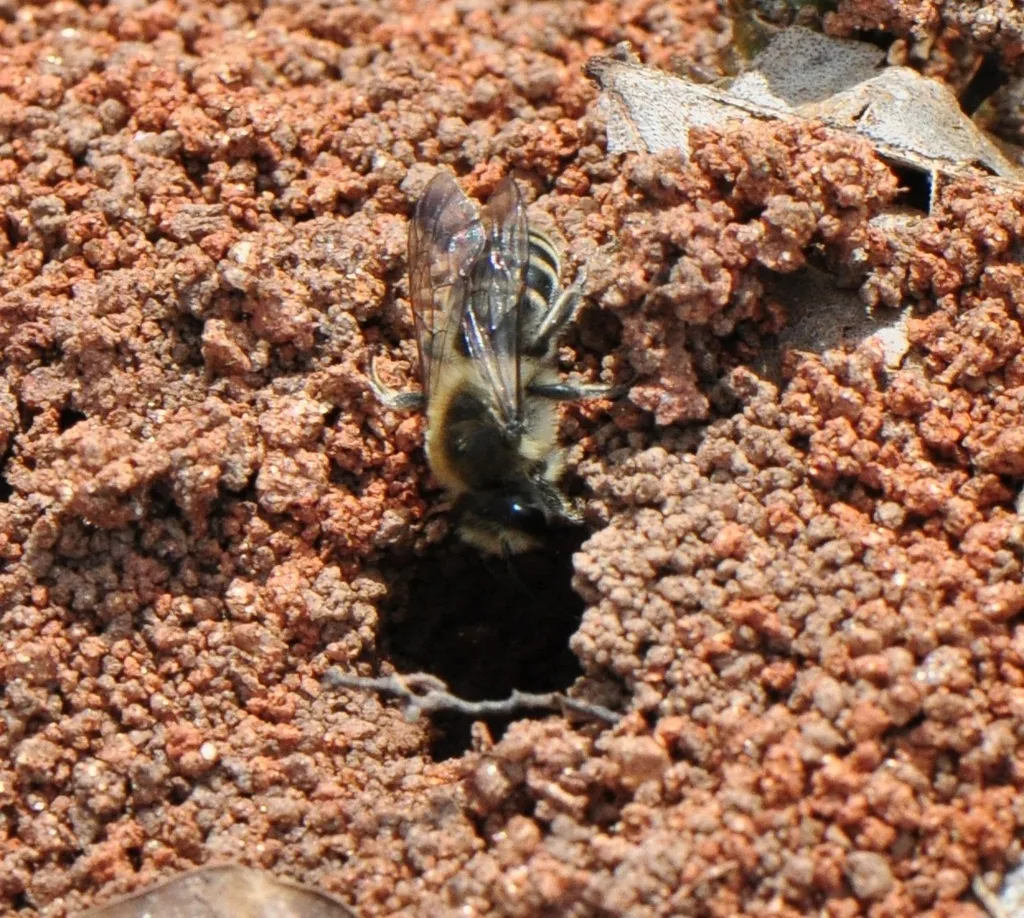
- Black, about the size of a honey bee, with pale hairs around the thorax and pale hair bands on the abdomen.[1]
- Unlike honey bees, their eyes are bare rather than hairy.[1]
- Each female digs her own nest in the ground, usually in well-drained, often sandy soil with little organic matter and a spot that gets morning sun. The soil she throws out piles up around the hole.[1]
- In the common eastern species Colletes inaequalis, males come out earlier in spring than females and are smaller.[3]
Look-alikes
Where it lives
Cellophane bees are recorded across the United States: GBIF holds about 37,000 U.S. records of the genus since 1990, with the most from Utah, California, Florida and Arizona. Colletes inaequalis is one of the first pollinators to come out in the North American spring.[4][3]
Biology and life cycle
There is one generation a year. Adults come out in spring; once the spring flight dies out, nothing more is seen at the nest site until the following spring.[1][3]
The female digs a tunnel, hollows out a small cell and coats its inside with the lining. She packs in a mass of pollen and nectar, lays a single egg on top, seals the cell and goes on to the next one.[1]
The sources differ on where the lining comes from. NC State says it is presumably secreted by the salivary glands; a 1979 study in Science traced it to lactones stored in the Dufour's gland, which the bee secretes and which link into a polyester.[1][2]
The grub hatches, eats the pollen mass, pupates in the cell and comes out of the soil as an adult the next spring.[1]
Where conditions suit them, many females nest close together. A study of Colletes inaequalis in an urban area found that females in a nesting patch were slightly more related than random bees, that males do most of the dispersing, and that bigger nesting patches held bigger populations.[5]
Cuckoo bees in the genus Epeolus lay their eggs in Colletes nests; a 2018 revision lists 43 Epeolus species north of Mexico along with their known or suspected Colletes hosts.[6]
Damage and signs
- They do no damage. NC State calls them valuable pollinators of spring crops; they visit almost any flower available, especially those in the aster family.[1]
Health risk
They are not aggressive. They have no nest-guarding instinct or alarm pheromones, so walking past nests will not set them off; NC State says stepping on one barefoot is about the only way to get stung.[1]
Control
Prevention
Coexist with the bees if you can. NC State advises living with them for their pollination value rather than trying to wipe them out with pesticides.[1]
Built for early spring
Males sometimes emerge before flowers are open, and snow can fall after they are out. In lab tests Colletes inaequalis tolerated cold better than honey bees and recovered from chill coma much faster, but it tolerated heat less well; food, not cold, mattered most for male survival.[3]
The cellophane lining
The 1979 Science paper described the membrane as highly resistant, waterproof and transparent, and called it the first naturally occurring linear polyester on record.[2]
A 2026 study of Colletes inaequalis nest linings found the material resembles polyethylene yet breaks down fast in soil: polyester content fell from 73 to 40 percent by weight within 4 months. That helps explain why it never builds up in sites used for decades.[7]
Common questions
- Are the bees nesting in my yard dangerous?
- No. Cellophane bees don't defend their nests and won't attack people walking by; NC State says a barefoot step on a bee is about the only way to get stung.[1]
- How long will they be around?
- Only during the spring flight. After it ends there is no activity at the nests until the next generation comes out the following spring.[1]
- Why are there so many holes in one spot?
- Each hole belongs to a single female, but they often nest close together where the soil suits them.[1][5]
Sources
- NC State Extension, “Colletid Bees (Plasterer Bees, Cellophane Bees, and Polyester Bees) (PDIC Factsheet).” content.ces.ncsu.edu/colletid-bees-plasterer-bees-cellophane-bees-and-polyester-bees (accessed 2026-11-11)
- Science, via PubMed, “Natural polyesters: Dufour's gland macrocyclic lactones form brood cell laminesters in Colletes bees (Hefetz et al. 1979).” pubmed.ncbi.nlm.nih.gov/17758016/ (accessed 2026-11-11)
- Ecology and Evolution, via PubMed, “Thermal tolerance in the cellophane bee Colletes inaequalis reflects early spring adaptation (Gonzalez et al. 2025).” pubmed.ncbi.nlm.nih.gov/40800164/ (accessed 2026-11-11)
- Global Biodiversity Information Facility (GBIF), “Colletes: U.S. occurrence records since 1990 by state (GBIF occurrence search).” api.gbif.org/v1/occurrence/search?taxonKey=1348504&country=US&hasGeospatialIssue=false&occurrenceStatus=PRESENT&year=1990%2C2026&facet=stateProvince&facetLimit=400&limit=0 (accessed 2026-11-11)
- PLoS One, via PubMed, “Nest suitability, fine-scale population structure and male-mediated dispersal of a solitary ground nesting bee in an urban landscape (Lopez-Uribe et al. 2015).” pubmed.ncbi.nlm.nih.gov/25950429/ (accessed 2026-11-11)
- ZooKeys, via PubMed, “A revision of the cleptoparasitic bee genus Epeolus for Nearctic species, north of Mexico (Onuferko et al. 2018).” pubmed.ncbi.nlm.nih.gov/29769836/ (accessed 2026-11-11)
- Proceedings of the National Academy of Sciences, via PubMed, “Rapid soil degradation of a cross-linked, semicrystalline polyethylene-like polyester produced by Colletes bees (Coote et al. 2026).” pubmed.ncbi.nlm.nih.gov/42970670/ (accessed 2026-11-11)
- iNaturalist, “Colletes inaequalis taxon page (order and family).” www.inaturalist.org/taxa/1438690 (accessed 2026-10-06)