On this page
How to identify it
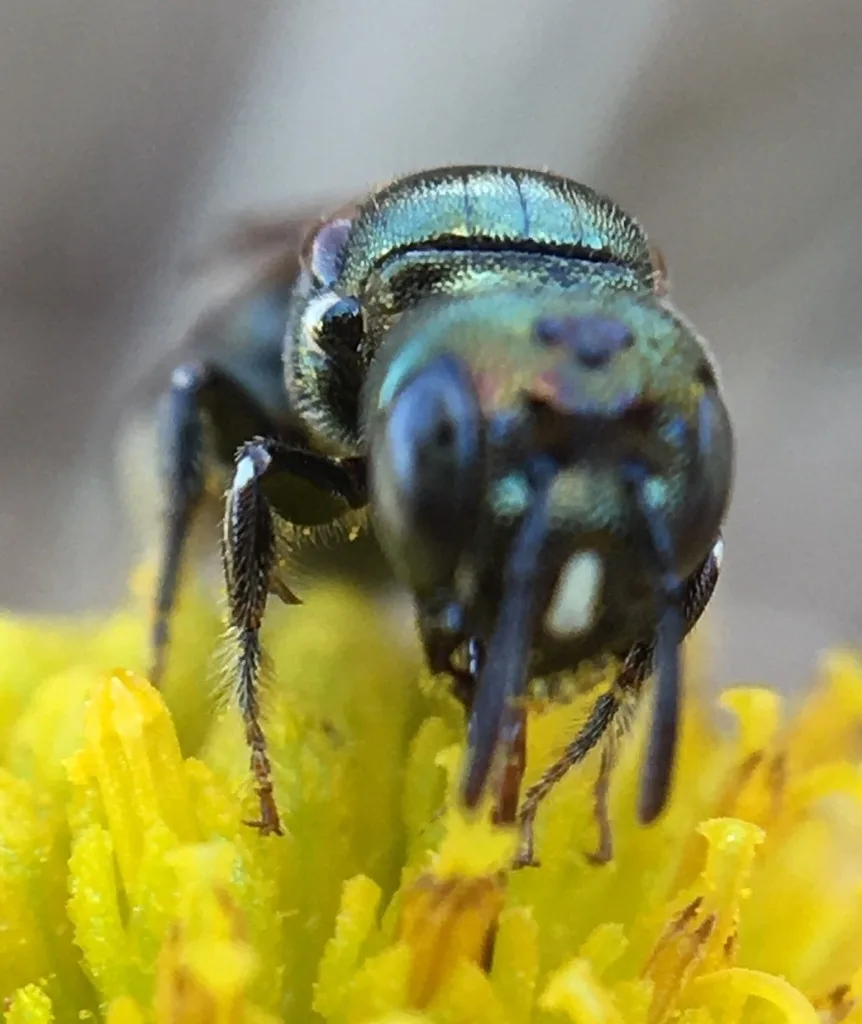
- They are no more than 3/8 inch long (under a centimeter), black with bluish-green or blue highlights, sometimes with yellowish-white marks on the face, thorax and legs.[1][4][2]
- The usual sign is a cut or broken cane end with a neat hole leading down a tunnel in the pith; split open, it holds a row of cells with larvae or pupae.[1][3][4]
Look-alikes
| Look-alike | How to tell them apart |
|---|---|
| Carpenter bees | The large Xylocopa carpenter bees bore into wooden beams and logs without bark; small carpenter bees use plant stems.[1] |
| Leafcutter bees | Leafcutter bees sometimes nest in the pith of the largest pruned rose canes and rarely girdle them; Colorado State says small carpenter bees and Pemphredon hunting wasps more commonly tunnel and nest in rose canes.[5] |
Where it lives
Small carpenter bees are described by extension services across the United States, from North Carolina, where they nest in rose, sea oat and weed stems, to Colorado, where they are among the commoner nesters in rose canes, and Oregon, where they carve nests in raspberry and Himalayan blackberry canes.[1][5][2][3]
Biology and life cycle
A female bores down into the pith of a stem, makes a cell, stocks it with a ball of pollen moistened with nectar, lays one egg on it, seals it with chewed pith and builds the next cell above it. Nests range from 1 1/4 to 12 inches deep.[1][3]
New adults emerge the same year and overwinter in the hollow stems. Oregon State notes the mother can also survive the winter and raise another brood the next year, and a Japanese species lives 2 or more years in the wild.[3][1][6]
Unlike most solitary bees, the mother stays in or near the nest and guards her young until they mature.[3][1]
Females gather pollen and nectar from at least 25 plant families, including rose, blackberry and marguerite daisy.[1]
In a field experiment with the eastern small carpenter bee (Ceratina calcarata), mothers strongly preferred sunny nest sites: 59% of sun nests produced brood versus 32% of shade nests, but young from sun nests were smaller and less likely to survive to adulthood.[7]
Damage and signs
- Nests are usually in dead stems, and NC State's entomologists say the bees don't injure canes themselves but take advantage of tip die-back after pruning. Where they do nest in a freshly cut rose stem, the stem dies back to the depth of the nest; NC State calls this fairly rare.[4][1]
- Dying cane tips can point to another problem: in caneberries, large pruning wounds let cane blight in, so growers are advised to pinch canes while small rather than make large cuts.[4]
Health risk
They are not aggressive pollinators, and NC State rates the chance of being stung by one as very low.[1]
Control
Prevention
Avoid insecticides; these bees are sensitive to landscape insecticides and are useful pollinators, and NC State says management isn't needed when they nest in pruned canes.[1][4]
To give them somewhere else to nest, Oregon State suggests leaving an extra 8 to 10 inches of stem when pruning pithy plants such as raspberries, elderberries, hydrangea, coneflowers, sunflowers and asters in fall and winter.[2]
Keep them out
Seal freshly cut rose stems with tree wound paint so the bees nest elsewhere.[1]
Where sources disagree
Social life: NC State's fact sheet says all carpenter bees are solitary, while Oregon State says some small carpenter bees live socially, and research describes the eastern small carpenter bee and a Japanese species as facultatively social, with mothers and dwarf eldest daughters in one and queens and workers in the other.[1][3][8][6]
Damage to plants: NC State's fact sheet says rose stems die back to the depth of the nest, while an NC State entomology note on a pruned grape vine says the bees don't injure canes and only use tip die-back that pruning already caused.[1][4]
Common questions
- What tiny shiny bee is tunneling into my rose canes?
- Likely a small carpenter bee (Ceratina), a tiny shiny black bee with blue or green highlights that nests in the pith of cut canes.[1][3]
- How do I stop them?
- Seal fresh rose cuts with tree wound paint; the bees will move to another nest site.[1]
- Do they sting?
- Rarely. They are not aggressive, and NC State rates the chance of a sting as very low, although a mother may stay to guard her nest.[1]
- Should I leave old stems for them?
- If you want to help native bees, yes: Oregon State suggests leaving 8 to 10 extra inches on pithy stems when you prune, since these bees nest and overwinter in old stems.[2][3]
Sources
- NC State Extension, “Small Carpenter Bees (PDIC Factsheet).” content.ces.ncsu.edu/small-carpenter-bees (accessed 2026-11-11)
- Oregon State University Extension Service, “Leave behind some stems for bee habitat, EM 9507.” extension.oregonstate.edu/catalog/em-9507-leave-behind-some-stems-bee-habitat (accessed 2026-11-11)
- Oregon State University Extension Service, “Carpenter bees are right at home in dead blackberry canes.” extension.oregonstate.edu/catalog/carpenter-bees-are-right-home-dead-blackberry-canes (accessed 2026-11-11)
- NC State Extension, Entomology, “A Surprising Cause of Holes in Pruned Canes (Dec. 2013).” entomology.ces.ncsu.edu/2013/12/bees-in-pruned-canes/ (accessed 2026-11-11)
- Colorado State University Extension, “Leafcutter Bees.” extension.colostate.edu/resource/leafcutter-bees/ (accessed 2026-11-11)
- Proceedings of the Royal Society B, via PubMed, “Shell and Rehan (2022), Social divergence: molecular pathways underlying castes and longevity in a facultatively eusocial small carpenter bee.” pubmed.ncbi.nlm.nih.gov/35317677/ (accessed 2026-11-11)
- Ecology, via PubMed, “deHaan, Maretzki, Skandalis, Tattersall and Richards (2025), Costs and benefits of maternal nest choice: trade-offs between brood survival and thermal stress in bees.” pubmed.ncbi.nlm.nih.gov/39844775/ (accessed 2026-11-11)
- Microbial Ecology, via PubMed, “Nguyen and Rehan (2026), Microbial communities across social roles in small carpenter bee nests.” pubmed.ncbi.nlm.nih.gov/42101618/ (accessed 2026-11-11)
- iNaturalist, “Ceratina taxon page (order and family).” www.inaturalist.org/taxa/155108 (accessed 2026-10-06)