On this page
How to identify it
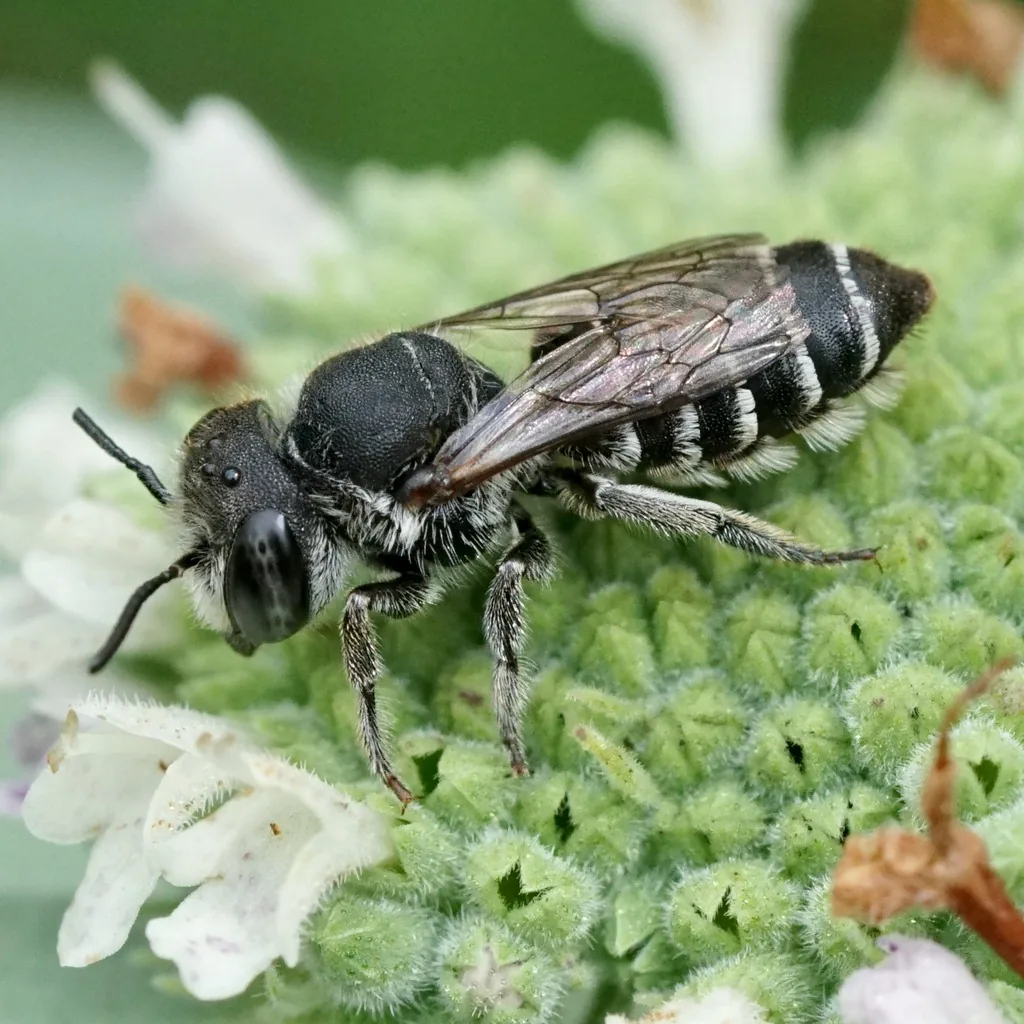
- Adults are dark gray to black with pale bands of hair across the abdomen. Common species are about the size of a honey bee; UC IPM gives up to 1/2 inch long, and Missouri's field guide gives about 1/4 to 1 inch across species.[1][3][4]
- Females carry pollen on dense hairs on the underside of the abdomen, never on the hind legs.[1][4]
- The sign most people notice is smooth circular or semicircular cuts in the edges of leaves or petals; Colorado State gives the cuts as about 3/4 inch across.[3][1]
- Nest cells look somewhat like cigar butts: rolls of cut leaf packed one after another in a tunnel, which can hold a dozen or more cells in a tube 4 to 8 inches long.[3]
Look-alikes
| Look-alike | How to tell them apart |
|---|---|
| Honey bee | Honey bees carry pollen in baskets on their hind legs and live in colonies; leafcutter bees carry pollen under the abdomen and nest alone.[1][4] |
| Mason bees | Mason bees in the related genus Osmia are mostly metallic blue or green and line nests with chewed leaf pulp, mud or sand rather than cut leaf pieces.[1] |
| Small carpenter bees | Small carpenter bees and some hunting wasps also tunnel into pruned rose canes, and do so more often than leafcutter bees; leafcutters are the ones that line the tunnel with cut leaf pieces.[3] |
| Carpenter ants | Leafcutter bees nesting in soft, rotted wood can push coarse sawdust out of the entrance, which gets them mistaken for carpenter ants, but they tunnel only in rotted wood or pithy stems and don't damage homes or other wooden structures.[3] |
Where it lives
Leafcutter bees live across North America: about 130 Megachile species occur north of Mexico, at least 75 in California, and at least a dozen in Missouri, where they're found statewide. GBIF has 1990-2026 records of the genus from all 50 states and Washington, D.C.[4][1][6]
Biology and life cycle
Females nest in existing holes such as abandoned tunnels of wood-boring insects, hollow stems and tree holes, or dig into soft, rotted wood and the pith of thick stems such as rose; some nest in the ground.[1][3][4]
Each leaf-lined cell gets a mix of nectar and pollen and one egg before it is sealed. The larva eats the food over several weeks, spins a dark cocoon and spends winter as a mature larva in its cell.[1][3][4]
UC IPM says most species have one generation a year with adults active in spring and early summer; Missouri's field guide says leafcutters are active from late spring into early autumn and some species have two or more generations.[1][4]
A female may live up to two months and lay some 35 to 40 eggs. Parasitic bees and wasps, velvet ants and some blister beetles attack the nests, so leaf cutting can vary widely from year to year.[3]
They are solitary: each female builds and stocks her own nest, with no colony or hive.[3][1][4]
Their leaf choices are broader than once thought: DNA barcoding of leaf pieces from nests in Toronto identified 54 plant species, and multiflora rose made up 23.1 percent of the leaves one species used.[5]
Some are managed pollinators. The alfalfa leafcutting bee, introduced from Europe, pollinates alfalfa grown for seed far more efficiently than honey bees.[1][3][4]
Damage and signs
- They cut many kinds of leaves but favor some; Colorado State names rose, green ash, lilac and Virginia creeper.[3]
- The cuts can mar a plant's looks but don't harm otherwise healthy plants. Serious leaf loss happens mainly where many bees concentrate on isolated rural plantings.[1][3]
- Nesting in pruned rose canes stays in the pith and rarely girdles the cane, and their tunnels don't damage homes or other wooden structures.[3]
Health risk
Leafcutter bees are not aggressive and sting only when handled. Colorado State Extension describes the sting as very mild, much less painful than a honey bee's or a yellowjacket's.[3]
Control
Prevention
Insecticides don't stop leaf cutting, because the bees don't eat the leaves, and these pollinators shouldn't be killed.[3][1]
Keep them out
Seal the ends of pruned rose canes with wax, a couple of drops of white glue or a thumb tack. Filling holes 1/8 to 7/8 inch in diameter and removing rotting boards cuts down nesting sites.[1][3]
Traps and physical control
Cover favorite small plants with cheesecloth or other loose netting when leaf cutting first shows up, and remove it about midsummer when the adults are no longer active.[1][3]
If someone is stung
Wash the sting with soap and water. If a stinger is left in the skin, scrape it out with a fingernail, gauze or the edge of a card; don't squeeze it or use tweezers. Put ice wrapped in a cloth on the site to reduce swelling, and don't scratch.[7][8]
Stay with the person and watch for an allergic reaction. Trouble breathing or swallowing, face or mouth swelling, chest pain, or fainting can mean anaphylaxis, which needs emergency care right away: call 911 and use the person's epinephrine auto-injector if they carry one.[7][8]
Common questions
- What's cutting perfect circles out of my rose leaves?
- Almost certainly leafcutter bees. They carry the pieces off to build nest cells and don't eat the leaves.[1][3]
- Should I spray them?
- No. Insecticides don't prevent the cutting, the damage is usually cosmetic, and the bees are valuable pollinators. Cover favorite plants with netting instead.[3][1]
- Do leafcutter bees sting?
- Only when handled, and Colorado State describes the sting as much milder than a honey bee's.[3]
- Is a bee pushing sawdust out of my porch wood a leafcutter?
- It may be. Leafcutter bees nest in soft, rotted wood and can leave coarse sawdust at the entrance, but they don't tunnel into sound wood or damage the structure.[3]
Sources
- University of California Statewide IPM Program, “Leafcutting bees (Pest Notes for home and landscape).” ipm.ucanr.edu/PMG/GARDEN/PLANTS/INVERT/leafcutbes.html (accessed 2026-11-11)
- iNaturalist, “Megachile taxon page (order and family).” www.inaturalist.org/taxa/52784 (accessed 2026-11-11)
- Colorado State University Extension, “Leafcutter Bees (Fact Sheet 5.576).” extension.colostate.edu/topic-areas/insects/leafcutter-bees-5-576/ (accessed 2026-11-11)
- Missouri Department of Conservation, “Leafcutter Bees (Field Guide).” mdc.mo.gov/discover-nature/field-guide/leafcutter-bees (accessed 2026-11-11)
- Royal Society Open Science, via PubMed Central, “MacIvor JS (2016), DNA barcoding to identify leaf preference of leafcutting bees, Royal Society Open Science 3:150623.” pmc.ncbi.nlm.nih.gov/articles/PMC4821261/ (accessed 2026-11-11). Cited from the open-access full text (PubMed 27069650).
- Global Biodiversity Information Facility (GBIF), “Megachile (leafcutter bees): occurrence records in the U.S., 1990-2026 (GBIF occurrence search).” api.gbif.org/v1/occurrence/search?taxonKey=1335011&country=US&hasGeospatialIssue=false&occurrenceStatus=PRESENT&year=1990%2C2026&facet=stateProvince&facetLimit=400&limit=0 (accessed 2026-11-11). State counts are records reported (iNaturalist research-grade, museum specimens, surveys), not abundance.
- Centers for Disease Control and Prevention, NIOSH, “Insects and Scorpions at Work.” www.cdc.gov/niosh/outdoor-workers/about/insects-and-scorpions.html (accessed 2026-11-11)
- MedlinePlus, U.S. National Library of Medicine, “Insect bites and stings (Medical Encyclopedia 000033).” medlineplus.gov/ency/article/000033.htm (accessed 2026-11-11)