On this page
How to identify it
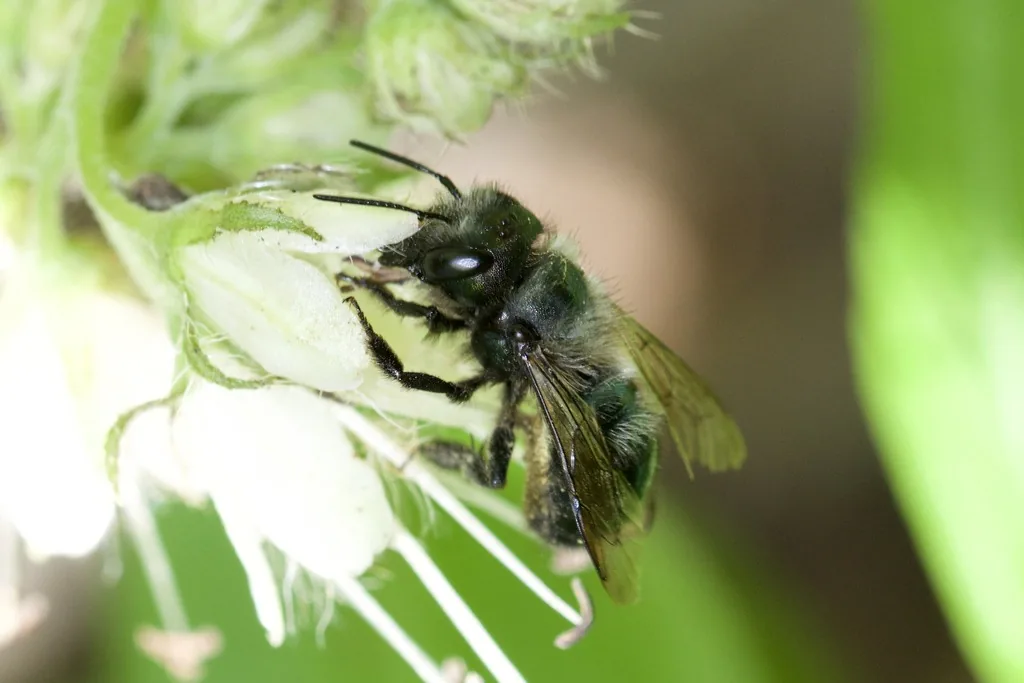
- Small to medium, robust bees, about 0.2 to 0.8 inch long, with round, broad heads. Most are metallic rather than striped: Oregon State describes the blue orchard bee as shiny dark blue-green, the Forest Service as dark metallic blue.[4][1][2]
- The blue orchard bee female is about the size of a honey bee; males are slightly smaller, with light-colored hair on the face and antennae one segment longer than the female's. UF/IFAS gives the female as about 14 mm long and iridescent bluish-gray that can look black, and the male as about 11 mm, with 13 antenna segments rather than 12 and a light-colored tuft of hair on the head.[1][2][5]
- Females carry pollen in a patch of hairs on the underside of the abdomen instead of in balls on the hind legs.[4][2]
- Look for nest holes plugged with mud in spring, in crevices, old insect tunnels or nesting tubes.[1][2]
Look-alikes
| Look-alike | How to tell them apart |
|---|---|
| Carpenter bee | Carpenter bees are large black bees that excavate their own tunnels in wood; mason bees are about honey bee size and can only use holes that already exist.[6][1][2] |
| Honey bee | Honey bees are striped brown and orange and carry pollen on their hind legs; mason bees are dark metallic blue and carry pollen on their bellies.[2] |
| Cuckoo bees (Stelis) | These look similar to the blue orchard bee but are smaller. They are cleptoparasites: they lay eggs in mason bee nests, and their young kill the mason bee larva and eat its food.[3] |
| Black fly | UF/IFAS notes that a blue orchard bee in flight is sometimes mistaken for a black fly. Up close, the bee's body is covered in small hairs, and females carry pollen packed on the underside of the abdomen.[5] |
Where it lives
The Forest Service counts 140 Osmia species in North America, and WSU Extension about 150. The blue orchard bee is native to North America; researchers recognize a western subspecies, long used in western orchards, and an eastern subspecies studied in Virginia and North Carolina. UF/IFAS says the Rocky Mountains divide the western and eastern subspecies, and that warm winters keep the blue orchard bee out of Florida and parts of the southeastern Gulf Coast.[2][4][7][8][5]
Biology and life cycle
Mason bees have one generation a year. Adults chew out of their cocoons in early spring once the air reaches about 50 to 55 degrees F; males come out first, and females follow 2 to 5 days later.[1][2]
Each female stocks a nest hole with balls of pollen and nectar, lays one egg on each, and walls them off with mud, building 5 to 8 cells before capping the entrance with a thicker mud plug. UF/IFAS says nest holes are about 6 mm across, often in wood but sometimes in hoses, bamboo or abandoned pipes; each cell takes 12 to 25 pollen-collecting flights, and a female can lay two to three eggs a day.[1][2][5]
Females are usually laid in the back of the tunnel and males near the entrance, so males emerge first; Oregon State gives a typical ratio of 2 males to 1 female.[1][2]
They are solitary, with no queen, hive or honey, but like to nest close together. UF/IFAS calls them gregarious, with several females nesting near one another, and notes that males often hover around nest entrances waiting for females to emerge.[1][2][5]
The larva feeds on its pollen ball for about 10 days, then spins a cocoon. It pupates in early summer and becomes an adult by fall, staying dormant in the nest until the next spring.[1][2]
Adults are active only a few weeks in spring, March to May or mid-June in western Oregon, and usually forage within about 200 to 300 feet of the nest. In Virginia and North Carolina orchards, nests of the eastern subspecies held mostly eastern redbud pollen where redbud grew nearby.[1][7]
UF/IFAS describes the egg as cylindrical, whitish and about 1.4 mm long, similar to a honey bee egg; the larva goes through five instars and finishes developing 10 to 14 days after hatching.[5]
Damage and signs
- None to structures: mason bees cannot drill their own holes and use gaps that already exist, such as crevices in siding or old insect tunnels.[1]
- They are valued pollinators of apples, cherries, pears, plums, almonds and peaches. USDA's Agricultural Research Service says 250 to 300 females can pollinate an acre of apples or cherries, and they forage in cloudier, cooler weather than most bees. UF/IFAS adds that they are efficient pollinators of blueberries and have successfully pollinated almonds.[1][2][3][5]
- Per visit, the blue orchard bee often pollinates better than the honey bee, though a 2026 review notes that managed populations often reproduce inconsistently and still rely on wild-collected bees.[9]
Health risk
Mason bees are relatively nonaggressive and sting only if handled roughly or trapped under clothing; USDA's Agricultural Research Service says they rarely sting.[1][3]
Control
Prevention
No control is needed. WSU Extension advises avoiding regular use of synthetic, broad-spectrum pesticides so these pollinators can thrive, and Oregon State recommends avoiding harmful or unnecessary pesticides.[4][1]
Gardeners who want them can provide nesting tubes or blocks about 6 inches deep in a house facing south or southeast, 3 to 6 feet off the ground, with spring flowers nearby and a source of moist clay mud.[1]
Sanitation
In bee houses, use paper liners, tubes or blocks that can be opened and cleaned each year. Oregon State advises against solid wood blocks, bamboo and plastic, which hold moisture and let parasites and mold build up. UF/IFAS recommends lining nest holes with parchment paper or other liners that can be removed each season to prevent fungi and bacteria from building up.[1][3][5]
Pests in mason bee houses
Pollen mites eat the food stored for the larvae, and heavy infestations can starve the brood. USDA's Agricultural Research Service notes the mites can't move between the mud partitions in a nest unless a partition is damaged when the nest is moved.[3][1]
Tiny parasitic wasps lay eggs on the bee larvae through cracks; sealing the backs of nest tubes tightly helps keep them out. Checkered flower beetle larvae and blister beetle larvae also invade cells and eat the brood or its food.[3][1]
Oregon State recommends opening tubes or blocks in October or November and cleaning cocoons to remove pollen mites, wasps, dermestid beetles and fungal pathogens before cold storage.[1]
UF/IFAS notes that some flies and wasps chew through the mud plugs to eat the larvae and their food, that females often leave the first cell empty as a defense, and that predators usually take down colonies before disease does.[5]
Where the sources disagree
Cells per nest: Oregon State and the Forest Service give 5 to 8 cells per nest hole; UF/IFAS says females generally create seven to eleven.[1][2][5]
Larval feeding time: Oregon State gives about 10 days; UF/IFAS says larvae finish developing 10 to 14 days after hatching.[1][5]
Timing of pupation: Oregon State says the larvae become pupae in late May and June, and the Forest Service by the end of summer; UF/IFAS puts pupation in August and September.[1][2][5]
Wooden nest blocks: Oregon State says solid wood blocks, bamboo and plastic are not recommended; UF/IFAS describes blocks of 4 by 4 inch untreated lumber with 6 mm holes drilled 8 to 15 cm deep, lined with removable parchment or paper liners.[1][5]
Common questions
- Will mason bees damage my house like carpenter bees?
- No. Mason bees can't excavate wood; they only move into holes and crevices that already exist and seal them with mud.[1][6]
- Do mason bees sting?
- Rarely. They are gentle and sting only when roughly handled or trapped against the skin, which is why they suit backyard gardens.[1][3]
- Do mason bees make honey?
- No. They are solitary bees with no hive; each female feeds her young on balls of pollen and nectar sealed in mud cells.[1][2]
- Will mason bees nest in Florida?
- The blue orchard bee won't. UF/IFAS says warm winter temperatures keep it out of Florida and parts of the southeastern Gulf Coast.[5]
Sources
- Oregon State University Extension Service, “Nurturing Mason Bees in Your Backyard in Western Oregon (EM 9130).” extension.oregonstate.edu/pub/em-9130 (accessed 2026-11-14)
- USDA Forest Service, “Blue Orchard Mason Bee (Osmia lignaria), Pollinator of the Month.” www.fs.usda.gov/wildflowers/pollinators/pollinator-of-the-month/mason_bees.shtml (accessed 2026-11-14)
- U.S. Department of Agriculture, Agricultural Research Service, “Blue Orchard Bee (Pollinating Insect-Biology, Management, Systematics Research, Logan, UT).” www.ars.usda.gov/pacific-west-area/logan-ut/pollinating-insect-biology-management-systematics-research/docs/blue-orchard-bee/ (accessed 2026-11-14)
- Washington State University Extension, “Megachilidae: Mason Bees (Osmia spp.) (HortSense).” hortsense.cahnrs.wsu.edu/fact-sheet/megachilidae-mason-bees-osmia-spp/ (accessed 2026-11-14)
- University of Florida/IFAS Extension (Featured Creatures), “Blue Orchard Bee, Osmia lignaria Say, EENY-549/IN982 (Estep, Zettel-Nalen and Ellis).” ask.ifas.ufl.edu/publication/IN982 (accessed 2026-11-14)
- University of Kentucky Entomology, “ENTFACT-611: Carpenter Bees.” entomology.mgcafe.uky.edu/ef611 (accessed 2026-11-14)
- Environmental Entomology, via PubMed, “Nesting and pollen preference of Osmia lignaria lignaria (Hymenoptera: Megachilidae) in Virginia and North Carolina orchards (Kraemer et al. 2014).” pubmed.ncbi.nlm.nih.gov/24865141/ (accessed 2026-11-14)
- Journal of Insect Physiology, via PubMed, “Progeny of Osmia lignaria from distinct regions differ in developmental phenology and survival under a common thermal regime (Pitts-Singer et al. 2014).” pubmed.ncbi.nlm.nih.gov/24879969/ (accessed 2026-11-14)
- Current Opinion in Insect Science, via PubMed, “Scaling Osmia lignaria: biological constraints and opportunities for sustainable management (Boyle and McCabe 2026).” pubmed.ncbi.nlm.nih.gov/42722130/ (accessed 2026-11-14)
- iNaturalist, “Osmia lignaria taxon page (order and family).” www.inaturalist.org/taxa/121507 (accessed 2026-11-14)